About
Calculus is fundamental to virtually every mathematical and scientific discipline. Each semester across the world, rocket scientists unite with economists and doctors to learn the same mathematical principles. Mastering calculus not only advances one's mathematical foundations but also cultivates the problem-solving skills students need for a successful career. It is therefore crucial to learn calculus well. I created ValsCalc to help students accomplish this mission.
Online Textbook

Calculus is the first course that connects natural observations to real-world models. You will realize that the entire discipline of calculus is based on only a few operations. For example, solving differential equations (Chapter 8) is a single idea that enables us to build models for population growth, radioactive dating, chemical reactions, cooling objects, and objects in free fall. This text features a rich variety of applications throughout the chapters, allowing you to answer why you are learning calculus.
The free online single-variable textbook develops limits, derivatives, integrals, series, and their applications through geometric motivation, precise definitions, and fully worked examples. Throughout each of the 10 chapters, figures and animations are used to clarify limiting processes and conceptual subtleties. I address common misconceptions through margin notes, warnings, and commentary. As a primary resource, the textbook emphasizes problem-solving skills and pattern awareness across its 73 sections.
Appropriate Courses The textbook covers single-variable calculus, so it is best utilized by students in Calculus I and II. High school students enrolled in Advanced Placement Calculus AB or Calculus BC, or International Baccalaureate mathematics courses, can also use this textbook.
The advantages of a web-based textbook are numerous: Cross-references to sections, headers, examples, and figures are just a click away. A search tool is present, and a navigational panel enables effortless transitioning between sections and chapter pages. Less time is spent flipping between pages, optimizing the learning process. For students who desire print versions, a PDF file of section notes can be printed.
To encourage active participation, sections contain several example problems whose solutions must be toggled open. This system forces you to stop back for a second and try the problem on your own. Once you have a preliminary solution, you should then open the text's solution to compare your answers. Afterward, close the solution and try the problem again. You should continue this process until you can reproduce the correct solution independently and can explain why. Teaching is the best way to learn: By explaining a concept to yourself or walking through a difficult problem, you force active recall and identify any weaknesses.
Challenge Problems
Each chapter has a collection of challenge problems.
In each set, students apply the chapter's concepts to complex problems
that require abstract algebraic and geometric problem-solving skills.
To help you connect calculus to real-world scenarios, I have included several
application problems from the physical and natural sciences.
For example, the challenge problems of
Chapter 8
ask you to relate differential equations to vibrations,
electrical circuits, and free fall under air resistance.
Similarly, in Chapter 10
you will apply infinite series to programming logic
and banks generating money.
These applications aim to answer a common student question: When will I use this in the real world?
Practice Exams
I have supplemented the textbook with 22 total practice exams: one multiple-choice exam and one free-response exam per chapter.
- Multiple-choice practice exams contain 50 problems that cover all of the chapter's topics. These questions test conceptual understanding (e.g., setting up an integral) and your ability to apply the chapter's topics to solve problems quickly. An answer key is present on the last page of every practice exam.
- Free-response practice exams contain between 10 and 20 open-ended questions. In each practice exam, you are asked to synthesize chapter topics to solve comprehensive, multi-part problems. Solutions and scoring rubrics are found in the back of each practice exam.
To Instructors
This online textbook is designed for applied, concept-driven instruction,
with flexible resources that support both independent learning and traditional classroom use.
It can serve as either a primary or supplemental resource
for single-variable courses using the early transcendentals approach.
Each section emphasizes the principles of problem-solving through enumerated steps,
interpretations of results, and frequent TIP
and WARNING
notes.
The text overall builds conceptual understanding and established motivations before formal derivations
from first principles.
Although the textbook can be used in a diverse set of curricula,
it particularly excels in applied courses, such as Calculus for Engineers.
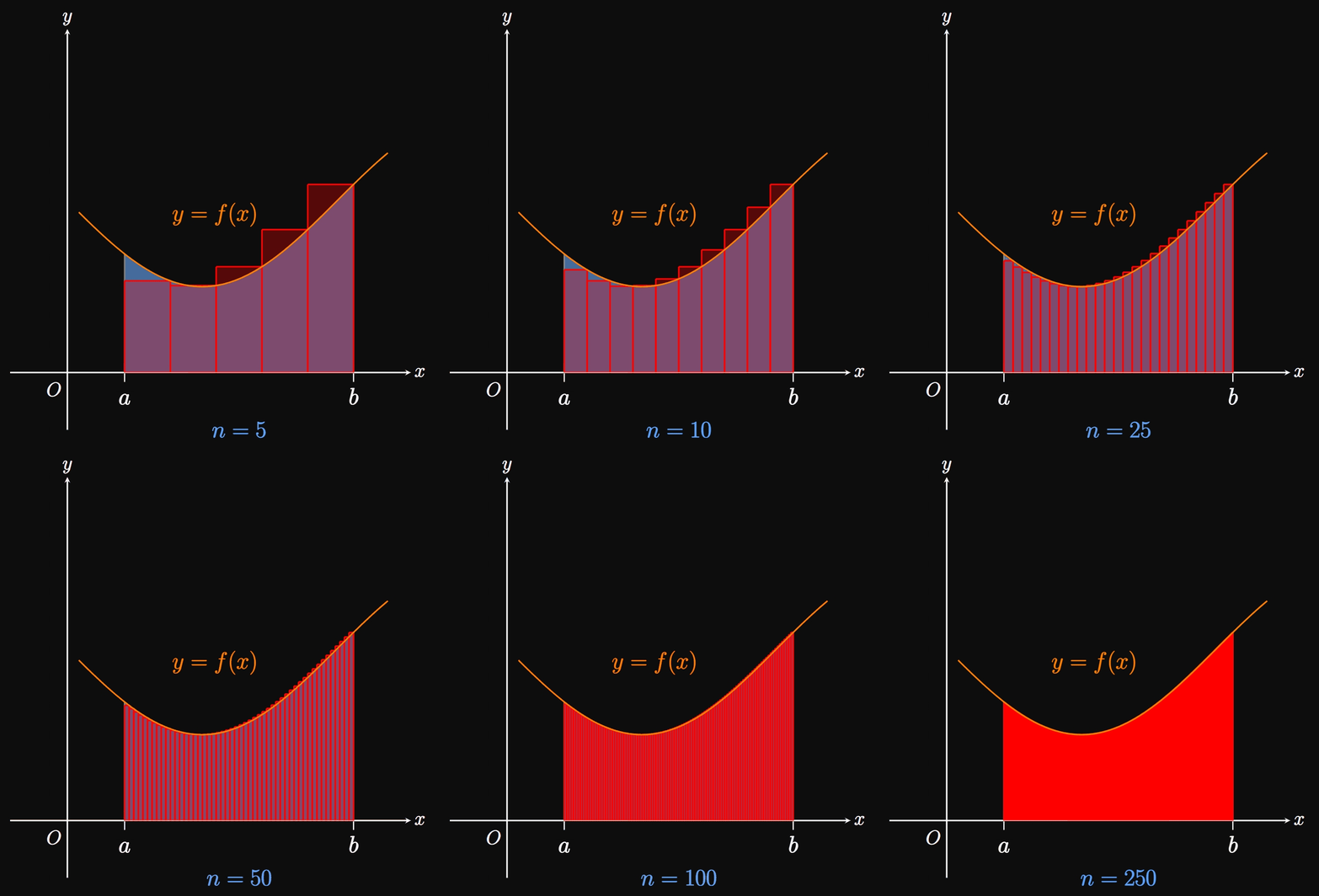
The online textbook is designed for independent learning outcomes. Students have the autonomy to browse a diverse set of resources, from the textbook's sections to its challenge problems and practice exams. Instructors have an equal amount of flexibility in how to use the website's resources to support students' learning. For example, the website's figures and animations (such as in Animation 1) complement sensory-based learning, while challenge problems engage high-performing students.
Chapters 0–5 are appropriate for a first-semester calculus course (e.g., Calculus I), and Chapters 6–10 are suited for a second-semester course (e.g., Calculus II). Chapter 0 is an optional chapter that reviews the fundamentals of numbers, algebra, geometry, and trigonometry. Starting from Chapter 1, the text assumes a working proficiency in these areas, so you may find it beneficial to use Chapter 0 in your course.
Practice Problems Each section includes several example problems with solutions. Practice multiple-choice and free-response exams are included in each chapter, synthesizing chapter topics. In addition, each chapter's challenge problems present novel techniques of problem-solving. Some of these problems state the necessity of a computer-algebra system, giving you flexibility in the amount of technology you desire. Challenge problems or practice exam problems can be given as group work or projects during scheduled class times.
Additional Exercises In addition to the examples and practice exams of this website, I have created a bank of roughly 700 secure problems across all the chapters. To conserve their security, these problems and their solutions are not posted on this website. However, they are explicitly available to instructors to use in secure settings (e.g., homework problems and exams). Please contact me for instructor access to secure problems.
Advanced Placement® Calculus
The textbook aligns well with the College Board's Advanced Placement® (AP) Calculus Course and Exam Description (CED) and can be used as a primary or supplemental resource for both AP Calculus AB and BC.
AP Calculus AB For AP Calculus AB, a coherent sequence includes sections from the following chapters:
- Chapter 1: Sections 1.1–1.4, 1.6 (excluding formal proofs of limits)
- Chapter 2: Sections 2.1–2.8
- Chapter 3: Sections 3.1–3.4, 3.5 (excluding indeterminate limit forms with differences, products, and exponents), 3.6
- Chapter 4: Sections 4.1–4.4, 4.5 (excluding error bounds and Simpson's Rule)
- Chapter 5: Sections 5.1–5.3, 5.6
- Chapter 8: Sections 8.1 (excluding Euler's Method), 8.2 (excluding orthogonal trajectories and mixing problems), 8.3 (excluding applications)
AP Calculus BC The suggested sections for AP Calculus BC build upon those for AP Calculus AB, with the following additional sections:
- Chapter 6: Sections 6.1, 6.4 (excluding decomposition of nonlinear factors), 6.5
- Chapter 7: Section 7.1
- Chapter 8: Sections 8.1, 8.2 (excluding orthogonal trajectories and mixing problems), 8.3 (excluding applications), 8.4
- Chapter 9: Sections 9.1 (excluding cycloids and projectile motion), 9.2–9.5, 9.6 (excluding surface areas of revolution)
- Chapter 10: Sections 10.1–10.7, 10.8 (excluding binomial series)
These sections address the topics required for the AP Calculus AB and BC exams. Instructors may optionally include additional sections for enrichment or deeper theoretical treatment. The text emphasizes graphical, numerical, and analytical reasoning, aligning with the AP Mathematical Practices.
AP® is a trademark registered by the College Board, which is not affiliated with, and does not endorse, this website, its practice exams, or 1500 Calculus Problems Solved.
About the Author
ValsCalc is a sole-author project. As a mechanical engineer, I approach calculus through its applications, and my writing aims to foster fluency and problem-solving skills while emphasizing conceptual understanding and mathematical rigor.
Why Free?
Calculus has long held a special place in my heart.
As a mechanical engineer, I use calculus every day—it is the language of my craft.
I self-studied calculus, and
I vividly remember failing to understand why and how.
Through this journey, I have become sensitive to students' struggles in this area.
Accordingly, my passions for writing, programming, and pedagogy culminated in ValsCalc.
I believe a resource's success should be measured by the number of students it helps,
not its revenue generated.
When I wrote my first sections, I hoped that they would inspire struggling students
to continue with the course and remain curious—and truly believe in calculus.
Calculus is frequently cited as unintuitive,
pointless,
and a barrier. My goal is to change those perceptions.
Therefore, the calculus textbook, practice exams, and challenge problems remain open and free.
At the same time, building ValsCalc has taken years of effort. I operate this project as simply one woman who prioritizes creating high-quality materials. I therefore consider each sale of 1500 Calculus Problems Solved to be a donation to continue growing ValsCalc. If you would like to support ValsCalc, then purchasing this problems book is one way to do so. I am eager to continue growing this project, and I welcome your opinions and suggestions. You may contact me by clicking here.