Challenge Problems
Capstone Challenge Problems with Full Solutions
In Chapter 1 we learned the utility of limits to describe a function's behavior as some quantity is made arbitrarily close to some number. In this chapter we learn the foundations of differential calculus, in which we measure functions' rates of change. How do we use limits to motivate the idea of change at an instant, and what relations do instantaneous rates of change have in our everyday lives? (Find out in Section 2.1.) After we define such a paradoxical concept, we will learn to take derivatives of any function—sums, differences, products, quotients, and compositions of all the functions we know.
2.2 Differentiating Power, Exponential, and Sinusoidal Functions
Derivatives of exponential, polynomial, and sinusoidal functions. Discussion of tangent and normal lines. Defining the number \(e.\)2.3 Product Rule and Quotient Rule
Differentiating products and quotients of functions. Geometric intuition and proof. Derivatives of all trigonometric functions.2.4 Chain Rule
Differentiating compositions of functions, with proof. General Power Rule. Applying Chain Rule multiple times. Differentiating exponential functions of any base.2.5 Implicit Differentiation and Differentiating Inverse Functions
Differentiating implicit equations. First- and second-order derivatives of implicit equations. Locations of horizontal and vertical tangents. Differentiating inverse functions, with geometric interpretation. Differentiating inverse trigonometric functions.2.6 Differentiating Logarithmic Functions
Formally defining the natural logarithm. Derivatives of the natural logarithm and logarithms with any base. Logarithmic Differentiation: the use of natural logarithms to simplify products, quotients, and powers of functions for easier differentiation. The number \(e\) expressed by a limit.2.7 Related Rates
Problems in which quantities change. Problem-solving tips for geometric, physical, and map problems.2.8 Linearization and Differentials
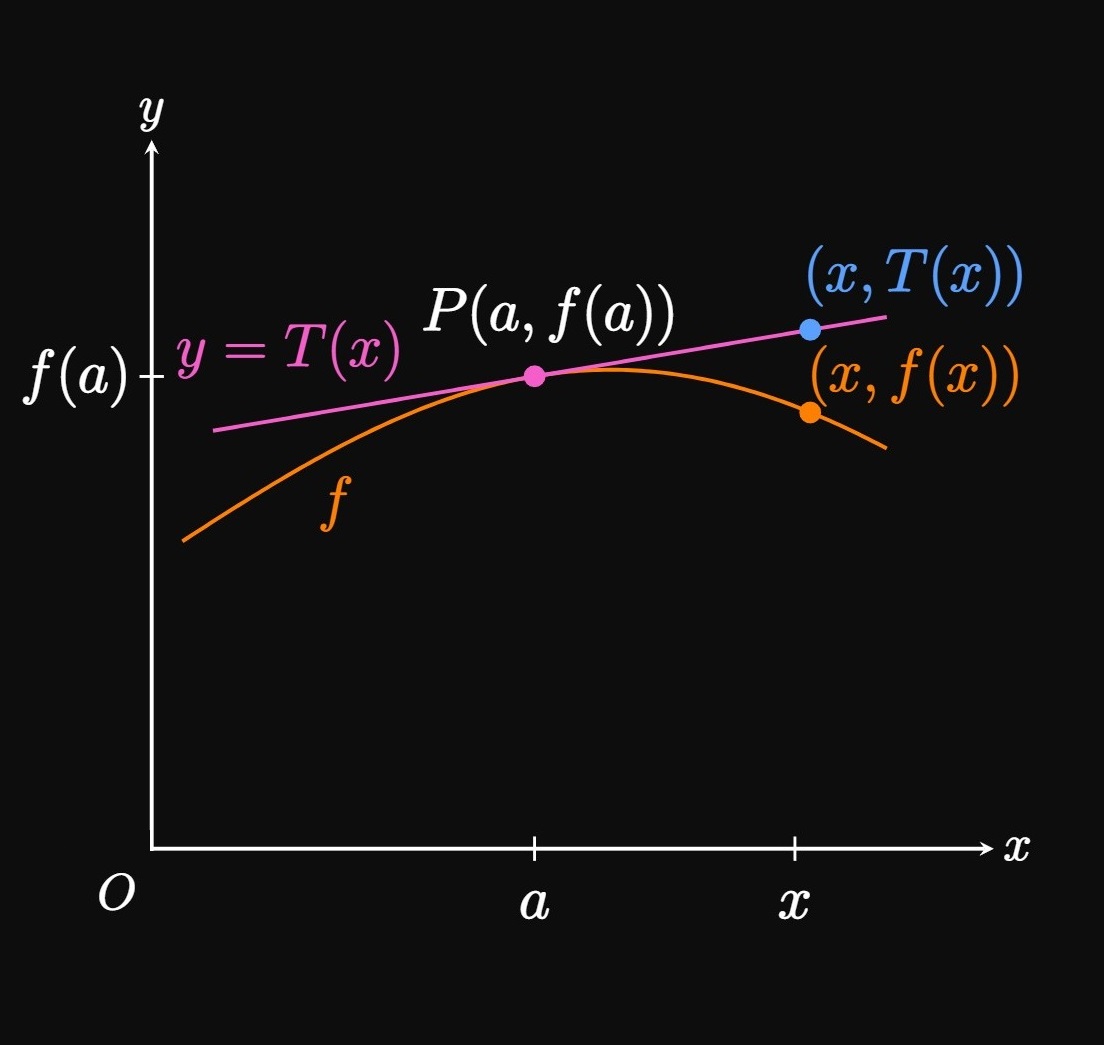
Using linearization (tangent line approximations) to estimate values of functions. Geometric interpretations of differentials. Relative error and percent error.