The trigonometric substitution \(x + 1 = c \sec \theta,\)
where \(c \ne 0,\)
can be used to evaluate
\[\int_0^2 \frac{(x + 1)^2 - c^2}{x + 1} \di x \pd\]
But for some values of \(c,\)
you cannot proceed to convert the bounds to be in terms of \(\theta.\)
Find these values of \(c.\)
Letting \(n\) be a positive integer
greater than \(2,\)
prove that
\[\int \sec^n x \di x = \frac{\sec^{n - 2} x \tan x}{n - 1} + \frac{n - 2}{n - 1} \int \sec^{n - 2} x \di x \pd\]
(This formula is the
power-reduction formula for secant.)
By factoring the denominator as \(x (x^{2023} - 1)\) and splitting the integrand into two fractions,
evaluate
\[\int \frac{1}{x^{2024} - x} \di x \pd\]
The convolution operation is defined as
\[(u \circledast v)(x) = \int_{-\infty}^\infty u(y) v(x - y) \di y \pd\]
By using the change of variable \(t = x - y,\) show that the convolution operation is commutative; that is,
\[(u \circledast v)(x) = (v \circledast u)(x) \pd\]
Assume \(u\) and \(v\) are integrable functions such that the improper integral converges.
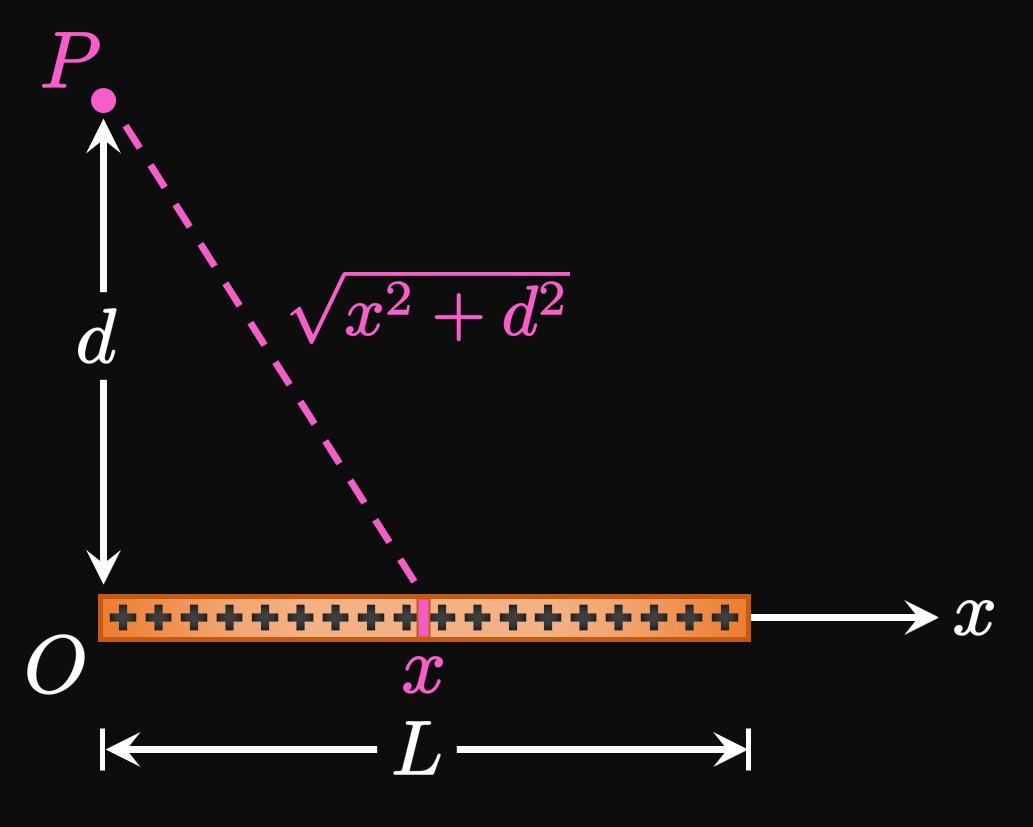
A uniform, long, positively charged rod of length \(L\) holds a charge \(Q.\)
Let the \(x\)-axis be positioned through the rod spanning from \(x = 0\) to \(x = L.\)
Point \(P\) is located a distance \(d\) above the left end of the rod.
(See Figure 1.)
Let \(V\) be the electric potential at \(P.\)
At any \(0 \leq x \leq L,\)
it follows that
\[\frac{\dd V}{\dd x} = \frac{k Q}{L \sqrt{x^2 + d^2}} \cma\]
where \(k\) is a constant.
The total electric potential at \(P\) is given by integrating the right expression
from \(x = 0\) to \(x = L.\)
Determine this electric potential, \(V.\)
A boat initially lies \(20\) feet below a lighthouse.
The boat then sails along the flat ocean until the angle of elevation to the lighthouse is \(45 \degree.\)
During the boat's journey, what is its average distance to the lighthouse?
How far has the boat sailed when it attains this average distance?
The gamma function enables factorials to be computed for all real numbers,
and it is defined by the improper integral
\[\Gamma(z) = \int_0^\infty e^{-t} \, t^{z - 1} \di t \cma\]
which converges for any \(z > 0.\)
This function appears often in applications such as probability and physics.
For positive integers \(n,\) the gamma function satisfies \(\Gamma(n) = (n - 1)! \, .\)
Verify that \(\Gamma(4) = 3! \,.\)
As an extension of the identity \((n + 1)! = (n + 1) \, n! \, ,\)
show that \(\Gamma(n + 1) = n \Gamma(n)\) for any \(n > 0.\)
Using the gamma function, write an improper integral that equals \(\par{\tfrac{1}{3}} ! \, .\)
Then use a calculator to approximate \(\par{\tfrac{1}{3}} !\) to three decimal places.
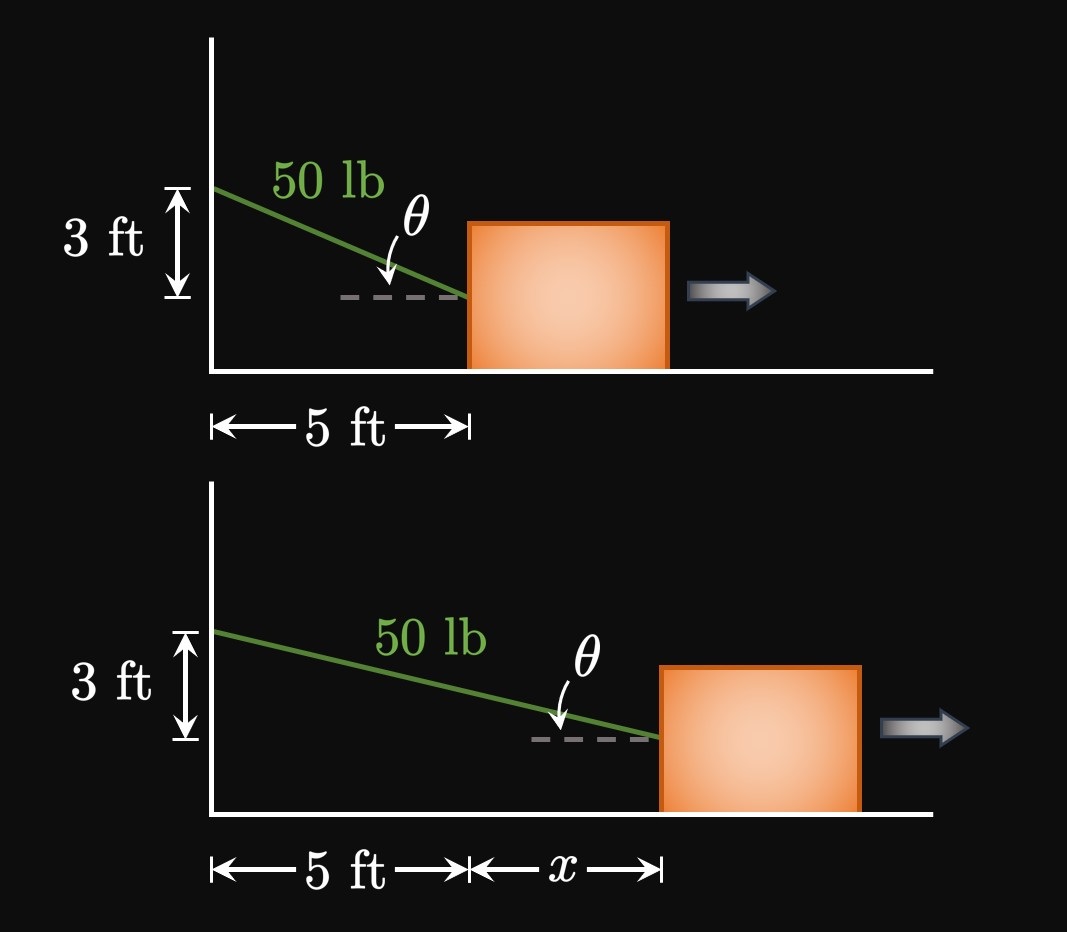
A box located \(5\) feet away from a wall is pinned at a spot \(3\) feet above.
The applied pull along the rope is maintained at \(T = 50\) pounds.
The box is then pushed away from the wall;
at any moment, the box has traveled \(x\) feet.
(See Figure 2.)
After sliding \(1\) foot, the box stops due to the opposing rope force.
By assuming that \(T\) is constant,
the work done by the rope on the box is
\[W = \int_0^1 -T \cos \theta \di x \cma\]
where \(\theta\) is the rope's variable angle of elevation.
Calculate \(W.\)