A \(100\)-point exam has \(16\) questions,
each worth either four or seven points.
Determine how many four-point questions and seven-point questions are on the exam.
A rectangular prism has a square base whose lengths are \(x.\)
If the prism's volume is \(400,\) then express its surface area \(S\) as a function of \(x.\)
Then give the domain in context.
Particle A moves to the right with a speed of \(4\) feet per second.
Particle B, initially located \(20\) feet to the right of particle A,
travels to the left with a speed of \(6\) feet per second.
When do both particles collide?
A belt is wrapped around the top half of a circular shaft,
and the belt is pulled at the left end with a force \(T_1.\)
A frictional force opposes the shaft's rotation,
so the right end of the belt experiences a tensile force \(T_2.\)
(See Figure 2.)
The coefficient of friction between the belt and shaft is \(\mu;\)
large values of \(\mu\) indicate high levels of friction.
Then \(T_1,\) \(T_2,\) and \(\mu\) satisfy
\[\ln \par{\frac{T_1}{T_2}} = \mu \pi \pd\]
Solve for \(T_1\) in terms of \(T_2\) and \(\mu.\)
Then calculate \(T_2\) if \(T_1 = 60\) pounds and \(\mu = 0.6.\)
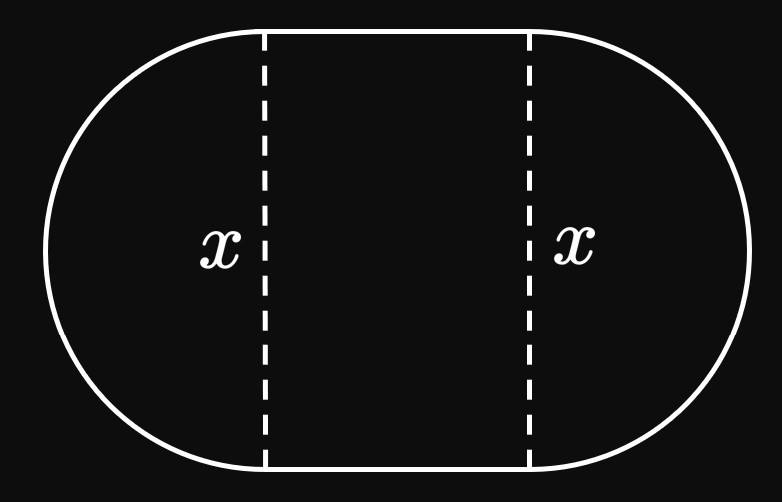
A slot is constructed by connecting two semicircles to two horizontal line segments
(Figure 3).
If the slot's perimeter is \(50,\)
then express its area \(A\) as a function of each semicircle's diameter, \(x.\)
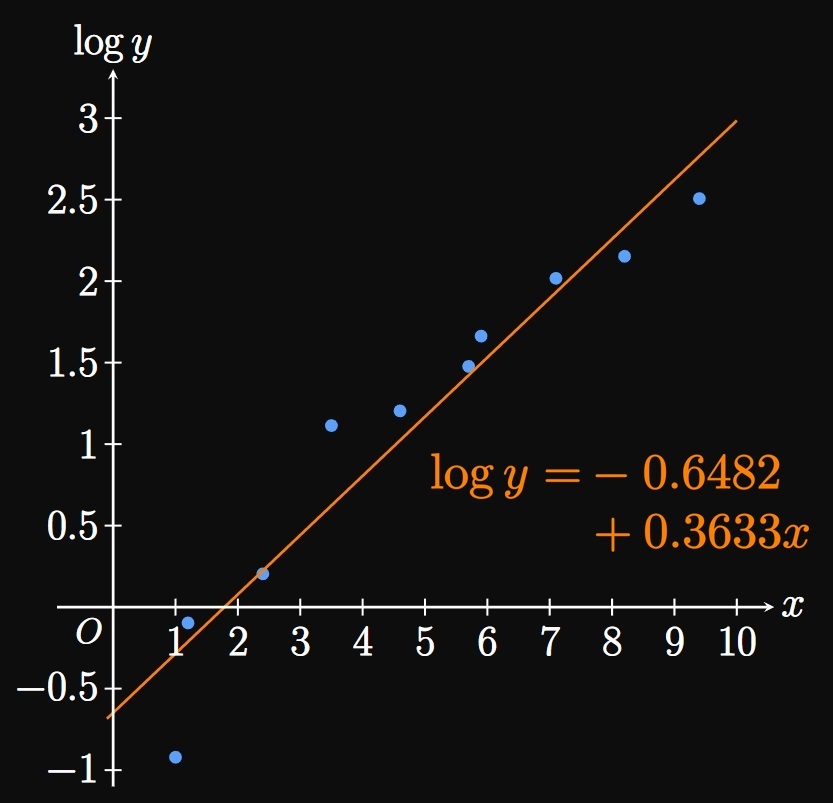
Some data trends are best modeled by an exponential function \(y = ab^x,\)
such as the model in Figure 4A.
The logarithm of the \(y\)-values is plotted against the original \(x\)-values to produce a linear pattern;
the equation of the best-fit line is
\[\log y = -0.6482 + 0.3633 x \pd\]
(See Figure 4B.)
Find the values of \(a\) and \(b\) to complete the exponential model.