In Section 4.4
we studied a fundamental technique for evaluating integrals—by substitution.
We now expand upon this idea by considering unique substitutions,
trigonometric substitutions,
which allow us to integrate functions containing radicals.
Some examples include
\[\andThree{\int \sqrt{100 - x^2} \di x}{\int \frac{x^2 - 1}{x \sqrt{x^2 + 16}} \di x}{\int \frac{3x - 6}{\sqrt{4x^2 - 100}} \di x} \pd\]
In this section we learn to convert these integrals into trigonometric integrals.
First consider the family of integrals
\(\int x \sqrt{a^2 - x^2} \di x,\)
\(a \ne 0.\)
To evaluate it, we substitute \(u = a^2 - x^2\)
because then \(\dd u = -2x \di x,\)
effectively stripping the extra \(x\) in the integrand.
But evaluating \(\int \sqrt{a^2 - x^2} \di x,\)
\(a \gt 0,\)
requires a special plan—we first remove the root sign.
Let's perform the trigonometric substitution \(x = a \sin \theta.\)
Then, by the Pythagorean identity in the form \(1 - \sin^2 \theta = \cos^2 \theta,\)
\[
\ba
\sqrt{a^2 - x^2} &= \sqrt{a^2 - (a \sin \theta)^2} \nl
&= a \sqrt{1 - \sin^2 \theta} \nl
&= a \sqrt{\cos^2 \theta} \nl
&= a \abs{\cos \theta} \pd
\ea
\]
Integrating \(a \cos \theta\) is far easier than integrating \(\sqrt{a^2 - x^2}.\)
Thus, stripping the root sign will become our primary goal.
Next we examine two other radical forms.
For \(\sqrt{x^2 - a^2},\) we try \(x = a \sec \theta.\)
Then since \(\sec^2 \theta - 1 = \tan^2 \theta,\) we have
\[
\ba
\sqrt{x^2 - a^2} &= \sqrt{(a \sec \theta)^2 - a^2} \nl
&= a \sqrt{\sec^2 \theta - 1} \nl
&= a \sqrt{\tan^2 \theta} \nl
&= a \abs{\tan \theta} \pd
\ea
\]
Similarly, for the case \(\sqrt{x^2 + a^2}\) we substitute \(x = a \tan \theta.\)
Because \(\tan^2 \theta + 1 = \sec^2 \theta,\)
\[
\ba
\sqrt{x^2 + a^2} &= \sqrt{(a \tan \theta)^2 + a^2} \nl
&= a \sqrt{\tan^2 \theta + 1} \nl
&= a \sqrt{\sec^2 \theta} \nl
&= a \abs{\sec \theta} \pd
\ea
\]
The following table summarizes the substitutions for all three cases.
In each case, we restrict the values of \(\theta\) so that the substitution forms a function that is one-to-one on the selected interval.
PICKING SUBSTITUTIONS TO ELIMINATE ROOTS
Form
Substitution
Trigonometric Identity
\(\sqrt{a^2 - x^2}\)
\(\ds x = a \sin \theta \cmaa -\frac{\pi}{2} \leq \theta \leq \frac{\pi}{2}\)
\(1 - \sin^2 \theta = \cos^2 \theta\)
\(\sqrt{x^2 + a^2}\)
\(\ds x = a \tan \theta \cmaa -\frac{\pi}{2} \lt \theta \lt \frac{\pi}{2}\)
\(\tan^2 \theta + 1 = \sec^2 \theta\)
\(\sqrt{x^2 - a^2}\)
\(\ds x = a \sec \theta \cmaa 0 \leq \theta \lt \frac{\pi}{2} \sspace\) or \(\ds \sspace \frac{\pi}{2} \lt \theta \leq \pi\)
\(\sec^2 \theta - 1 = \tan^2 \theta\)
EXAMPLE 1
Use trigonometric substitutions to rewrite each expression without radicals.
This expression is in the form \(\sqrt{a^2 - x^2}\) with \(a = 5.\)
Hence, we substitute \(x = 5 \sin \theta,\) with \(-\pi/2 \leq \theta \leq \pi/2,\) to see
\[
\ba
\sqrt{25 - (5 \sin \theta)^2}
&= 5 \sqrt{1 - \sin^2 \theta} \nl
&= 5 \sqrt{\cos^2 \theta} \nl
&= 5 \abs{\cos \theta} \nl
&= \boxed{5 \cos \theta}
\ea
\]
We dropped the absolute value bars because on \([-\pi/2, \pi/2],\)
\(\cos \theta \geq 0\)
and so \(\abs{\cos \theta}\) \(= \cos \theta.\)
This case matches \(\sqrt{x^2 + a^2}\) with \(a = 9.\)
Accordingly, we substitute \(x = 9 \tan \theta\) \((-\pi/2 \lt \theta \lt \pi/2),\)
attaining
\[
\ba
\sqrt{81 + (9 \tan \theta)^2} &= 9 \sqrt{1 + \tan^2 \theta} \nl
&= 9 \sqrt{\sec^2 \theta} \nl
&= 9 \abs{\sec \theta} \nl
&= \boxed{9 \sec \theta}
\ea
\]
The last step is true because \(\sec \theta \gt 0\) on \((-\pi/2, \pi/2).\)
First we rewrite the expression as
\[2 \sqrt{x^2 - 100} \pd\]
Now the radical matches the form \(\sqrt{x^2 - a^2}\)
with \(a = 10.\)
We substitute \(x = 10 \sec \theta\) with \(\pi/2 \lt \theta \leq \pi.\)
This interval ensures that \(10 \sec \theta\) (and therefore \(x\))
is negative, as given in the problem.
We attain
\[
\ba
2 \sqrt{(10 \sec \theta)^2 - 100} &= 20 \sqrt{\sec^2 \theta - 1} \nl
&= 20 \sqrt{\tan^2 \theta} \nl
&= 20 \abs{\tan \theta} \pd
\ea
\]
On \((\pi/2, \pi),\) tangent is negative and so \(\abs{\tan \theta} = - \tan \theta.\)
The expression therefore simplifies to \(\boxed{-20 \tan \theta}.\)
Now we combine trigonometric substitutions with the Substitution Rule
to evaluate indefinite integrals.
After choosing a trigonometric substitution, we compute the differential.
For example, if we choose \(x = 3 \sin \theta,\)
then the differential is \(\dd x = 3 \cos \theta \di \theta.\)
Then we simply substitute these expressions to convert the integral in terms of \(\theta.\)
The following steps summarize this process.
TRIGONOMETRIC SUBSTITUTIONS: INDEFINITE INTEGRALS
Suppose an indefinite integral contains a radical in the form \(\sqrt{a^2 - x^2},\)
\(\sqrt{x^2 + a^2},\) or \(\sqrt{x^2 - a^2}.\)
The following steps enable us to resolve the integral.
Compute the differential of your substitution.
Apply the Substitution Rule to convert the integral in terms of \(\theta.\)
Perform the integration with respect to \(\theta.\)
Reexpress your final answer in terms of the original variable, \(x,\)
by drawing a reference right triangle.
EXAMPLE 2
\[\int \frac{1}{x \sqrt{4 - x^2}} \di x\]
The denominator has the factor \(\sqrt{4 - x^2},\)
so we choose the trigonometric substitution \(x = 2 \sin \theta\)
\((-\pi/2 \leq \theta \leq \pi/2).\)
Then \(\dd x = 2 \cos \theta \di \theta,\)
and the integral becomes
\[
\int \frac{1}{(2 \sin \theta) \sqrt{4 - 4 \sin^2 \theta}} (2 \cos \theta) \di \theta
= \int \frac{\cos \theta}{2 \sin \theta \abs{\cos \theta}} \di \theta \pd
\]
Note that \(\abs{\cos \theta}\) \(= \cos \theta\) on \([-\pi/2, \pi/2],\)
enabling us to drop the absolute value bars.
Hence,
\[
\ba
\int \frac{\cos \theta}{2 \sin \theta \abs{\cos \theta}} \di \theta
&= \tfrac{1}{2} \int \csc \theta \di \theta \nl
&= -\tfrac{1}{2} \ln \abs{\csc \theta + \cot \theta} + C \pd
\ea
\]
Now we convert our answer back to \(x.\)
Since \(x = 2 \sin \theta,\) we have \(\sin \theta = x/2.\)
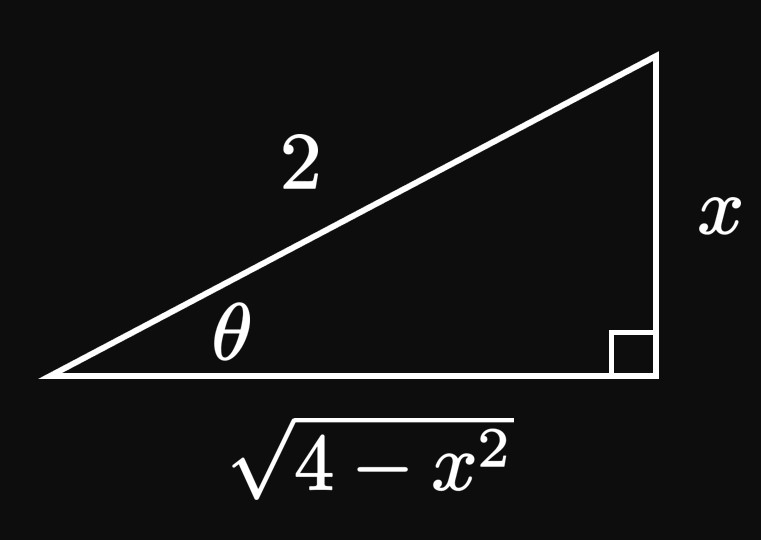
Accordingly, in a reference right triangle of hypotenuse \(2,\)
\(x\) is the side opposite \(\theta.\)
Then the side adjacent to \(\theta\) is, by the Pythagorean Theorem, \(\sqrt{2^2 - x^2}\)
\(= \sqrt{4 - x^2}.\)
(See Figure 1.)
Through trigonometric relationships, we see
\[\csc \theta = \frac{2}{x} \and \cot \theta = \frac{\sqrt{4 - x^2}}{x} \pd\]
Although \(\theta \gt 0\) in the diagram,
these expressions are valid even for \(\theta \lt 0.\)
Thus,
\[\int \frac{1}{x \sqrt{4 - x^2}} \di x =
\boxed{-\frac{1}{2} \ln \abs{\frac{2}{x} + \frac{\sqrt{4 - x^2}}{x}} + C}\]
EXAMPLE 3
Using a trigonometric substitution, show that
\[\int \frac{1}{\sqrt{a^2 + x^2}} \di x = \ln \abs{\sqrt{a^2 + x^2} + x} + C \cma\]
where \(a \gt 0.\)
The expression \(\sqrt{a^2 + x^2}\) warrants the trigonometric substitution \(x = a \tan \theta,\)
\(-\pi/2 \lt \theta \lt \pi/2.\)
Then \(\dd x = a \sec^2 \theta \di \theta,\)
and the integral becomes
\[
\ba
\int \frac{1}{\sqrt{a^2 + a^2 \tan^2 \theta}} (a \sec^2 \theta) \di \theta
&= \int \frac{a \sec^2 \theta}{\sqrt{a^2 \sec^2 \theta}} \di \theta \nl
&= \int \frac{\sec^2 \theta}{\abs{\sec \theta}} \di \theta \pd
\ea
\]
On \((-\pi/2, \pi/2),\)
secant is positive and so
\(\abs{\sec \theta} = \sec \theta.\)
The integral therefore becomes
\[\int \sec \theta \di \theta = \ln \abs{\sec \theta + \tan \theta} + C_1 \pd \]
Now we rewrite this answer in terms of \(x.\)
Because \(x = a \tan \theta,\) it follows that \(\tan \theta = x/a.\)
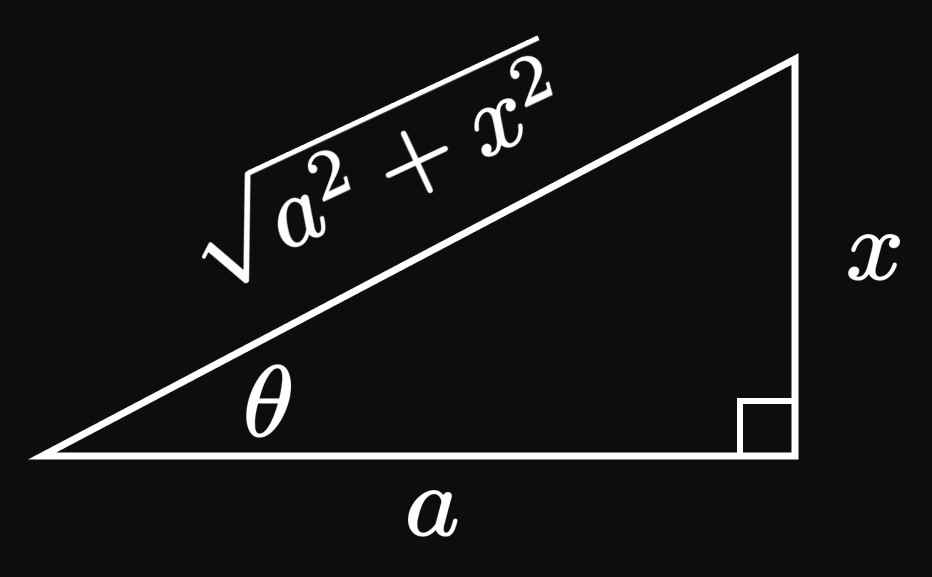
Thus, we construct a reference right triangle containing an angle \(\theta\)
whose opposite side has length \(x\) and adjacent side has length \(a.\)
By the Pythagorean Theorem,
the hypotenuse has length \(\sqrt{a^2 + x^2}.\)
(See Figure 2.)
We then see \(\sec \theta = \sqrt{a^2 + x^2}/a.\)
Therefore, the integral becomes
\[\ln \abs{\frac{\sqrt{a^2 + x^2}}{a} + \frac{x}{a}} + C_1 \pd \]
Using logarithm laws and noting that \(a \gt 0,\) we have
\[\ln \abs{\sqrt{a^2 + x^2} + x} - \ln a + C_1 \pd\]
Since \(a\) is a constant, we denote \(C_1 - \ln a\) as one constant: \(C.\)
Our final answer is then, as requested,
\[\ln \abs{\sqrt{a^2 + x^2} + x} + C \pd \]
Now we examine performing trigonometric substitutions to evaluate definite integrals.
In these problems, it is easiest to convert the bounds to be in terms of \(\theta,\)
as shown by the following examples.
Remember not to omit any absolute value bars;
we resolve them based on the function's behavior between the integral's bounds.
First we rewrite the integrand as \(4 \sqrt{1 - x^2}.\)
Then we substitute \(x = \sin \theta,\)
\(-\pi/2 \leq \theta \leq \pi/2,\)
from which \(\dd x = \cos \theta \di \theta.\)
Now we change the integration limits to be in terms of \(\theta.\)
Thus, the integral becomes
\[
4 \int_{\pi/6}^{\pi/3} \sqrt{1 - \sin^2 \theta} \, (\cos \theta) \di \theta
= 4 \int_{\pi/6}^{\pi/3} \abs{\cos \theta} \cos \theta \di \theta \pd
\]
Since \(\cos \theta\) is positive on \((\pi/6, \pi/3),\)
we have \(\abs{\cos \theta}\) \(= \cos \theta.\)
Then using the power-reduction formula for cosine, we get
\[
\ba
4 \int_{\pi/6}^{\pi/3} \cos^2 \theta \di \theta
&= 4 \int_{\pi/6}^{\pi/3} \tfrac{1}{2} \par{1 + \cos 2 \theta} \di \theta \nl
&= \par{2 \theta + \sin 2 \theta} \intEval_{\pi/6}^{\pi/3} \nl
&= \boxed{\frac{\pi}{3}}
\ea
\]
After changing the integral's bounds,
we did not return to \(x\);
we performed all remaining calculations in terms of \(\theta.\)
To eliminate the root sign in \(\sqrt{x^2 - 4},\)
we substitute \(x = 2 \sec \theta,\)
where \(0 \leq \theta \lt \pi/2\) or \(\pi/2 \lt \theta \leq \pi.\)
Then \(\dd x = 2 \sec \theta \tan \theta \di \theta.\)
We now change the integration limits to be in terms of \(\theta.\)
Lower Bound
When \(x = -2 \sqrt 2,\) we have \(2 \sec \theta = - 2\sqrt 2,\)
or \(\sec \theta = -\sqrt 2.\)
In the interval \([0, \pi/2) \cup (\pi/2, \pi],\)
the only solution is \(\theta = 3 \pi/4.\)
Upper Bound
When \(x = -4/ \sqrt 3,\) it follows that \(2 \sec \theta = -4/\sqrt 3,\)
or \(\sec \theta = -2/\sqrt 3.\)
In the interval \([0, \pi/2) \cup (\pi/2, \pi],\)
the only solution is \(\theta = 5 \pi/6.\)
Determine the area enclosed by the ellipse
\[\frac{x^2}{a^2} + \frac{y^2}{b^2} = 1 \pd\]
Solving for \(y\) as a function of \(x\) yields
\[y = \pm b \sqrt{1 - \frac{x^2}{a^2}} \pd\]
The top portion of the ellipse is given by the positive solution,
so the area in the first quadrant (as shown in Figure 3) is
\[
\ba
A_1 &= \int_0^a b \sqrt{1 - \frac{x^2}{a^2}} \di x \nl
&= \frac{b}{a} \int_0^a \sqrt{a^2 - x^2} \di x \pd
\ea
\]
To evaluate this integral, we substitute \(x = a \sin \theta,\)
\(-\pi/2 \leq \theta \leq \pi/2.\)
Then \(\dd x = a \cos \theta \di \theta.\)
We now change the bounds of integration as follows.
Lower Bound
When \(x = 0,\)
we have \(a \sin \theta = 0\)
or \(\sin \theta = 0.\)
Thus, \(\theta = 0.\)
Upper Bound
When \(x = a,\)
it follows that \(a \sin \theta = a\)
or \(\sin \theta = 1.\)
The only solution in \([-\pi/2, \pi/2]\)
is \(\theta = \pi/2.\)
We see
\[
\ba
\sqrt{a^2 - x^2} &= \sqrt{a^2 - a^2 \sin^2 \theta} \nl
&= \sqrt{a^2 \cos^2 \theta} \nl
&= a \abs{\cos \theta} \nl
&= a \cos \theta \cma
\ea
\]
where the last step is true because cosine is nonnegative on \([0, \pi/2].\)
Accordingly, we have
\[
\ba
A_1 &= \frac{b}{a} \int_0^{\pi/2} a \cos \theta \, (a \cos \theta) \di \theta \nl
&= ab \int_0^{\pi/2} \cos^2 \theta \di \theta \nl
&= ab \int_0^{\pi/2} \tfrac{1}{2} (1 + \cos 2 \theta) \di \theta \nl
&= ab \par{\tfrac{1}{2} \theta + \tfrac{1}{4} \sin 2 \theta} \intEval_0^{\pi/2} \nl
&= \frac{\pi}{4} ab \pd
\ea
\]
Since the ellipse is symmetric with respect to both axes,
the total area is four times the area in the first quadrant—namely,
\[A = 4A_1 = \boxed{\pi ab}\]
If \(a = b = r,\)
then the ellipse becomes a circle of radius \(r;\)
indeed, the area formula becomes the famous \(A = \pi r^2.\)
In the following examples,
we solve more complicated integrals requiring trigonometric substitutions.
See Section 6.2
to review the strategies for resolving trigonometric integrals.
EXAMPLE 7
\[\int \frac{3x}{\sqrt{x^2 - 2x + 5}} \di x\]
We complete the square under the radical to get
\[\int \frac{3x}{\sqrt{(x - 1)^2 + 4}} \di x \pd\]
We let \(x - 1 = 2 \tan \theta,\) where \(-\pi/2 \lt \theta \lt \pi/2.\)
Then
\[
\ba
x &= 1 + 2 \tan \theta \cma \nl
\dd x &= 2 \sec^2 \theta \di \theta \pd
\ea
\]
Afterward, the integral becomes
\[
\int \frac{3(1 + 2 \tan \theta)}{\sqrt{4 \tan^2 \theta + 4}} (2 \sec^2 \theta) \di \theta
= 3 \int \frac{1 + 2 \tan \theta}{\abs{\sec \theta}} \, \sec^2 \theta \di \theta \pd
\]
Because secant is positive on \((-\pi/2, \pi/2),\)
we have \(\abs{\sec \theta}\) \(= \sec \theta\) and so
the integral becomes
\[
\ba
3 \int \frac{1 + 2 \tan \theta}{\sec \theta} \, \sec^2 \theta \di \theta
&= 3 \int \par{\sec \theta + 2 \sec \theta \tan \theta} \di \theta \nl
&= 3 \ln \abs{\sec \theta + \tan \theta} + 6 \sec \theta + C_1 \pd
\ea
\]
Lastly, we express the answer in terms of \(x.\)
We substituted \(x - 1 = 2 \tan \theta,\)
so it follows that \(\tan \theta = (x - 1)/2.\)
Thus, we draw a reference right triangle with legs of lengths \((x - 1)\) and \(2,\)
which create a hypotenuse of length \(\sqrt{4 + (x - 1)^2}.\)
(See Figure 4.)
We then see
\[\sec \theta = \frac{\sqrt{4 + (x - 1)^2}}{2} \cma\]
so we have
\[
3 \ln \abs{\frac{\sqrt{4 + (x - 1)^2}}{2} + \frac{x - 1}{2}} + 6 \par{\frac{\sqrt{4 + (x - 1)^2}}{2}} + C_1
\pd
\]
Simplifying then yields
\[
3 \ln \abs{\frac{\sqrt{x^2 - 2x + 5}}{2} + \frac{x - 1}{2}} + 3 \sqrt{x^2 - 2x + 5} + C_1 \pd
\]
By logarithm laws, this expression is equivalent to
\[3 \ln \abs{\sqrt{x^2 - 2x + 5} + x - 1} - 3 \ln 2 + 3 \sqrt{x^2 - 2x + 5} + C_1 \pd\]
It is easiest to combine \(-3 \ln 2 + C_1\) into simply one constant: \(C.\)
Doing so yields
\[\boxed{3 \ln \abs{\sqrt{x^2 - 2x + 5} + x - 1} + 3 \sqrt{x^2 - 2x + 5} + C}\]
EXAMPLE 8
\[\int_{1}^2 \frac{\sqrt{16 - 2x^2}}{x^4} \di x\]
We rewrite the numerator as \(\sqrt 2 \, \sqrt{8 - x^2}.\)
Then we substitute \(x = \sqrt 8 \sin \theta,\)
\(-\pi/2 \leq \theta \leq \pi/2,\)
from which \(\dd x = \sqrt 8 \cos \theta \di \theta.\)
Then we see
\[
\ba
\sqrt 2 \, \sqrt{8 - x^2} &= \sqrt 2 \, \sqrt{8 - 8 \sin^2 \theta} \nl
&= \sqrt{16} \, \sqrt{\cos^2 \theta} \nl
&= 4 \abs{\cos \theta} = 4 \cos \theta \pd
\ea
\]
(We dropped the absolute value bars because cosine is nonnegative on \([-\pi/2, \pi/2].\))
Now we change the bounds.
Lower Bound
When \(x = \sqrt 8 \sin \theta\) \(= 1,\)
we have \(\sin \theta = 1/\sqrt 8\) \(\iffArrow \theta = \asin(1/\sqrt 8).\)
For convenience, we let \(\alpha = \asin(1/\sqrt 8).\)
Upper Bound
When \(x = \sqrt 8 \sin \theta\) \(= 2,\)
we have \(\sin \theta = 2/\sqrt 8\) \(\iffArrow \theta = \asin(2/\sqrt 8).\)
For convenience, we let \(\beta = \asin(2/\sqrt 8).\)
Simplifying the radical gives \(\beta = \asin(1/\sqrt 2).\)
(Note that both angles \(\alpha\) and \(\beta\) lie in the first quadrant of the Unit Circle.)
The integral becomes
\[
\ba
\int_\alpha^\beta \frac{4 \cos \theta}{(\sqrt 8 \sin \theta)^4} (\sqrt 8 \cos \theta) \di \theta
&= \frac{\sqrt 2}{8} \int_\alpha^\beta \frac{\cos^2 \theta}{\sin^4 \theta} \di \theta \nl
&= \frac{\sqrt 2}{8} \int_\alpha^\beta \cot^2 \theta \csc^2 \theta \di \theta \pd
\ea
\]
Substituting \(u = \cot \theta,\)
we get \(\dd u = -\csc^2 \theta \di \theta.\)
The lower and upper bounds become \(\cot \alpha\) and \(\cot \beta,\) respectively.
Hence, we attain
\[
\ba
-\frac{\sqrt 2}{8} \int_{\cot \alpha}^{\cot \beta} u^2 \di u
&= -\frac{\sqrt 2}{24} u^3 \intEval_{\cot \alpha}^{\cot \beta} \nl
&= \frac{\sqrt 2}{24} \par{\cot^3 \alpha - \cot^3 \beta} \pd
\ea
\]
But we defined \(\sin \alpha = 1/\sqrt 8,\)
so the Pythagorean identity gives
\[\cos \alpha = \sqrt{1 - \par{\frac{1}{\sqrt 8}}^2} = \frac{\sqrt 7}{\sqrt 8} \cma\]
where we use the positive solution since \(\alpha\) lies in the first quadrant of the Unit Circle.
Likewise, we defined \(\sin \beta = 1/\sqrt 2;\)
because \(\beta\) is in the first quadrant of the Unit Circle,
we use the positive solution for cosine:
\[\cos \beta = \sqrt{1 - \par{\frac{1}{\sqrt 2}}^2} = \frac{1}{\sqrt 2} \pd\]
Because cotangent is the ratio of cosine over sine, we see
\[
\baat{2}
\cot \alpha &= \frac{\sqrt 7/\sqrt 8}{1/\sqrt 8} \lspace \cot \beta &&= \frac{1/\sqrt 2}{1/\sqrt 2} \nl
&= \sqrt 7 &&= 1 \pd
\eaat
\]
Substituting these values gives
\[\frac{\sqrt 2}{24} \parbr{\par{\sqrt 7}^3 - (1)^3} = \boxed{\frac{\sqrt 2}{24} \par{7 \sqrt 7 - 1}}\]
EXAMPLE 9
\[\int \frac{x^3}{(9x^2 + 25)^{3/2}} \di x\]
We rewrite the denominator as
\[\par{\sqrt{9x^2 + 25}}^3 = \par{3 \sqrt{x^2 + \tfrac{25}{9}}}^3 = 27 \par{\sqrt{x^2 + \tfrac{25}{9}}}^3 \pd\]
This form reveals the need for the substitution \(x = \tfrac{5}{3} \tan \theta,\)
\(-\pi/2 \lt \theta \lt \pi/2.\)
Then \(\dd x = \frac{5}{3} \sec^2 \theta \di \theta,\)
and the denominator becomes
\[
\ba
27 \par{\sqrt{\par{\tfrac{5}{3} \tan \theta}^2 + \tfrac{25}{9}}}^3
&= 27 \par{\sqrt{\tfrac{25}{9} \sec^2 \theta}}^3 \nl
&= 125 \, \abs{\sec \theta}^3 \pd
\ea
\]
The integral therefore becomes
\[
\int \frac{\par{\frac{5}{3} \tan \theta}^3}{125 \, \abs{\sec \theta}^3}
\par{\tfrac{5}{3} \sec^2 \theta} \di \theta
= \frac{5}{81} \int \frac{\tan^3 \theta}{\abs{\sec \theta}^3} \, \sec^2 \theta \di \theta \pd
\]
But secant is positive on \((-\pi/2, \pi/2),\)
so we have
\(\abs{\sec \theta}\) \(= \sec \theta.\)
Hence, the integral becomes
\[
\frac{5}{81} \int \frac{\tan^3 \theta}{\sec^3 \theta} \, \sec^2 \theta \di \theta
= \frac{5}{81} \int \frac{\tan^3 \theta}{\sec \theta} \di \theta \pd
\]
It is a good idea to split the fraction of complicated trigonometric functions into sines and cosines;
doing so gives
\[
\ba
\frac{5}{81} \int \frac{\sin^3 \theta}{\cos^2 \theta} \di \theta
&= \frac{5}{81} \int \frac{\sin^2 \theta \sin \theta}{\cos^2 \theta} \di \theta \nl
&= \frac{5}{81} \int \frac{(1 - \cos^2 \theta) \sin \theta}{\cos^2 \theta} \di \theta \pd
\ea
\]
The integrand contains an extra factor \(\sin \theta,\)
which we strip by substituting \(u = \cos \theta.\)
Consequently, \(\dd u = - \sin \theta \di \theta\)
and so the integral becomes
\[
\ba
-\frac{5}{81} \int \frac{1 - u^2}{u^2} \di u
&= \frac{5}{81} \int \par{1 - \frac{1}{u^2}} \di u \nl
&= \frac{5}{81} \par{u + \frac{1}{u}} + C \nl
&= \frac{5}{81} \par{\cos \theta + \frac{1}{\cos \theta}} + C \nl
&= \frac{5}{81} \par{\cos \theta + \sec \theta} + C \pd
\ea
\]
Finally, we convert back to \(x.\) Since \(x = \tfrac{5}{3} \tan \theta,\)
it follows that \(\tan \theta = 3x/5.\)
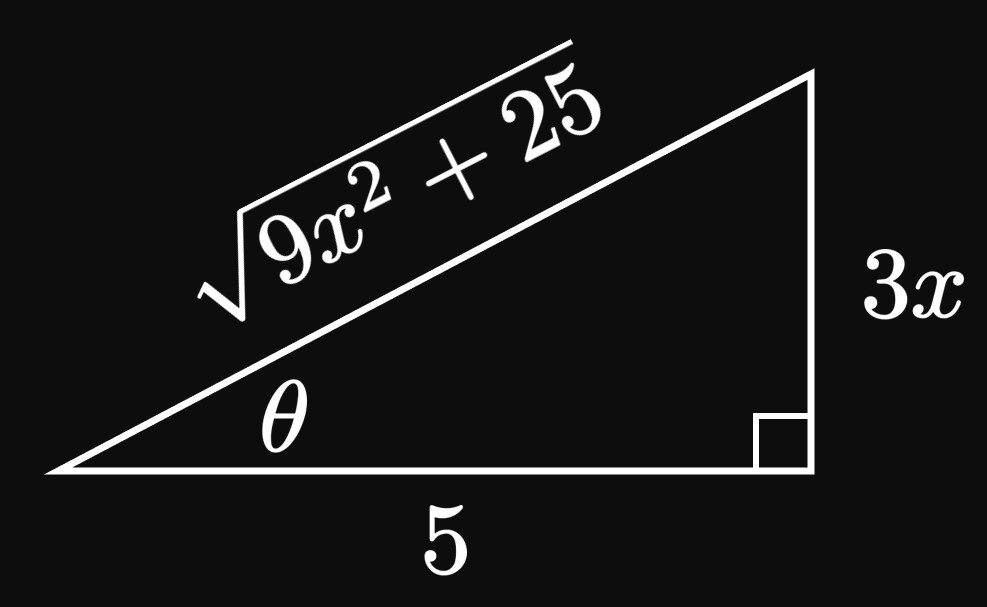
Therefore, we construct a reference right triangle and label an angle \(\theta\)
whose opposite side has length \(3x\) and adjacent side has length \(5.\)
By the Pythagorean Theorem, the hypotenuse has length \(\sqrt{(3x)^2 + 5^2} = \sqrt{9x^2 + 25}.\)
(See Figure 5.)
Thus, we see
\[\cos \theta = \frac{5}{\sqrt{9x^2 + 25}} \and \sec \theta = \frac{\sqrt{9x^2 + 25}}{5} \pd\]
So our final answer is
\[\frac{5}{81} \par{\frac{5}{\sqrt{9x^2 + 25}} + \frac{\sqrt{9x^2 + 25}}{5}} + C
= \boxed{\frac{25}{81 \sqrt{9x^2 + 25}} + \frac{\sqrt{9x^2 + 25}}{81} + C}
\]
A trigonometric substitution
is a special case of the Substitution Rule
in which we let \(x\) be a trigonometric function.
In conjunction with the Pythagorean identity,
the strategy eliminates roots of the forms \(\sqrt{a^2 - x^2},\)
\(\sqrt{x^2 + a^2},\) and \(\sqrt{x^2 - a^2}.\)
The following table shows the appropriate substitutions for each form.
In each case, \(\theta\) is restricted so that the substitution defines a function that is one-to-one on the specified interval.
Form
Substitution
Trigonometric Identity
\(\sqrt{a^2 - x^2}\)
\(\ds x = a \sin \theta \cmaa -\frac{\pi}{2} \leq \theta \leq \frac{\pi}{2}\)
\(1 - \sin^2 \theta = \cos^2 \theta\)
\(\sqrt{x^2 + a^2}\)
\(\ds x = a \tan \theta \cmaa -\frac{\pi}{2} \lt \theta \lt \frac{\pi}{2}\)
\(\tan^2 \theta + 1 = \sec^2 \theta\)
\(\sqrt{x^2 - a^2}\)
\(\ds x = a \sec \theta \cmaa 0 \leq \theta \lt \frac{\pi}{2} \sspace\) or \(\ds \sspace \frac{\pi}{2} \lt \theta \leq \pi\)
\(\sec^2 \theta - 1 = \tan^2 \theta\)
Suppose that an indefinite integral contains a radical in the form \(\sqrt{a^2 - x^2},\)
\(\sqrt{x^2 + a^2},\) or \(\sqrt{x^2 - a^2}.\)
The following steps enable you to resolve the integral.
Compute the differential of your substitution.
Apply the Substitution Rule to convert the integral in terms of \(\theta.\)
Perform the integration with respect to \(\theta.\)
Reexpress your final answer in terms of the original variable, \(x,\)
by drawing a reference right triangle.
In an indefinite integral,
we tend to omit the absolute value bars around a trigonometric function
for simplicity.
Conversely, in a definite integral,
be careful not to drop any absolute value bars;
resolve them based on the function's behavior between the integral's bounds.
In solving definite integrals, it's easiest to convert the bounds to \(\theta\)
and finish the problem with \(\theta.\)