Let \(g(x) = x^2 + bx + 2\). For what values of \(b\) does \(g\) have no real zeros?
SOLUTION
The discriminant of \(g\) is
\[\Delta = b^2 - 8 \period \]
The function \(g\) has no real zeros if \(\Delta \lt 0. \)
Thus, we find the values of \(b\) that satisfies this inequality:
\[b^2 - 8 \lt 0 \implies \boxed{-2 \sqrt 2 \lt b \lt 2 \sqrt 2} \]
EXERCISE 2
A \(100\)-point exam has \(16\) questions,
each worth either four or seven points.
Determine how many four-point questions and seven-point questions are on the exam.
SOLUTION
Let \(x\) be the number of four-point questions and \(y\) be the number of seven-point questions.
To solve for both variables,
we write a system of two linear equations:
\begin{align}
x + y &= 16 \label{eq:points-1} \nl
4x + 7y &= 100 \label{eq:points-2} \pd
\end{align}
Let's solve this system by elimination:
Multiplying both sides of \(\eqref{eq:points-1}\) by \(4\)
and subtracting it from \(\eqref{eq:points-2}\) gives
\[
\ba
4x + 7y - 4(x + y) &= 100 - 4(16) \nl
3y &= 36 \nl
y &= 12 \pd
\ea
\]
So by \(\eqref{eq:points-1},\) \(x = 16 - 12\) \(= 4.\)
Thus, the exam has 4 four-point questions and 12 seven-point questions.
EXERCISE 3
For any positive integer \(n,\) let \(f(x) = x^n.\)
Prove that
\(f\) is even if \(n\) is even
\(f\) is odd if \(n\) is odd
SOLUTION
The function \(f\) is even if and only if \(f(-x) = f(x),\)
and it is odd if and only if \(f(-x) = -f(x).\)
Replacing \(x\) with \(-x\) gives
\[f(-x) = (-x)^n = (-1)^n \, x^n \pd\]
For even \(n,\) \((-1)^n = 1.\)
Hence,
\[f(-x) = (1) \, x^n = x^n = f(x)\]
and so \(f\) is even.
If \(n\) is odd, then \((-1)^n = -1.\)
Consequently,
\[f(-x) = (-1) \, x^n = -x^n = -f(x) \cma\]
so \(f\) is odd.
EXERCISE 4
Find the value of \(k\)
such that the points \((-3, 4),\) \((1, 1),\)
and \((k, -2)\) are collinear.
SOLUTION
The word collinear means all three points lie on the same straight line.
The slope of the line connecting \((-3, 4)\) and \((1, 1)\) is
\[m = \frac{1 - 4}{1 - (-3)} = -\frac{3}{4} \pd\]
So an equation of the line connecting the two points is, by point-slope form,
\[y - 1 = -\tfrac{3}{4} (x - 1) \or y = -\tfrac{3}{4} x + \tfrac{7}{4} \pd\]
Substituting \((k, -2)\) into the equation of the line, we attain
\[
\ba
-2 &= -\tfrac{3}{4} k + \tfrac{7}{4} \nl
-8 &= -3k + 7 \nl
-3k &= -15 \nl
\implies k &= 5 \pd
\ea
\]
Hence, \(\boxed{k = 5}\) ensures that \((k, -2)\) lies on the same line
as the other two points.
EXERCISE 5
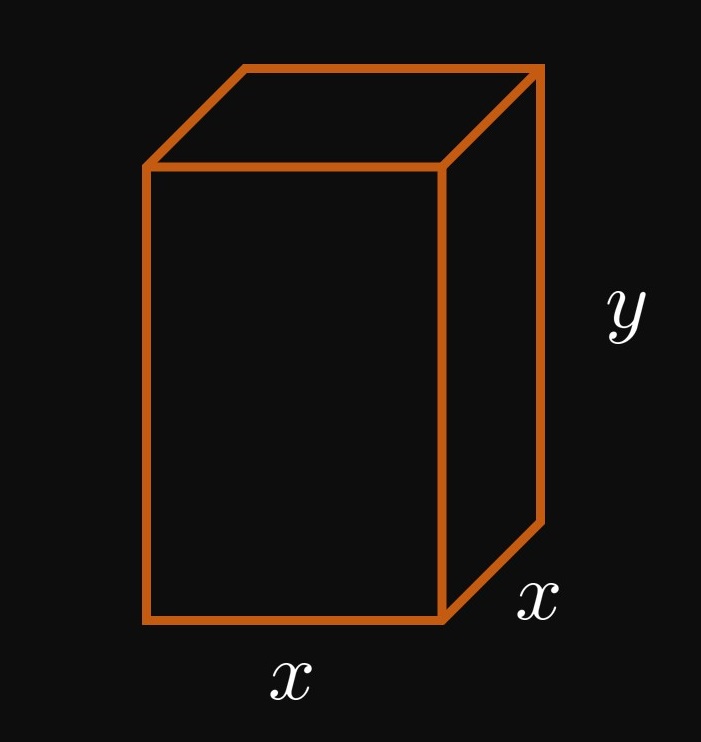
A rectangular prism has a square base whose lengths are \(x.\)
If the prism's volume is \(400,\) then express its surface area \(S\) as a function of \(x.\)
Then give the domain in context.
SOLUTION
Let's call \(y\) the prism's height.
Then the prism's volume is
\begin{equation}
x^2 y = 400 \pd \label{eq:prism-V}
\end{equation}
The prism's two square faces each have an area of \(x^2,\)
and the four rectangular faces each have an area of \(xy.\)
So the prism's total surface area is their sum:
\begin{equation}
S = 2x^2 + 4xy \pd \label{eq:prism-S}
\end{equation}
To express \(S\) entirely in terms of \(x,\)
we express \(y\) in terms of \(x.\)
From \(\eqref{eq:prism-V}\) we have \(y = 400/x^2,\)
which we substitute into \(\eqref{eq:prism-S}\) to get
\[
\ba
S(x) &= 2x^2 + 4x \par{\frac{400}{x^2}} \nl
&= \boxed{2x^2 + \frac{1600}{x}}
\ea
\]
Because the side length \(x\) can't be negative,
the domain of \(S\) in context is
\[
\ba
\{x \mid x \gt 0\} = \boxed{(0, \infty)}
\ea
\]
EXERCISE 6
Solve for \(x\) in the equation
\[\frac{3}{\csc x} - \frac{6}{\cot x} = 0 \pd\]
SOLUTION
When working with reciprocal trigonometric functions,
it is a good idea to rewrite the equation in terms of sines and cosines.
Doing so and factoring, we get
\[
\ba
3 \sin x - 6 \frac{\sin x}{\cos x} &= 0 \nl
(3 \sin x)(1 - 2 \sec x) &= 0 \pd
\ea
\]
Equating each factor to \(0,\) we get
\[
\baat{2}
3 \sin x &= 0 \lspace &1 - 2 \sec x &= 0 \nl
\sin x &= 0 \lspace &\sec x &= \tfrac{1}{2} \pd
\eaat
\]
But since the range of secant is \((-\infty, -1]\) \(\cup\) \([1, \infty),\)
the equation \(\sec x = 1/2\) has no solutions.
Thus, the only solutions exist when \(\sin x = 0;\)
that is, if \(n\) is any integer, then
\[x = n \pi \pd\]
But these solutions turn out to be extraneous;
the original equation was
\[\frac{3}{\csc x} - \frac{6}{\cot x} = 0 \pd\]
The domains of cosecant and cotangent both exclude \(x = n \pi,\)
so, this equation has no real solutions.
EXERCISE 7
Particle A moves to the right with a speed of \(4\) feet per second.
Particle B, initially located \(20\) feet to the right of particle A,
travels to the left with a speed of \(6\) feet per second.
When do both particles collide?
SOLUTION
Consider an axis system where \(x = 0\) is particle A's initial position.
Then particle B is initially located at \(x = 20.\)
Let \(t\) be time in seconds;
both particles' positions are functions of \(t.\)
The rate of change of each particle is its speed.
Since particle A's speed is \(4 \undiv{ft}{sec},\)
its position function is \(x_A(t) = 4t.\)
Particle B's position is decreasing at a rate given by its speed, \(6 \undiv{ft}{sec},\)
and its initial position is \(20.\)
Accordingly, its position function is \(x_B(t) = 20 - 6t.\)
When both particles collide, their \(x\)-coordinates are equivalent, so
\[
\ba
x_A(t) &= x_B(t) \nl
4t &= 20 - 6t \nl
10 t &= 20 \nl
\implies t &= \boxed{2 \un{sec}}
\ea
\]
Also note that \(x = 4(2)\) \(= 20 - 6(2)\) \(= 8.\)
Thus, both particles collide \(8 \un{ft}\) to the right of particle A's initial position.
EXERCISE 8
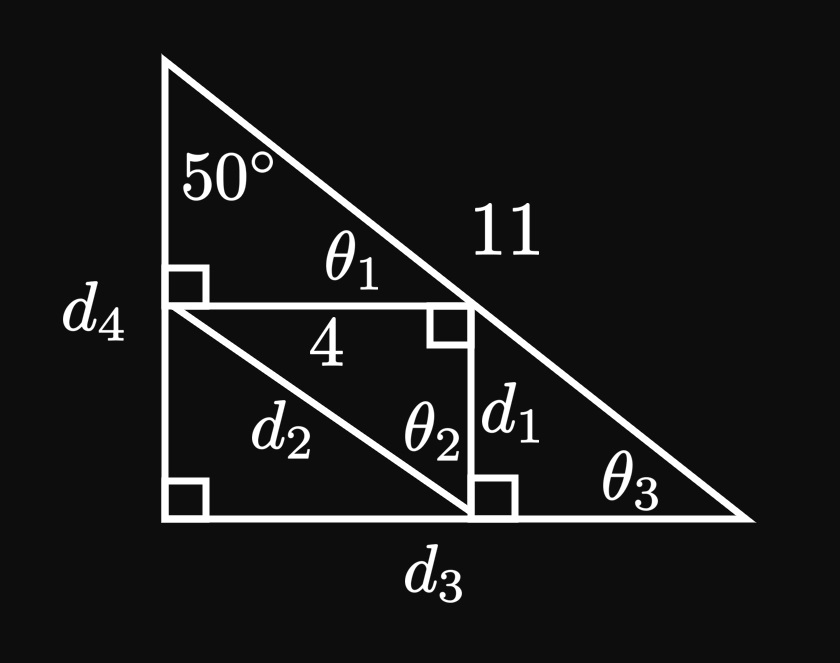
In Figure 1
find the side lengths \(d_1,\) \(d_2,\) \(d_3,\) and \(d_4\)
and the angles \(\theta_1,\) \(\theta_2,\) and \(\theta_3.\)
SOLUTION
Observe that the \(50 \degree\) angle is complementary to angles \(\theta_1\) and \(\theta_3.\)
Thus, we have
\[\theta_1 = \theta_3 = 90 \degree - 50 \degree = 40 \degree \pd\]
Also, \(\theta_1\) and \(\theta_2\) are complementary, so
\[\theta_2 = 90 \degree - \theta_1 = 50 \degree \pd\]
Using trigonometry, it is easiest to first find \(d_3\) and \(d_4,\) as follows:
\[
\baat{2}
d_3 &= 11 \sin 50 \degree &&\approx 8.426 \cma \nl
d_4 &= 11 \cos 50 \degree &&\approx 7.071 \pd
\eaat
\]
Next we find the side lengths of the inner triangle.
We see
\[
\ba
\tan \theta_2 &= \frac{4}{d_1} \nl
\implies d_1 &= 4 \cot 50 \degree \approx 3.356 \pd
\ea
\]
Likewise, we have
\[
\ba
\sin \theta_2 &= \frac{4}{d_2} \nl
\implies d_2 &= 4 \csc 50 \degree \approx 5.222 \pd
\ea
\]
In summary, the side lengths are
\[
\boxed{
\baat{2}
d_1 &\approx 3.356 \qquad &d_2 &\approx 5.222 \nl
d_3 &\approx 8.426 &\qquad d_4 &\approx 7.071
\eaat}
\]
The angles are
\[\boxed{\theta_1 = 40 \degree} \qquad \boxed{\theta_2 = 50 \degree} \qquad \boxed{\theta_3 = 40 \degree}\]
EXERCISE 9
Solve for \(x\) in \(\ds \log_7 x + \log_7(x - 4) = 1.\)
SOLUTION
The domain is \(\{x \mid x \gt 4\}\) so that neither logarithm has a negative argument.
Condensing the logarithms on the left side,
we get
\[\log_7 \par{x^2 - 4x} = 1 \pd\]
Exponentiating both sides with base \(7,\) we see
\[
\ba
7^{\log_7 \par{x^2 - 4x}} &= 7^1 \nl
x^2 - 4x &= 7 \nl
x^2 - 4x - 7 &= 0 \pd
\ea
\]
The Quadratic Formula (see Section 0.7) then gives
\[
\ba
x &= \frac{-(-4) \pm \sqrt{(-4)^2 - 4(1)(-7)}}{2(1)} \nl
&= \frac{4 \pm \sqrt{44}}{2} \nl
&= \frac{4 \pm 2 \sqrt{11}}{2} \nl
&= 2 \pm \sqrt{11} \pd
\ea
\]
Only \(\boxed{x = 2 + \sqrt{11}}\) \(\approx 5.317\) is in the domain of
\(\log_7 x + \log_7(x - 4);\)
the other solution is extraneous.
EXERCISE 10
Let
\[f(x) = \tfrac{1}{2} x - 1 \and g(x) = 4^x \pd\]
Find \((f \circ g)(x)\) and \((g \circ f)(x)\)
and their domains.
We have
\[
\ba
(f \circ g)(x) &= f(g(x)) \nl
&= f \par{4^x} \nl
&= \boxed{\tfrac{1}{2} \par{4^x} - 1}
\ea
\]
The domain is \(\boxed{(-\infty, \infty)}.\)
Also,
\[
\ba
(g \circ f)(x) &= g(f(x)) \nl
&= g \par{x/2 - 1} \nl
&= \boxed{4^{x/2 - 1}}
\ea
\]
The domain is \(\boxed{(-\infty, \infty)}.\)
The composite function \(f \circ g\) is positive when
\[
\ba
\tfrac{1}{2} \par{4^x} - 1 &\gt 0 \nl
4^x &\gt 2 \pd
\ea
\]
Since \(2 = 4^{1/2},\)
the inequality becomes \(4^x \gt 4^{1/2},\) which is true for \(x \gt 1/2.\)
Hence, the solution interval is
\[\{x \mid x \gt \tfrac{1}{2}\} = \boxed{\par{\tfrac{1}{2}, \infty}}\]
We have
\[
\ba
4^{x/2 - 1} &\gt \par{\tfrac{1}{2} \par{4^x} - 1} + 1 \nl
\par{4^{1/2}}^x \, 4^{-1} &\gt 2^{-1} \, \par{2^2}^x \nl
2^x \, 2^{-2} &\gt 2^{-1} \, 2^{2x} \nl
2^{x - 2} &\gt 2^{2x - 1} \pd
\ea
\]
By comparing exponents, we have
\[
\ba
x - 2 &\gt 2x - 1 \nl
x &\lt -1 \pd
\ea
\]
So the solution interval is
\[\{x \mid x \lt -1\} = \boxed{(-\infty, -1)}\]
EXERCISE 11
Show that
\[\sin(\acos x) = \sqrt{1 - x^2} \pd\]
SOLUTION
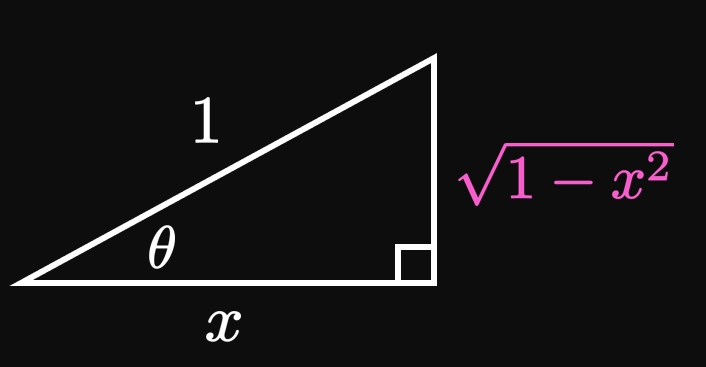
Let's draw a right triangle in which one angle is \(\theta.\)
Think of \(\theta = \acos x\) as \(\theta = \acos(x/1).\)
Since cosine is the ratio of the adjacent side length to the hypotenuse length,
the side adjacent to \(\theta\) has length \(x\) and the hypotenuse's length is \(1.\)
Then the side opposite to \(\theta\) is, by the Pythagorean theorem, \(\sqrt{1 - x^2}.\)
Sine is the ratio of the opposite side to the hypotenuse; thus, we get
\[\sin \theta = \frac{\sqrt{1 - x^2}}{1} = \sqrt{1 - x^2} \cma\]
as requested.
Another method is to let \(\theta = \acos x.\)
Then \(\cos x = x\) and \(\theta \in [0, \pi],\)
over which \(\sin \theta \geq 0.\)
Thus,
\[\sin (\acos x) = \sin \theta = \sqrt{1 - \cos^2 \theta} = \sqrt{1 - x^2} \cma\]
where the penultimate step is true by the Pythagorean identity.
With this method, the relationship
\[\sin(\acos x) = \sqrt{1 - x^2}\]
holds for \(x \in [-1, 1],\) not just for positive \(x.\)
EXERCISE 12
A belt is wrapped around the top half of a circular shaft,
and the belt is pulled at the left end with a force \(T_1.\)
A frictional force opposes the shaft's rotation,
so the right end of the belt experiences a tensile force \(T_2.\)
(See Figure 2.)
The coefficient of friction between the belt and shaft is \(\mu;\)
large values of \(\mu\) indicate high levels of friction.
Then \(T_1,\) \(T_2,\) and \(\mu\) satisfy
\[\ln \par{\frac{T_1}{T_2}} = \mu \pi \pd\]
Solve for \(T_1\) in terms of \(T_2\) and \(\mu.\)
Then calculate \(T_2\) if \(T_1 = 60\) pounds and \(\mu = 0.6.\)
SOLUTION
Exponentiating both sides using the base \(e,\) we get
\[
\ba
e^{\ln(T_1/T_2)} &= e^{\mu \pi} \nl
\frac{T_1}{T_2} &= e^{\mu \pi} \nl
\implies T_1 &= T_2 e^{\mu \pi} \pd
\ea
\]
If \(T_1\) \(= 60 \un{lb}\) and \(\mu = 0.6,\)
then we have
\[
\ba
60 &= T_2 e^{0.6 \pi} \nl
T_2 &= \frac{60}{e^{0.6 \pi}} \approx \boxed{9.11 \un{lb}}
\ea
\]
EXERCISE 13
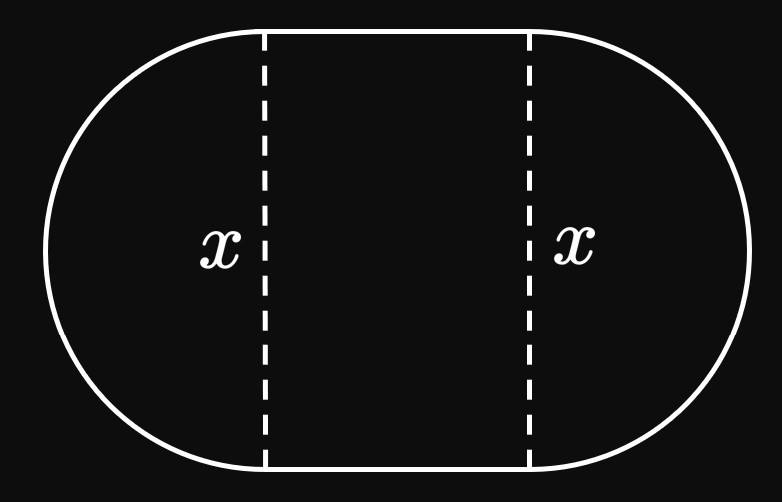
A slot is constructed by connecting two semicircles to two horizontal line segments
(Figure 3).
If the slot's perimeter is \(50,\)
then express its area \(A\) as a function of each semicircle's diameter, \(x.\)
SOLUTION
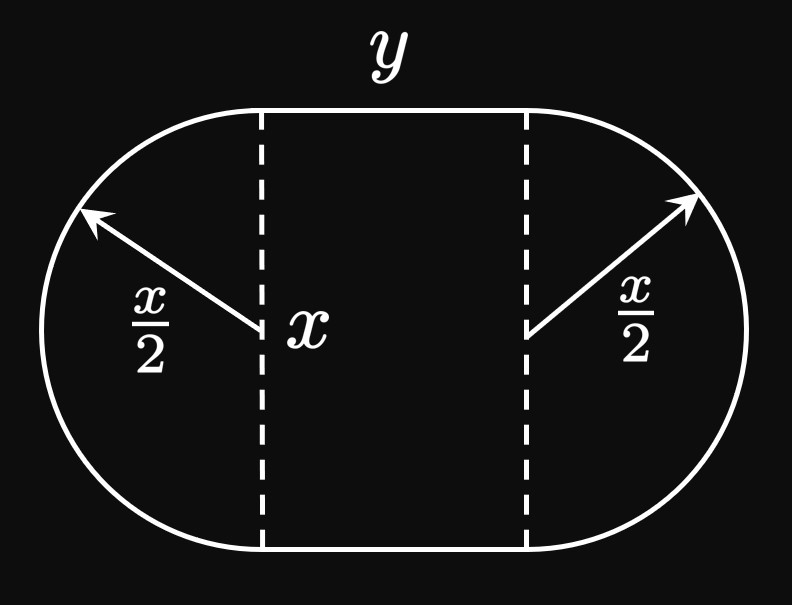
Let \(y\) be the length of each horizontal line segment.
Each semicircle's radius is \(x/2,\)
so its circumference is \(\pi x/2.\)
The slot's perimeter of \(50\) is given by \(2y\) plus the two semicircles' circumferences—namely,
\begin{align}
2 \par{\frac{\pi x}{2}} + 2y &= 50 \nonum \nl
\pi x + 2y &= 50 \label{eq:slot-perimeter} \pd
\end{align}
Each semicircle's area is \(\tfrac{1}{2} \pi (x/2)^2\) \(= \pi x^2/8,\)
and the middle rectangle's area is \(xy.\)
Hence, the slot's area is
\begin{align}
A &= 2 \par{\frac{\pi x^2}{8}} + xy \nonum \nl
&= \frac{\pi x^2}{4} + xy \pd \label{eq:slot-area}
\end{align}
Our goal is to express \(A\) solely in terms of \(x,\)
so we want to express \(y\) in terms of \(x.\)
From \(\eqref{eq:slot-perimeter},\)
solving for \(y\) gives
\[
\ba
y &= \tfrac{1}{2} (50 - \pi x) \nl
&= 25 - \frac{\pi x}{2} \cma
\ea
\]
which we substitute into \(\eqref{eq:slot-area}\) to attain
\[
\ba
A(x) &= \frac{\pi x^2}{4} + x \par{25 - \frac{\pi x}{2}} \nl
&= \boxed{25x - \frac{\pi x^2}{4}}
\ea
\]
EXERCISE 14
Using a Proof by Induction, prove the formula
\[\sum_{i = 1}^n i^3 = \parbr{\frac{n(n + 1)}{2}}^2 \pd\]
SOLUTION
Let \(S_n\) \(= \sum_{i = 1}^n i^3\) \(= [n(n + 1)/2]^2.\)
Our first goal is to show that \(S_1\) is true.
Then we assume that \(S_k\) (where \(k\) is any positive integer)
is true and hold that \(S_{k + 1}\) is true.
First observe that \(S_1\) is true because
\[\sum_{i = 1}^1 i^3 = 1^3 \equalsCheck \parbr{\frac{1(1 + 1)}{2}}^2 \pd\]
Next we assume that \(S_k\) is true—namely,
\[\sum_{i = 1}^k i^3 = \parbr{\frac{k(k + 1)}{2}}^2 \pd\]
We must show that \(S_{k + 1}\) is consequently true—that is,
\[\sum_{i = 1}^{k + 1} i^3 = \parbr{\frac{(k + 1)(k + 2)}{2}}^2 \pd\]
We see
\[
\ba
\sum_{i = 1}^{k + 1} i^3
&= \sum_{i = 1}^k i^3 + (k + 1)^3 \nl
&= \parbr{\frac{k(k + 1)}{2}}^2 + (k + 1)^3 \nl
&= (k + 1)^2 \par{\frac{k^2}{4} + (k + 1)} \nl
&= (k + 1)^2 \par{\frac{k^2 + 4k + 4}{4}} \nl
&= (k + 1)^2 \frac{(k + 2)^2}{4} \nl
&\equalsCheck \parbr{\frac{(k + 1)(k + 2)}{2}}^2 \pd
\ea
\]
Therefore, by mathematical induction,
\(S_n\) is true for all positive integers \(n.\)
EXERCISE 15
Some data trends are best modeled by an exponential function \(y = ab^x,\)
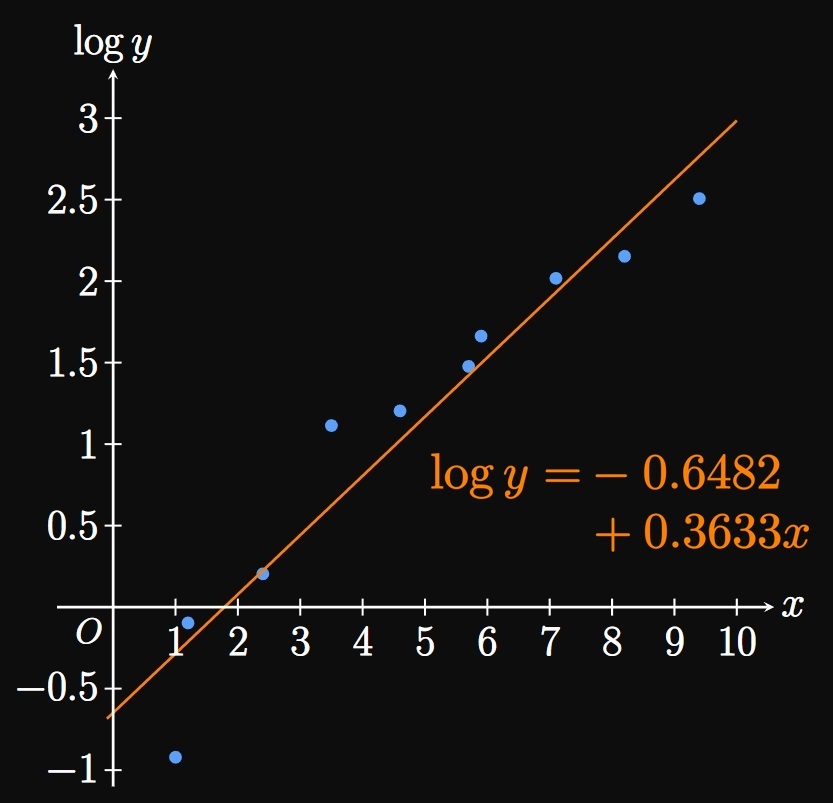
such as the model in Figure 4A.
The logarithm of the \(y\)-values is plotted against the original \(x\)-values to produce a linear pattern;
the equation of the best-fit line is
\[\log y = -0.6482 + 0.3633 x \pd\]
(See Figure 4B.)
Find the values of \(a\) and \(b\) to complete the exponential model.
SOLUTION
Exponentiating both sides of the best-fit equation for the line,
we have
\[
\ba
10^{\log y} &= 10^{-0.6482 + 0.3633 x} \nl
y &= 10^{-0.6482} \, 10^{0.3633 x} \nl
y &= 0.2248 \par{2.3083}^x \pd
\ea
\]
Comparing this equation to \(y = ab^x,\)
we see \(\boxed{a = 0.2248}\) and \(\boxed{b = 2.3083}.\)
EXERCISE 16
For two angles \(\alpha\) and \(\beta,\) it is known that
\[
\ba
5 \sin \alpha + 2 \cos \beta &= 6 \cma \nl
5 \cos \alpha + 2 \sin \beta &= 1 \pd
\ea
\]
If \(0 \lt \alpha + \beta \lt \pi/2,\) then find \(\sin(\alpha + \beta)\) and \(\cos(\alpha + \beta).\)
SOLUTION
By squaring both equations, we get
\[
\ba
25 \sin^2 \alpha + 20 \sin \alpha \cos \beta + 4 \cos^2 \beta &= 36 \cma \nl
25 \cos^2 \alpha + 20 \cos \alpha \sin \beta + 4 \sin^2 \beta &= 1 \pd
\ea
\]
Adding both equations, we get
\[
\ba
25(\sin^2 \alpha + \cos^2 \alpha) + 20(\sin \alpha \cos \beta + \cos \alpha \sin \beta) + 4(\cos^2 \beta + \sin^2 \beta) &= 37 \nl
29 + 20(\sin \alpha \cos \beta + \cos \alpha \sin \beta) &= 37 \nl
\sin \alpha \cos \beta + \cos \alpha \sin \beta &= \tfrac{8}{20} \nl
\sin(\alpha + \beta) &= \boxed{\tfrac{2}{5}}
\ea
\]
Then by the Pythagorean identity,
\[\cos(\alpha + \beta) = \sqrt{1 - \sin^2(\alpha + \beta)} = \sqrt{1 - \tfrac{4}{25}} = \boxed{\frac{\sqrt{21}}{5}}\]
(We chose the positive solution because cosine is positive for inputs between \(0\) and \(\pi/2\) radians.)