Determine all the values \(k\) for which
\[f(x) = \frac{x^2 + kx - 24}{x - 2k}\]
has no vertical asymptotes.
SOLUTION
The denominator of \(f\) inevitably equals \(0\) at some value of \(x.\)
To prevent a vertical asymptote,
we need both the numerator and denominator to equal \(0\) simultaneously;
we then take the limit to determine whether the discontinuity is removable or infinite.
The denominator equals \(0\) when \(x = 2k.\) Substituting this expression into the numerator and equating the result to \(0\) show
\[
\ba
(2k)^2 + k(2k) - 24 &= 0 \nl
6k^2 &= 24 \nl
\implies k &= -2 \cma 2 \pd
\ea
\]
When \(k = -2,\)
\[f(x) = \frac{x^2 - 2x - 24}{x + 4} = \frac{(x - 6) \cancel{(x + 4)}}{\cancel{(x + 4)}} = x - 6 \cmaa x \ne -4 \pd\]
Then
\[\lim_{x \to -4} f(x) = -4 - 6 = -10 \cma\]
so \(f\) has a removable discontinuity (not a vertical asymptote) at \(-4.\)
Additionally, when \(k = 2,\)
\[f(x) = \frac{x^2 + 2x - 24}{x - 4} = \frac{(x + 6)\cancel{(x - 4)}}{\cancel{(x - 4)}} = x + 6 \cmaa x \ne 4 \pd\]
We see
\[\lim_{x \to 4} f(x) = 4 + 6 = 10 \pd\]
Thus, \(f\) has a removable discontinuity (not a vertical asymptote) at \(4.\)
Hence, \(\boxed{k = -2}\) and \(\boxed{k = 2}\) ensure that \(f\) has no vertical asymptotes.
EXERCISE 2
Determine all the values of \(n\) such that the Intermediate Value Theorem does not apply to
\[f(x) = \sqrt[\Large 5n]{2x + 1}\]
on the closed interval \([-1, 0].\)
SOLUTION
The Intermediate Value Theorem requires \(f\) to be continuous on \([-1, 0].\)
Note that
\[f(-1) = \sqrt[\Large 5n]{-1} \and f(0) = \sqrt[\Large 5n]{1} \pd\]
Radical expressions with even indices are not defined for negative inputs.
Hence, \(\sqrt[\Large 5n]{2x + 1} \; \) is undefined on \([-1, -\tfrac{1}{2})\) when \(5n\) is even.
When \(n\) is odd, \(5n\) is odd; when \(n\) is even, \(5n\) is even.
Thus, the Intermediate Value Theorem does not apply to \(f\) on \([-1, 0]\) for
\[\boxed{\text{all even } n}\]
EXERCISE 3
Calculate
\[\lim_{x \to \infty} \parbr{6x^4 \par{\sin^4 \frac{1}{x}} + \frac{1}{x^2} \par{\csc^2 \frac{1}{x}} - 3} \pd\]
[Hint: Let \(t = x \sin (1/x)\) and use the result of
Example 1.3-8.]
SOLUTION
With \(t = x \sin(1/x),\)
the result of Example 1.3-8
asserts that \(t \to 1\) as \(x \to \infty.\)
Hence, the limit becomes
\[
\ba
\lim_{t \to 1} \par{6t^4 + \frac{1}{t^2} - 3}
&= 6(1)^4 + \frac{1}{(1)^2} - 3 \nl
&= \boxed 4
\ea
\]
EXERCISE 4
For constants \(a\) and \(b\) such that \(a \gt 1\) and \(b \gt 3,\)
let
\[p(x) = \frac{x^{4a} - 3x^4 + e}{x^{b/3} + 8x - 12} \pd\]
Determine the relationship between \(a\) and \(b\) for which \(\lim_{x \to \infty} p(x)\) is finite.
SOLUTION
The conditions \(a \gt 1\) and \(b \gt 3\) establish
\(x^{4a}\) and \(x^{b/3}\) as the highest-degree terms of the numerator and denominator, respectively.
Thus, as \(x \to \infty,\) the behavior of \(p\) matches
\[\frac{x^{4a}}{x^{b/3}} = x^{4a - b/3} \pd\]
For \(x^{4a - b/3}\) to be finite as \(x \to \infty,\)
the power \(4a - b/3\) must be negative or \(0.\)
Thus, the required relationship is
\[4a - \frac{b}{3} \leq 0 \or \boxed{b \geq 12a}\]
EXERCISE 5
When disturbed, an object vibrates at its natural frequency,
\(\omega_n,\)
which depends on the object's material properties and structure.
But when a harmonic force of magnitude \(F \gt 0\) and frequency \(\omega\)
is continually applied to a vibrating object,
it eventually vibrates at the forced frequency \(\omega.\)
After several cycles, the object's position varies with time \(t\) according to
\(x(t) = A \cos \omega t.\)
The amplitude is
\[A = \frac{F/k}{\sqrt{1 - (\omega/\omega_n)^2}} \cma\]
where \(k\) and \(\omega_n\) are positive constants inherent to the object.
What happens to the amplitude as the forced frequency approaches the natural frequency—that is,
as \(\omega \to \omega_n^- \ques\)
(This concept is called resonance.)
SOLUTION
We want to find \(\lim_{\omega \to \omega_n^-} A.\)
When \(\omega = \omega_n,\) note that
\(1 - (\omega/\omega_n)^2 = 0\)
and so the entire denominator equals \(0.\)
Because the numerator is nonzero, the function \(A\) has a vertical asymptote at \(\omega = \omega_n.\)
The denominator is always positive because all quantities are positive and within a square root,
and \(F\) and \(k\) are similarly positive.
Thus, \(A\) is positive as \(\omega \to \omega_n^-.\)
Consequently,
\[\lim_{\omega \to \omega_n^-} A = \boxed{\infty}\]
In words, the object's amplitude—the distance it displaces—grows infinitely large as the
forced frequency is made closer to the natural frequency.
Resonance explains many phenomena in everyday life.
When you push a child on a swing, pushing with the right timing—the swing's natural frequency—amplifies
its motion, making the child travel higher.
This situation is a simplified analogy to the collapse of the 1940 Tacoma Narrows Bridge.
During a windstorm, the breezes swayed the bridge at its natural frequency,
leading to incrementally more intense swings until it collapsed.
EXERCISE 6
By the methods of Chapter 3, it can be shown that
\[\lim_{x \to 0} \frac{\ln (x + e) - 1}{x} = \frac{1}{e} \pd\]
Evaluate
\[L = \lim_{t \to \infty} \parbr{3 t \ln \par{e + \frac{1}{t}} - 3t + \frac{9}{t}} \pd\]
SOLUTION
To force the limit as \(t \to \infty\) into the form of \(x \to 0,\)
we perform the variable change \(t = 1/x.\) Then
\[
\ba
L &= \lim_{x \to 0} \parbr{\frac{3}{x} \ln \par{e + x} - \frac{3}{x} + 9x} \nl
&= 3 \lim_{x \to 0} \parbr{\frac{1}{x} \ln \par{e + x} - \frac{1}{x}} + 9(0) \nl
&= 3 \lim_{x \to 0} \frac{\ln(x + e) - 1}{x} \nl
&= \boxed{\frac{3}{e}}
\ea
\]
EXERCISE 7
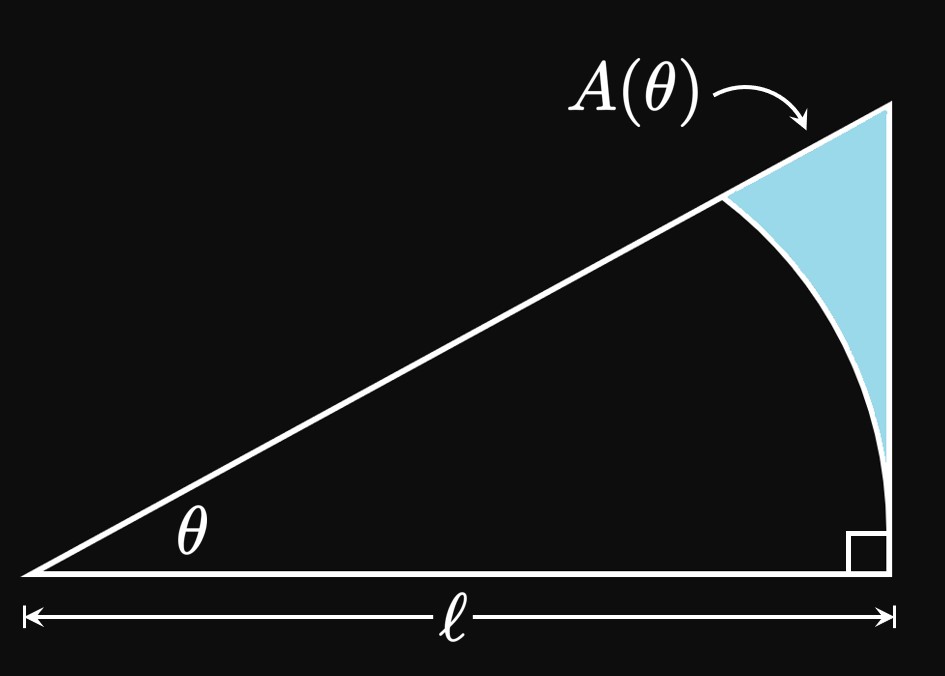
A circular sector that subtends an angle \(\theta\)
is inscribed in a right triangle whose base has length \(\ell,\)
as shown in Figure 1.
Let \(A(\theta)\) be the area of the region bounded between the sector and right triangle.
Determine an expression for \(A(\theta)\)
in terms of \(\ell\) and \(\theta.\)
Identify the domain of \(A(\theta).\)
Find and interpret \(\lim_{\theta \to (\pi/2)^-} A(\theta).\)
SOLUTION
We find the area by subtracting the area of the sector from the area of the triangle.
The triangle's length is \(\ell,\) so its height is \(\ell \tan \theta.\)
Thus, its area is \(1/2 \times \text{length} \times \text{height},\) or
\[\tfrac{1}{2} \ell (\ell \tan \theta) = \tfrac{1}{2} \ell^2 \tan \theta \pd\]
In addition, the area of the sector is
\[\tfrac{1}{2} \theta \ell^2 \pd\]
Thus, the difference of these values is
\[A(\theta) = \tfrac{1}{2} \ell^2 \tan \theta - \tfrac{1}{2} \theta \ell^2
= \boxed{\tfrac{1}{2} \ell^2 (\tan \theta - \theta)}\]
The angle \(\theta\) can only range between \(0\) and \(90 \degree\) (or \(\pi/2\) radians).
The value \(0\) is acceptable because \(A(\theta) = 0,\) a finite value.
But \(\pi/2\) is unacceptable because \(A(\pi/2)\) is undefined,
so the domain is \(\boxed{[0, \pi/2)}.\)
The factor \((\tan \theta - \theta)\) approaches \(\infty\) as \(\theta \to (\pi/2)^-.\)
Thus, \(\lim_{\theta \to (\pi/2)^-} A(\theta) = \boxed{\infty}.\)
As \(\theta\) is increased to \(\pi/2\) radians, the region enclosed by the right triangle
and inscribed sector becomes infinite.
EXERCISE 8
Evaluate the following limit if it exists:
\[\lim_{x \to \infty} \par{x - \sqrt{x^2 + 4x}} \pd\]
SOLUTION
It would be wrong to deduce any numerical result from the indeterminate expression \(\infty - \infty.\)
To resolve this limit, one resource is to multiply by the conjugate—namely, \(\par{x + \sqrt{x^2 + 4x}}.\)
Doing so shows
\[
\ba
\lim_{x \to \infty} \par{x - \sqrt{x^2 + 4x}} &= \lim_{x \to \infty} \par{x - \sqrt{x^2 + 4x}} \cdot \frac{x + \sqrt{x^2 + 4x}}{x + \sqrt{x^2 + 4x}} \nl
&= \lim_{x \to \infty} \frac{x^2 - \par{x^2 + 4x}}{x + \sqrt{x^2 + 4x}} \nl
&= \lim_{x \to \infty} \frac{-4x}{x + \sqrt{x^2 + 4x}} \pd
\ea
\]
The limit is still in the indeterminate form \(\indInfty.\)
Yet dividing each term by \(\sqrt{x^2} = \abs x = x\) (since \(x \gt 0\)) shows
\[
\ba
\lim_{x \to \infty} \frac{-4x}{x + \sqrt{x^2 + 4x}} \cdot \frac{1/x}{1/x}
&= \lim_{x \to \infty} \frac{-4}{1 + \sqrt{\dfrac{x^2 + 4x}{x^2}}} \nl
&= \lim_{x \to \infty} \frac{-4}{1 + \sqrt{1 + 4/x}} \nl
&= \frac{-4}{1 + \sqrt{1 + 0}} \nl
&= \boxed{-2}
\ea
\]
EXERCISE 9
For the family of functions \(f(x) = Ce^{-Ax} \cos[g(x)],\)
where \(A\) and \(C\) are constants with \(A \gt 0,\) find \(\lim_{x \to \infty} f(x).\)
Assume that \(g\) is defined on \([N, \infty)\) for any real number \(N.\)
SOLUTION
The range of cosine is \([-1, 1],\)
so we must have
\[-1 \leq \cos[g(x)] \leq 1\]
for any function \(g.\)
Also note that \(- \abs C \leq C \leq \abs C,\)
so
\[- \abs C e^{-Ax} \leq C e^{-Ax} \cos [g(x)] \leq \abs C e^{-Ax} \pd\]
Note that
\[\lim_{x \to \infty} \par{- \abs C e^{-Ax}} = \lim_{x \to \infty} \par{\abs C e^{-Ax}} = 0 \pd\]
By the Squeeze Theorem, it also follows that \(\lim_{x \to \infty} f(x) = 0.\)
EXERCISE 10
Construct a proof for \(\lim_{x \to 2} x^3 = 8.\)
SOLUTION
Let \(\varepsilon \gt 0\) be any number.
We want to find a number \(\delta \gt 0\) such that
\[
\abs{\par{x^3} - 8} \lt \varepsilon \if 0 \lt \abs{x - 2} \lt \delta \pd
\]
In the first inequality, we have a difference of cubes.
We therefore factor it as follows:
\[\abs{x^3 - 8} = \abs{x - 2} \abs{x^2 + 2x + 4} \lt \varepsilon \pd\]
To isolate the factor \(\abs{x - 2},\) let's compromise by
bounding it by a larger number.
Let \(C\) be a positive number such that
\(\abs{x^2 + 2x + 4}\) \(\lt C.\)
Because \(\abs{x - 2}\) is small, it is safe to assume \(0 \lt \abs{x - 2} \lt 1,\)
from which \(1 \lt x \lt 3,\) \(x \ne 2.\)
Accordingly, \(7 \lt x^2 + 2x + 4\) \(\lt 19\)
and so we let \(C = 19.\)
Thus, we have
\[
\ba
\abs{x^3 - 8} &= \abs{x - 2} \abs{x^2 + 2x + 4} \nl
&\lt 19 \abs{x - 2} \lt \varepsilon \nl
\implies \abs{x - 2} &\lt \frac{\varepsilon}{19} \pd
\ea
\]
Comparing this result to the inequality \(\abs{x - 2} \lt \delta,\)
we should select \(\delta = \varepsilon/19.\)
But we have two conditions:
\[\abs{x - 2} \lt 1 \and \abs{x - 2} \lt \frac{\varepsilon}{19} \pd\]
The only way to satisfy both inequalities is to make \(\delta\) be the smaller
of the two bounds—namely,
\[\delta = \min{1}{\frac{\varepsilon}{19}} \pd\]
\par
Constructing the Proof.
With \(\delta = \varepsilon/19\) we see, for \(0 \lt \abs {x - 2} \lt \delta,\)
\[\abs{\par{x^3} - 8} = \abs{x - 2} \abs{x^2 + 2x + 4}
\lt 19 \abs{x - 2} \lt 19 \delta = 19 \par{\frac{\varepsilon}{19}} = \varepsilon \pd\]
Accordingly, if \(1 \lt x \lt 3\) (except \(x = 2\)), then
\[
\abs{\par{x^3} - 8} \lt \varepsilon \if 0 \lt \abs{x - 2} \lt \frac{\varepsilon}{19} \pd
\]
This proves that \(\lim_{x \to 2} x^3 = 8.\)
(For larger intervals of \(x,\) we can increase \(C\) as needed.)
EXERCISE 11
Let \(a\) and \(c\) be real numbers such that \(2a - c \gt 1.\) Consider the limit
\[L = \lim_{x \to a} \sqrt{2x - c} \pd\]
Find \(L\) in terms of \(a\) and \(c.\)
Construct a proof for the limit statement in part (a).
SOLUTION
By the Root Law (or Direct Substitution),
\[L = \boxed{\sqrt{2a - c}}\]
The condition \(2a - c \gt 1\) ensures that \(2a - c\) is positive,
ensuring that the square root is defined.
For every number \(\varepsilon \gt 0,\) there exists a number \(\delta \gt 0\) such that
\[
\abs{\sqrt{2x - c} - L} \lt \varepsilon \if 0 \lt \abs{x - a} \lt \delta \cma
\]
that is,
\[\abs{\sqrt{2x - c} - \sqrt{2a - c}} \lt \varepsilon \if 0 \lt \abs{x - a} \lt \delta \pd\]
To simplify the first inequality,
it is a good idea to multiply the expression in absolute value bars by the conjugate: \(\sqrt{2x - c} + \sqrt{2a - c}.\)
Doing so shows
\[
\ba
\abs{\par{\sqrt{2x - c} - \sqrt{2a - c}} \cdot \frac{\sqrt{2x - c} + \sqrt{2a - c}}{\sqrt{2x - c} + \sqrt{2a - c}}}
&= \abs{\frac{(2x - c) - (2a - c)}{\sqrt{2x - c} + \sqrt{2a - c}}} \nl
&= \abs{\frac{2x - 2a}{\sqrt{2x - c} + \sqrt{2a - c}}} \nl
&= 2 \abs{\frac{x - a}{\sqrt{2x - c} + \sqrt{2a - c}}} \pd
\ea
\]
Because \(2a - c \gt 1,\) we also have \(\sqrt{2a - c} \gt 1.\)
Additionally, \(\sqrt{2x - c} \gt 0,\) so the denominator \(\sqrt{2x - c} + \sqrt{2a - c}\) must be greater than \(1.\)
We therefore see
\[2 \abs{\frac{x - a}{\sqrt{2x - c} + \sqrt{2a - c}}} \lt 2 \abs{x - a}\]
and thus
\[
\ba
2 \abs{\frac{x - a}{\sqrt{2x - c} + \sqrt{2a - c}}} \lt \varepsilon &\implies 2 \abs{x - a} \lt \varepsilon \nl
&\implies \abs{x - a} \lt \frac{\varepsilon}{2} \pd
\ea
\]
Comparing this inequality to \(\abs{x - a} \lt \delta,\) we can select \(\delta = \varepsilon/2.\)
Yet the same time, we must ensure that \(2x - c \geq 0\) for \(x\) close to \(a\) (to avoid negative values within the root).
In particular, we need
\begin{equation}
0 \lt \abs{x - a} \lt \delta \and x \geq \frac{c}{2} \pd \label{eq:root-proof-inequalities}
\end{equation}
The first inequality can be written as \(a - \delta \lt x \lt a + \delta,\)
which we compare to \(x \geq c/2.\)
Doing so enables us to select the condition \(a - \delta \geq c/2,\)
from which \(\delta \leq a - c/2.\)
Therefore, to ensure both inequalities in \(\eqref{eq:root-proof-inequalities}\) are satisfied,
we choose
\[\delta = \min{\frac{\varepsilon}{2}}{a - \frac{c}{2}} \pd\]