Online Textbook Practice Tests 1500 Calculus Problems Solved About

Chapter 2 Challenge Problems Solutions

EXERCISE 1
Figure 1
The central curve of the Gateway Arch in St. Louis, Missouri (Figure 1), was designed by the equation \[y = 211.49 - 20.96 \cosh 0.03291765x \cmaa \abs x \leq 91.20 \cma\] where \(x\) and \(y\) are measured in meters and \(y\) is the height above the ground.
  1. Calculate the maximum height of the central arch.
  2. At what points is the height \(80\) meters?
  3. Calculate the slope of the arch at the points in part (b).

SOLUTION
  1. The maximum height occurs when \(x = 0 \col\) \[ \ba y &= 211.49 - 20.96 \cosh 0 \nl &= 211.49 - 20.96 = \boxed{190.53 \un{m}} \ea \] (Note: The Gateway Arch's maximum height is \(192 \un{m},\) but the central arch is \(190.53 \un{m}\) tall.)

  2. Using a graphing calculator, we find the solutions of \[y = 211.49 - 20.96 \cosh 0.03291765x = 80\] to be \(x = \pm 76.647.\) Hence, the central curve is \(80 \un{m}\) tall at the points located \(76.647 \un{m}\) from the center.

  3. The derivative function is \[ \ba y' &= -20.96(0.03291765) \sinh 0.03291765x \nl &= -0.689953944 \sinh 0.03291765x \pd \ea \] So at \(x = \pm 76.747,\) the slopes are \[ \ba y'(\pm 76.647) &= -0.689953944 \sinh 0.03291765 (\pm 76.647) \nl &\approx \mp 4.273 \pd \ea \] So the slope at \((-76.747, 80)\) is approximately \(4.273,\) and the slope at \((76.747, 80)\) is approximately \(-4.273.\)
EXERCISE 2
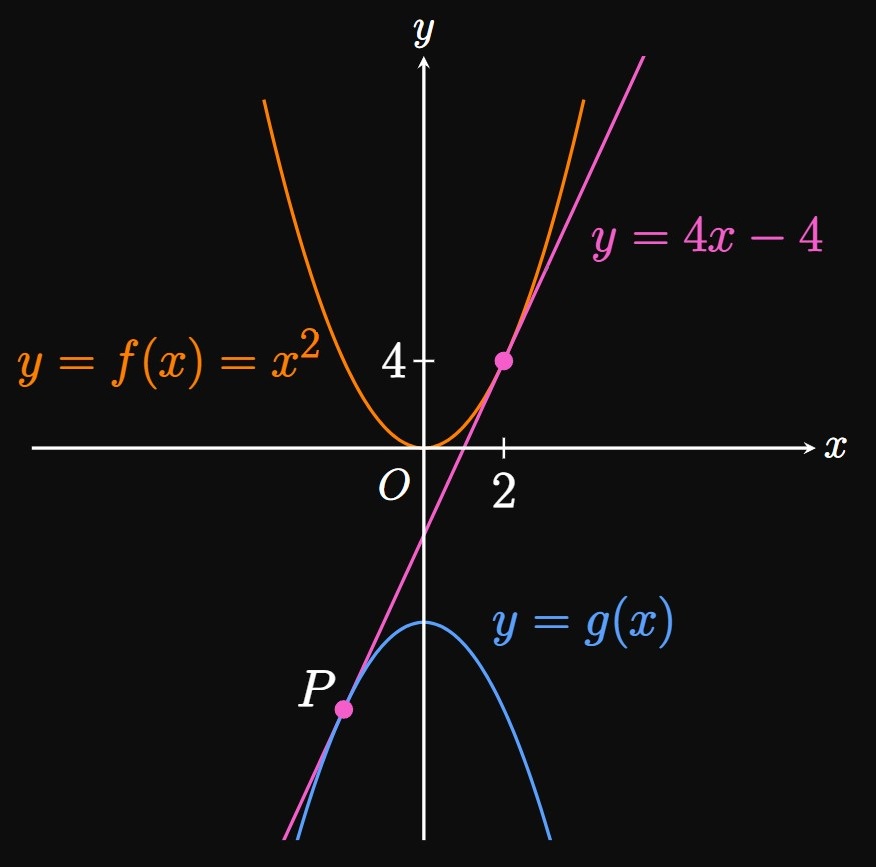
Let \(f(x) = x^2\) and \(g(x) = -x^2 - C.\) Find the value of \(C\) such that the line tangent to \(f\) at \(x = 2\) is also tangent to \(g.\)

SOLUTION
deriv-4x-4-tan.jpg
The word tangent means that the line intersects \(y = g(x)\) at \(x = a\) with slope \(g'(a).\) We anticipate that the tangent line to \(f\) at \(x = 2\) is also tangent to \(g\) in the third quadrant. So we are considering only one tangent line. We see \(f(2) = 4\) and \(f'(2) = 4,\) so an equation of this tangent line is \[y - 4 = 4(x - 2) \or y = 4x - 4 \pd\] This line has slope \(4\) and must be tangent to \(g(x) = -x^2 - C,\) whose derivative is \(g'(x) = -2x.\) Equating slopes shows \[-2x = 4 \implies x = -2 \pd\] Thus, the line \(y = 4x - 4\) is tangent to \(f\) at \(x = 2\) and tangent to \(g\) at \(x = -2.\) The word tangent means that this line also intersects \(g(x)\) at \(x = -2.\) When \(x = -2,\) the line's \(y\)-value is \[4(-2) - 4 = -12 \cma\] so \(g(-2) = -12.\) Thus, we see \[g(-2) = -(-2)^2 - C = -12 \implies \boxed{C = 8}\]
EXERCISE 3
Let \(f(x) = x^2 + C\) and \(T(x) = 6x - 5.\) Find the value of \(C\) such that \(T\) is the linearization of \(f\) at \(x = 3.\)

SOLUTION The line \(T(x)\) is the linearization of \(f(x)\) at \(x = 3\) if and only if \(T\) is tangent to \(f\) at \(3\)—that is, \(T(3) = f(3)\) and \(T'(3) = f'(3).\) Observe that \[f(3) = 9 + C \and T(3) = 13 \pd\] So we see \[9 + C = 13 \implies C = 4 \pd\] Also, \(f'(3) = T'(3) = 6.\) Thus, the graphs of \(f\) and \(T\) are tangent at \(x = 3\) for \(\boxed{C = 4}.\) You can view an interactive plot of \(f\) and \(T\) at https://www.desmos.com/calculator/4lpyxm3m1v?lang=en.
EXERCISE 4
At some \(x,\) suppose that the slope of the tangent to \(f(x)\) equals the slope of the tangent to \(1/f(x),\) where \(f(x) \ne 0.\) What is this slope?

SOLUTION The derivative of the reciprocal function is \[\deriv{}{x} \par{\frac{1}{f(x)}} = -\frac{f'(x)}{[f(x)]^2} \pd\] If the slope to \(f\) equals the slope to \(1/f,\) then their derivatives are equal: \[f'(x) = -\frac{f'(x)}{[f(x)]^2} \pd\] The only solution to this equation is \(f'(x) = 0.\) If we disregard this solution and instead cancel the \(f'(x)\)'s on both sides, then we get \[ \ba 1 &= -\frac{1}{[f(x)]^2} \nl [f(x)]^2 &= -1 \cma \ea \] which has no real solutions. Hence, the only possible value of the slope is \(\boxed{0}.\)
EXERCISE 5
If \(f\) is differentiable at \(a,\) then calculate the following limit in terms of \(f'(a) \col\) \[\lim_{x \to a} \frac{f(x) - f(a)}{\sqrt x - \sqrt a} \pd\]

SOLUTION Observe that the limit definition of \(f'(a)\) is \[f'(a) = \lim_{x \to a} \frac{f(x) - f(a)}{x - a} \pd\] Let's multiply the numerator and denominator of the given limit by \((\sqrt x + \sqrt a);\) doing so shows \[ \ba \lim_{x \to a} \frac{f(x) - f(a)}{\sqrt x - \sqrt a} &= \lim_{x \to a} \frac{f(x) - f(a)}{\sqrt x - \sqrt a} \frac{\par{\sqrt x + \sqrt a}}{\par{\sqrt x + \sqrt a}} \nl &= \lim_{x \to a} \frac{f(x) - f(a)}{x - a} \par{\sqrt x + \sqrt a} \nl &= f'(a) \lim_{x \to a} \par{\sqrt x + \sqrt a} \nl &= \boxed{2 f'(a) \sqrt a} \ea \]
EXERCISE 6
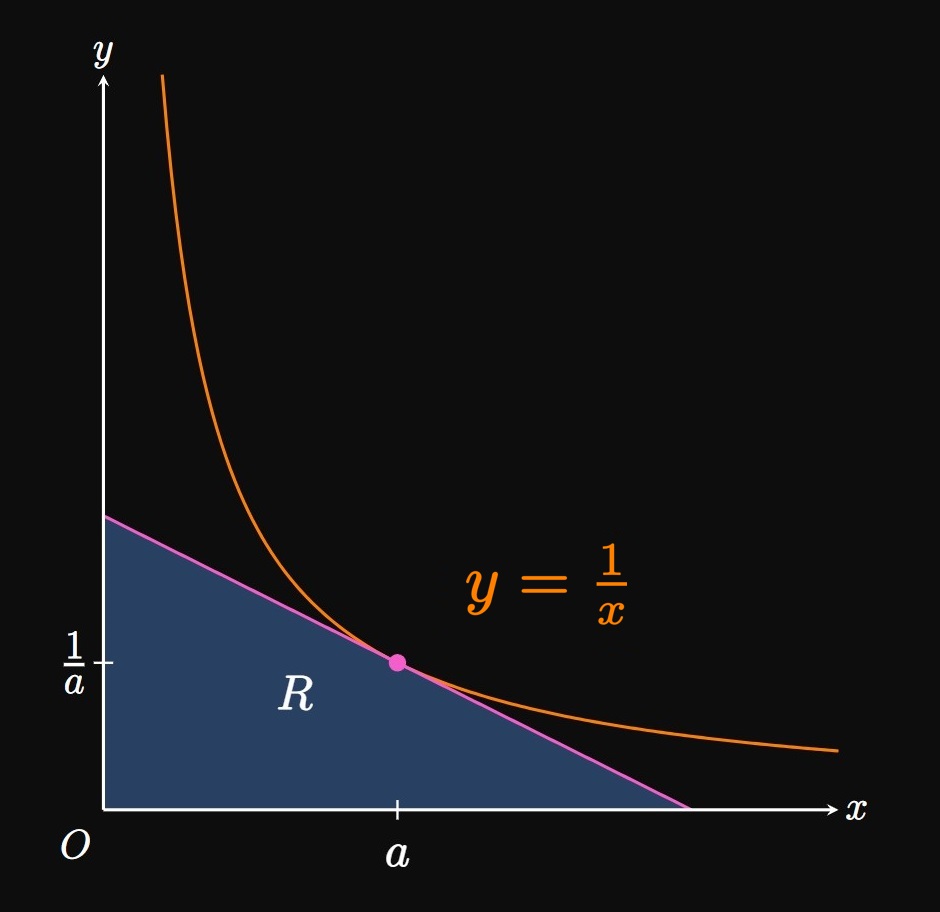
Let \(R\) be the region in the first quadrant bounded between the coordinate axes and the line tangent to the curve \(y = 1/x\) at any point \((a, 1/a).\) Does the area of \(R\) depend on \(a \ques\)

SOLUTION
deriv-1x-R.jpg
Region \(R\) is a triangle whose hypotenuse is the tangent line. The derivative of \(1/x\) is, by the Power Rule, \[-x^{-2} = -\frac{1}{x^2} \pd\] Thus, the slope to the curve \(1/x\) at \(x = a\) is \(-1/a^2.\) The point of tangency is \((a, 1/a),\) so an equation of the tangent line is \[y - \frac{1}{a} = -\frac{1}{a^2}(x - a) \or y = -\frac{x}{a^2} + \frac{2}{a} \pd\] To find the triangle's base \(b,\) we set \(y = 0 \col\) \[0 = -\frac{b}{a^2} + \frac{2}{a} \implies b = 2a \pd\] The triangle's height \(h\) is found by letting \(x = 0 \col\) \[h = -\frac{0}{a^2} + \frac{2}{a} \implies h = \frac{2}{a} \pd\] Hence, the triangle's area is \[\tfrac{1}{2} bh = \tfrac{1}{2}(2a) \par{\tfrac{2}{a}} = \boxed{2}\] Surprisingly, the area does not depend on \(a \exclam\)
EXERCISE 7
Find the value of \[\lim_{x \to \pi/2} \frac{e^{\cos x} - 1}{x - \dfrac{\strut \pi}{2}} \pd\]

SOLUTION Note that \(e^{\cos(\pi/2)}\) \(= e^0\) \(= 1.\) So the limit is \[\lim_{x \to \pi/2} \frac{e^{\cos x} - e^{\cos(\pi/2)}}{x - \dfrac{\strut \pi}{2}} \pd\] This is the limit definition of the derivative of \(e^{\cos x}\) at \(x = \pi/2.\) Hence, the limit equals \[ \ba \deriv{}{x} \par{e^{\cos x}} \intEval_{x = \pi/2} &= \par{- e^{\cos x} \sin x} \intEval_{x = \pi/2} \nl &= \boxed{-1} \ea \]
EXERCISE 8
For any real number \(c,\) use the limit definition of a derivative to prove that \[\deriv{}{x} \sin(x + c) = \cos(x + c) \pd\]

SOLUTION By the limit definition of a derivative, \[\deriv{}{x} \sin(x + c) = \lim_{h \to 0} \frac{\sin(x + c + h) - \sin(x + c)}{h} \pd\] We now use the addition identity for sine, treating \((x + c)\) as one term. Doing so gives \[ \ba \deriv{}{x} \sin(x + c) &= \lim_{h \to 0} \frac{\sin(x + c) \cos h + \cos(x + c) \sin h - \sin(x + c)}{h} \nl &= \lim_{h \to 0} \frac{\sin(x + c) (\cos h - 1)}{h} + \lim_{h \to 0} \frac{\sin h \cos(x + c)}{h} \nl &= \sin(x + c) \lim_{h \to 0} \frac{\cos h - 1}{h} + \cos(x + c) \lim_{h \to 0} \frac{\sin h}{h} \pd \ea \] Recall that as \(h \to 0,\) \((\cos h - 1)/h \to 0\) and \(\sin h/h \to 1.\) Thus, we see \[\deriv{}{x} \sin(x + c) = \sin(x + c) \cdot 0 + \cos(x + c) \cdot 1 = \cos(x + c) \cma\] as requested.
EXERCISE 9
For what value of \(C\) does the equation \(x^2 = C + \ln x\) have only one solution?

SOLUTION For the curves of \(f(x) = x^2\) and \(g(x) = C + \ln x\) to intersect once, they must be tangent at some point \(x = a.\) Recall that the word tangent means \(f(a) = g(a)\) and \(f'(a) = g'(a).\) Observe that \(f'(x) = 2x\) and \(g'(x) = 1/x.\) Equating the derivatives at \(a\) shows \[2a = \tfrac{1}{a} \implies a = \tfrac{1}{\sqrt 2} \pd\] Now we substitute this value into the equation \(x^2 = C + \ln x,\) seeing \[ \ba \par{\tfrac{1}{\sqrt 2}}^2 &= C + \ln \tfrac{1}{\sqrt 2} \nl \implies C &= \boxed{\tfrac{1}{2} - \ln \tfrac{1}{\sqrt 2}} \ea \]
EXERCISE 10
Determine the area of the triangle bounded between the \(y\)-axis, the tangent line to \(y = \ln x\) at \(x = e,\) and the normal line to \(y = \ln x\) at \(x = e.\)

SOLUTION The bounded region is a triangle of width \(e.\) To find its height, we must calculate the \(y\)-intercept of the normal line. Recall from Section 2.2 that a normal line is perpendicular to a tangent line. The derivative of \(\ln x\) is \(1/x,\) so the tangent to the curve at \(x = e\) has slope \(1/e.\) An equation of the tangent line is \[y - \ln e = \frac{1}{e} (x - e) \or y = \frac{x}{e} \pd\] The normal's slope is the negative reciprocal of \(1/e\)—that is, \(-e.\) An equation of the normal line is therefore \[y - \ln e = -e(x - e) \or y = 1 - e(x - e) \pd\] When \(x = 0\) we see \[y = 1 - e(0 - e) = 1 + e^2 \pd\] The \(y\)-intercept \((1 + e^2)\) is the height of the bounded triangle. Thus, its area is \[\tfrac{1}{2} (e)(1 + e^2) = \boxed{\tfrac{1}{2} (e + e^3)}\]
EXERCISE 11
Let \(k\) be any constant and \(n\) be a positive integer. Consider the function \(f(x) = \sin kx.\) Write an expression for \(f^{(n)}(x)\) when \(n\) is even and when \(n\) is odd. (Hint: The number \(-1\) becomes positive when raised to an even power and negative when raised to an odd power.)

SOLUTION Recall that \(f^{(n)}(x)\) represents the \(n\)th derivative of \(f(x).\) To find the \(n\)th derivative of \(f,\) we write out some derivatives to identify a pattern. The first four derivatives of \(f\) are as follows: \[ \ba f'(x) &= k \cos kx \nl f''(x) &= -k^2 \sin kx \nl f'''(x) &= -k^3 \cos kx \nl f^{(4)}(x) &= k^4 \sin kx \pd \ea \]

Even \(n\) The second derivative of \(f\) has a negative sign, but its fourth derivative has a positive sign. Likewise, \(n = 6\) features a negative sign and \(n = 8\) has a positive sign. The pattern for this sign alternation is represented by \[(-1)^{n/2} \pd\] Thus, we conclude that \[f^{(n)}(x) = \boxed{(-1)^{n/2} k^n \sin kx \cmaa n \textrm{ even}}\]

Odd \(n\) The first derivative of \(f\) has a positive sign, but its third derivative has a negative sign. If we kept repeating the pattern, then we would have a positive sign for \(n = 5\) and a negative sign for \(n = 7.\) The pattern for this sign alternation is represented by \[(-1)^{1 + (n + 1)/2} = (-1)^{(n - 1)/2} \pd\] Thus, we have \[f^{(n)}(x) = \boxed{(-1)^{(n - 1)/2} k^n \cos kx \cmaa n \textrm{ odd}}\]
EXERCISE 12
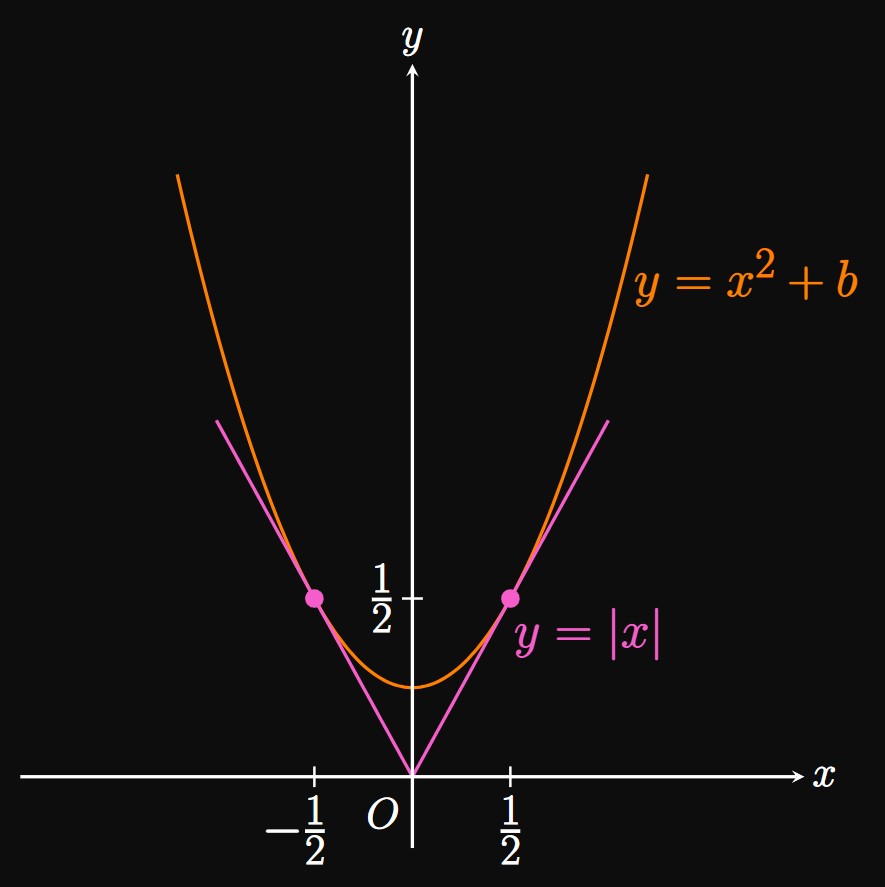
Find the value of \(b\) such that the parabola \(y = x^2 + b\) is tangent to \(y = \abs x.\)

SOLUTION
deriv-x2-b.jpg
The word tangent means that the graphs of \(y = x^2 + b\) and \(y = \abs x\) intersect each other with the same slope. The graph of \(\abs x\) has slope \(-1\) for \(x \lt 0\) and slope \(1\) for \(x \gt 0.\) The derivative function for the parabola is \[\deriv{}{x} \par{x^2 + b} = 2x \pd\] We equate this expression to \(1\) and \(-1\) to find \[ \baat{2} 2x &= 1 \lspace 2x &&= -1 \nl x &= \tfrac{1}{2} \scol \lspace x &&= -\tfrac{1}{2} \pd \eaat \] At each value of \(x,\) \(\abs x = 1/2.\) Thus, the parabola must also reach the \(y\)-value \(1/2\) when \(x = 1/2\) and \(x = -1/2 \col\) \[y = \par{\pm \tfrac{1}{2}}^2 + b = \tfrac{1}{2} \implies \boxed{b = \tfrac{1}{4}}\]
EXERCISE 13
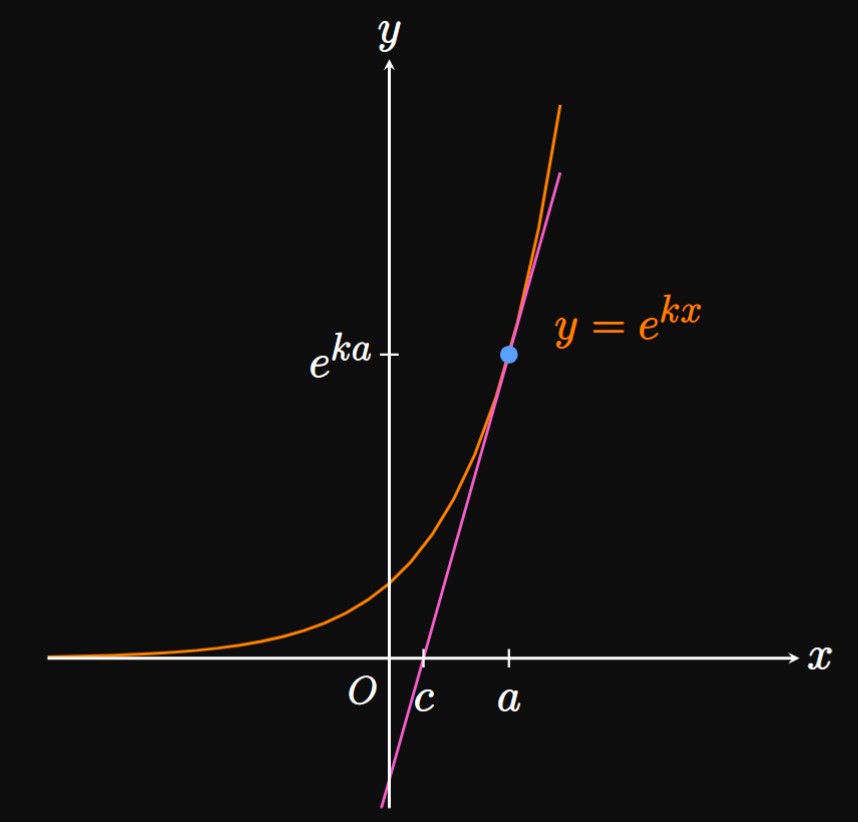
Let \(k\) be a positive constant. Line \(\ell\) is tangent to the curve \(f(x) = e^{kx}\) at \(x = a\) and strikes the \(x\)-axis at \((c, 0).\)
  1. Calculate \(\lim_{k \to \infty} c.\)
  2. Show that \(\lim_{k \to 0^+} c = -\infty.\) What does this result mean geometrically?
  3. Using differentials, approximate the amount by which \(c\) changes as \(k\) increases from \(2\) to \(2.1.\)
  4. With \(a\) held constant, the value of \(k\) increases at a constant rate of \(2\) units per minute. When \(k = 4,\) how quickly is \(c\) changing with time?
SOLUTION
diff-rules-challenge-e-tan.jpg
  1. We have \(f'(x) = ke^{kx}.\) So an equation of the line tangent to \(f\) at \((a, e^{ka})\) is \[y - e^{ka} = k e^{ka} (x - a) \pd\] This line has an \(x\)-intercept at \(x = c,\) so substituting \((c, 0)\) gives \[ \ba 0 - e^{ka} &= k e^{ka} (c - a) \nl \implies c &= a - \frac{1}{k} \pd \ea \] Then \[ \ba \lim_{k \to \infty} c &= \lim_{k \to \infty} \par{a - \frac{1}{k}} \nl &= \boxed a \ea \] This result is logical: as \(k\) increases, the curve \(f\) becomes steeper and so \(\ell\) becomes closer to the vertical line \(x = a.\)

  2. As \(k \to 0^+,\) \(1/k \to \infty.\) Accordingly, as requested, \[\underbrace{a - \frac{1}{k}}_{c} \to -\infty \as k \to 0^+ \pd\] Geometrically, \(k \to 0^+\) means the curve \(f(x) = e^{kx}\) becomes flatter, so line \(\ell\) becomes more horizontal. By making \(k\) arbitrarily close to \(0\) (with \(k \gt 0\)), the \(x\)-intercept of line \(\ell\) continually shifts to the left, away from the \(y\)-axis.

  3. Differentiating both sides of \(c = a - 1/k\) with respect to \(k,\) we get \[ \ba \deriv{c}{k} &= \frac{1}{k^2} \nl \implies \dd c &= \frac{1}{k^2} \di k \pd \ea \] Taking \(k = 2,\) \(\Delta c \approx \dd c,\) and \(\di k = \Delta k\) \(= 0.1,\) we have \[\Delta c \approx \frac{1}{(2)^2} (0.1) = \boxed{\frac{1}{40}}\]

  4. Differentiating both sides of \(c = a - 1/k\) with respect to time, and noting that \(a\) is constant, we get \[ \deriv{c}{t} = \frac{1}{k^2} \deriv{k}{t} \pd \] We are given \(\textderiv{k}{t} = 2\) and \(k = 4,\) which we substitute to get \[ \ba \deriv{c}{t} \intEval_{k = 4} = \frac{1}{4^2} (2) = \boxed{\frac{1}{8}} \ea \]
EXERCISE 14
Consider the family of functions \(f(x) = 1/(x^2 + 4x + k),\) where \(k\) is a constant.
  1. Show that \[f'(x) = \frac{-2x - 4}{\par{x^2 + 4x + k}^2} \pd\]
  2. If \(k = 4,\) then find the only vertical asymptote to the graph of \(y = f(x).\)
  3. For \(k \ne 4,\) determine the \(x\)-coordinate at which the graph of \(y = f(x)\) has a horizontal tangent.
  4. Determine and interpret \[\lim_{x \to -\infty} f'(x) \and \lim_{x \to \infty} f'(x) \pd\]
  5. Show that \(f\) has no vertical asymptotes if \(k \gt 4.\)

SOLUTION
  1. The Quotient Rule gives the derivative of \(f\) to be \[ \ba f'(x) &= \frac{(0) \par{x^2 + 4x + k} - 1(2x + 4)}{\par{x^2 + 4x + k}^2} \nl &= \frac{-2x - 4}{\par{x^2 + 4x + k}^2} \cma \ea \] as requested.

  2. If \(k = 4,\) then \(f\) becomes \[f(x) = \frac{1}{x^2 + 4x + 4} \pd\] The function \(f\) has a vertical asymptote when its denominator is \(0\) but its numerator is nonzero. So we equate the denominator to \(0\) to find \[ \ba x^2 + 4x + 4 &= 0 \nl (x + 2)^2 &= 0 \nl \implies x &= -2 \pd \ea \] Thus, the only vertical asymptote to the graph of \(f\) for \(k = 4\) is \(\boxed{x = -2}.\)

  3. The graph of \(f\) has a horizontal tangent at some \(x\) if and only if \(f'(x) = 0.\) We see \[f'(x) = \frac{-2x - 4}{\par{x^2 + 4x + k}^2} = 0 \implies \boxed{x = -2}\] Thus, the family of graphs \(f(x) = 1/(x^2 + 4x + k)\) has a horizontal tangent at \(x = -2\) if \(k \ne 4,\) but has a vertical asymptote if \(k = 4.\)

  4. Observe that the denominator of \(f'\) has a higher degree than the numerator of \(f'.\) Hence, the denominator grows faster than the numerator as \(x \to \infty\) or \(x \to -\infty,\) pushing the value of \(f'\) toward \(0.\) Accordingly, \[\lim_{x \to -\infty} f'(x) = 0 \and \lim_{x \to \infty} f'(x) = 0 \pd\] These limits tell us that the slope to \(f\) approaches \(0\) as \(x \to \infty\) or \(x \to -\infty.\) The graph of \(f\) has one horizontal asymptote, \(y = 0,\) so the slope approaching \(0\) is expected as \(x\) approaches infinity or negative infinity.

  5. The graph of \(f(x) = 1/(x^2 + 4x + k)\) has no vertical asymptotes if and only if the quadratic equation \(x^2 + 4x + k = 0\) has no real solutions. The discriminant of the quadratic is \[(4)^2 - 4(1)(k) = 16 - 4k \pd\] (See Section 0.7 to review how the discriminant shows how many real zeros a quadratic has.) If the quadratic equation has no real solutions, then the discriminant must be negative: \[16 - 4k \lt 0 \implies k \gt 4 \pd\] Thus, \(f(x) = 1/(x^2 + 4x + k)\) has no vertical asymptotes for \(k \gt 4\) because its denominator is never \(0.\)

You can view the graph of \(f\) at https://www.desmos.com/calculator/lbzuhjdpo9?lang=en.
EXERCISE 15
Is there a value of \(x\) at which the tangent lines to the graphs of \(f(x) = \tfrac{1}{4} x^4 + 12x,\) \(g(x) = x^3 + 2x^2,\) and \(h(x) = 2x^2 + 27x + 2\) are all parallel to each other? If so, then find this value of \(x.\)

SOLUTION The functions' derivatives are, respectively, \[ \ba f'(x) &= x^3 + 12 \cma \nl g'(x) &= 3x^2 + 4x \cma \nl h'(x) &= 4x + 27 \pd \ea \] The tangents to all three graphs are parallel if and only if they have the same slope, namely, \(f' = g' = h'.\) There are three cases we need to satisfy: \(f' = g',\) \(f' = h',\) and \(g' = h'.\)
  1. Solving \(f' = g',\) we see \[ \ba x^3 + 12 &= 3x^2 + 4x \nl x^3 - 3x^2 - 4x + 12 &= 0 \nl x^2 (x - 3) - 4(x - 3) &= 0 \nl (x - 3) (x^2 - 4) &= 0 \nl \implies x &= -2 \cma x = 2 \cma x = 3 \pd \ea \]
  2. Equating \(f' = h',\) we see \[ \ba x^3 + 12 &= 4x + 27 \nl x^3 - 4x - 15 &= 0 \pd \ea \] Out of all the solutions from the first case—that is, \(x = -2,\) \(x = 2,\) and \(x = 3\)—only \(x = 3\) solves this equation.
  3. We solve \(g' = h',\) as follows: \[ \ba 3x^2 + 4x &= 4x + 27 \nl x^2 &= 9 \nl \implies x &= -3 \cma x = 3 \pd \ea \]
Hence, the only solution to \(f' = g' = h'\) is \(\boxed{x = 3}.\)
EXERCISE 16
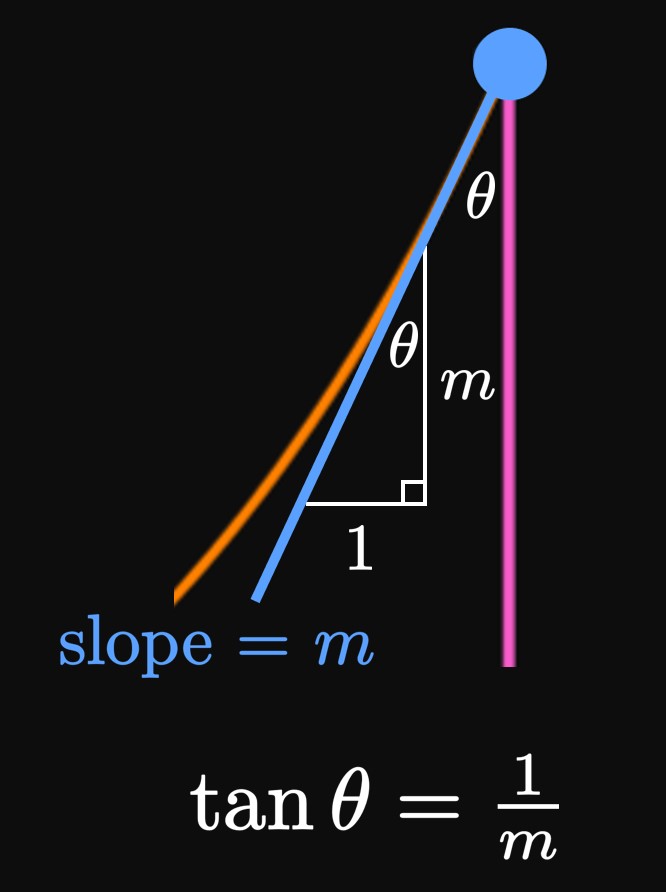
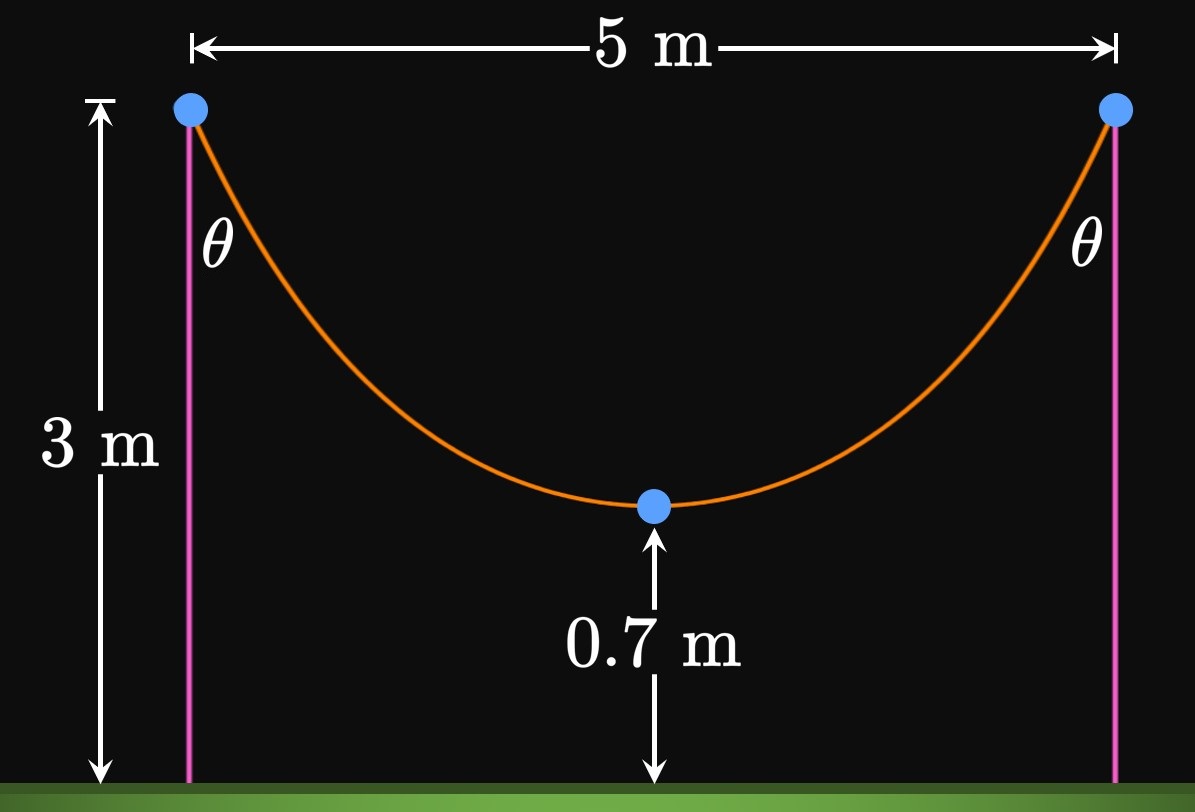
In Figure 2, with the aid of a graphing calculator, calculate the angle \(\theta\) between a support beam and the freely hanging cable.
Figure 2

SOLUTION
hanging-chain-ex-geom.jpg
Let's take the \(x\)-axis to be the ground and the \(y\)-axis to be the cable's axis of symmetry. Then the cable's shape is a catenary: \[f(x) = a \cosh \par{\frac{x}{a}} + c\] for any constants \(a\) and \(c.\) Our axis orientation provides the points \(f(0) = 0.7,\) \(f(-2.5) = 3,\) and \(f(2.5) = 3.\) Substituting \(f(0) = 0.7,\) we have \begin{align} f(0) = a \cosh 0 + c &= 0.7 \nonum \nl a + c &= 0.7 \pd \label{eq:chain-theta-1} \end{align} Likewise, substituting \(f(2.5) = 3\) gives \begin{equation} a \cosh \par{\frac{2.5}{a}} + c = 3 \pd \label{eq:chain-theta-2} \end{equation} From \(\eqref{eq:chain-theta-1},\) \(c = 0.7 - a;\) substituting this expression into \(\eqref{eq:chain-theta-2}\) gives \[a \cosh \par{\frac{2.5}{a}} + 0.7 - a = 3 \pd\] By graphing, we find \(a = 1.642;\) then \(c = 0.7 - 1.642\) \(= -0.942.\) So the shape of the hanging cable is \[f(x) = 1.642 \cosh \par{\frac{x}{1.642}} - 0.942 \pd\] The slope of the tangent to the cable at the right end is \[f'(2.5) \approx 2.183 \pd\] By similar triangles (see the figure), the angle is \[\theta = \atan \par{\frac{1}{2.183}} \approx 0.430 = \boxed{24.6 \degree}\]
EXERCISE 17
A circle of radius \(r\) is centered at point \(C\) on the \(y\)-axis and is inscribed in the triangle formed by the graph of \(y = \abs x\) and the horizontal line \(\ell,\) as shown in Figure 3. In terms of \(r,\) calculate the area of \(\Delta OPQ.\)
Figure 3

SOLUTION The problem becomes trivial if the identity of line \(\ell\) is known; this is our objective. First let's express the coordinates of point \(C(0, y_C)\) in terms of \(r.\) Note that point \(R\) is a point of tangency, so at \(R\) the graph \(y = \abs x\) and the circle share the same slope, \(1.\) Accordingly, an equation of the normal line (see Section 2.2) at \(R\) is \[y - y_C = -\frac{1}{1} (x - 0) \or y = y_C - x \pd\] The circle and \(y = \abs x\) also have the same \(y\)-coordinate at \(R,\) so we see \[y_C - x = x \implies x = \tfrac{1}{2} y_C \pd\] Hence, the coordinates of \(R\) are \(\par{\tfrac{1}{2} y_C, \tfrac{1}{2} y_C}.\) By the Distance Formula, we have \[ \ba r &= \length{CR} \nl &= \sqrt{\par{0 - \tfrac{1}{2} y_C}^2 + \par{y_C - \tfrac{1}{2} y_C}^2} \nl &= \frac{y_C}{\sqrt 2} \pd \ea \] It follows that \(y_C = r \sqrt 2.\) Hence, the identity of line \(\ell\) is \[ \ba y &= y_C + r \nl &= r \sqrt 2 + r \nl &= r (1 + \sqrt 2) \pd \ea \] Line \(\ell\) therefore intersects \(y = \abs x\) in the first quadrant at \(Q(r(1 + \sqrt 2), r(1 + \sqrt 2))\) and in the second quadrant at \(P(-r(1 + \sqrt 2), r(1 + \sqrt 2)).\) Therefore, \(\Delta OPQ\) has a width of \(2r(1 + \sqrt 2)\) and a height of \(r(1 + \sqrt 2).\) So its area is \[ \ba A &= \tfrac{1}{2} \parbr{2r(1 + \sqrt 2)} \parbr{r(1 + \sqrt 2)} \nl &= r^2 (1 + \sqrt 2)^2 \nl &= \boxed{r^2 \par{2 + 2 \sqrt 2 + 1}} \approx 5.828 r^2 \pd \ea \]
EXERCISE 18
The function \(f(x) = 1/x + \atan x\) is one-to-one for \(x \gt 0.\) Show that \[\lim_{x \to (\pi/2)^+} \par{\inv f}'(x) = -\infty \pd\]

SOLUTION Observe that \(f(x) \to (\pi/2)^+\) as \(x \to \infty.\) Consequently, \(\inv f(x) \to \infty\) as \(x \to (\pi/2)^+.\) We have \[ \baf &&f'(x) &= -\frac{1}{x^2} + \frac{1}{x^2 + 1} = -\frac{1}{x^4 + x^2} &\nl \laWord{and} &&\lim_{x \to (\pi/2)^+} \par{\inv f}'(x) &= \lim_{x \to (\pi/2)^+} \frac{1}{f' \par{\inv f(x)}} \pd \eaf \] To evaluate this limit, we substitute \(u = \inv f(x).\) Then \(u \to \infty\) as \(x \to (\pi/2)^+,\) so our limit becomes \[ \ba \lim_{u \to \infty} \frac{1}{f'(u)} &= \lim_{u \to \infty} \frac{1}{-\dfrac{1}{u^4 + u^2}} \nl &= \lim_{u \to \infty} - \par{u^4 + u^2} \nl &= -\infty \pd \ea \]