Over \(1 \leq x \leq 4,\) determine the average vertical distance between the graphs of \(y = \sqrt x\)
and \(y = x^2 + 3.\)
SOLUTION
Note that \(x^2 + 3 \gt \sqrt x\) for \(x \in [1, 4].\)
At any \(x,\) the distance between the graphs is their vertical difference:
\[d(x) = (x^2 + 3) - (\sqrt x) = x^2 + 3 - \sqrt x \pd\]
The average value of \(d(x)\) over \(1 \leq x \leq 4\) is
\[
\ba
\avg d &= \frac{1}{4 - 1} \int_1^4 \par{x^2 + 3 - \sqrt x} \di x \nl
&= \tfrac{1}{3} \par{\tfrac{1}{3} x^3 + 3x - \tfrac{2}{3} x^{3/2}} \intEval_1^4 \nl
&= \boxed{\tfrac{76}{9}}
\ea
\]
EXERCISE 2
Let \(A\) be the area of the region bounded
above by the line \(2x - y - 1 = 0,\)
below by the curve \(y = e^{3 \sin x} \cos x,\)
and on the sides by the lines \(x = 2\) and \(x = k,\)
where \(k \gt 2.\)
Express \(A\) as a function of \(k.\)
How quickly is \(A\) changing with respect to \(k \ques\)
What is unique about this result?
Suppose that \(k\) is increasing at a rate of \(2\) units per second.
How quickly is \(A\) increasing when \(k = 3 \ques\)
SOLUTION
The line is equivalent to the function \(y = 2x - 1.\)
With a top function of \(y = 2x - 1\) and a bottom function of \(y = e^{3 \sin x} \cos x,\)
the area between \(x = 2\) and \(x = k\) is
\[
\ba
A &= \int_2^k \parbr{(2x - 1) - e^{3 \sin x} \cos x} \di x \nl
&= \par{x^2 - x - \tfrac{1}{3} e^{3 \sin x}} \intEval_2^k \nl
&= \boxed{k^2 - k - \tfrac{1}{3} e^{3 \sin k} - 2 + \tfrac{1}{3} e^{3 \sin 2}}
\ea
\]
We have
\[
\ba
\deriv{A}{k} &= \deriv{}{k} \par{k^2 - k - \tfrac{1}{3} e^{3 \sin k} - 2 + \tfrac{1}{3} e^{3 \sin 2}} \nl
&= \boxed{2k - 1 - e^{3 \sin k} \cos k}
\ea
\]
This quantity is the vertical distance between the two graphs at \(x = k.\)
If \(t\) is time in seconds, then we are given
\(\textderiv{k}{t} = 2 \undiv{units}{sec},\)
and we need \(\textderiv{A}{t}.\)
By the process of Related Rates (Section 2.7),
\[
\ba
\deriv{A}{t} &= \deriv{A}{k} \deriv{k}{t} \nl
&= 2 \deriv{A}{k} \pd
\ea
\]
At \(k = 3,\)
\[\deriv{A}{k} \intEval_{k = 3} = 2(3) - 1 - e^{3 \sin 3} \cos 3 = 5 - e^{3 \sin 3} \cos 3 \pd\]
Thus,
\[
\ba
\deriv{A}{t} \intEval_{k = 3} &= 2 \par{5 - e^{3 \sin 3} \cos 3} \nl
&= \boxed{10 - 2 e^{3 \sin 3} \cos 3} \approx 13.024 \un{units}^2/\un{sec} \pd
\ea
\]
EXERCISE 3
Let \(R\) be the region bounded by the parabola \(y = x^2,\)
the \(x\)-axis, the \(y\)-axis, and the line \(x = k,\)
where \(k\) is a positive constant.
Let \(S\) be the solid whose base is region \(R\)
and whose cross sections perpendicular to the \(x\)-axis are squares.
Find the value of \(k\) for which the area of \(R\)
and the volume of \(S\) have equal magnitudes.
SOLUTION
The enclosed region \(R\) has area given by
\[A = \int_0^k x^2 \di x \pd\]
Conversely, the volume of the solid \(S\) has volume
\[V = \int_0^k \par{x^2}^2 \di x = \int_0^k x^4 \di x \pd\]
We equate \(A\) and \(V,\)
finding
\[
\ba
\int_0^k x^2 \di x &= \int_0^k x^4 \di x \nl
\tfrac{1}{3} k^3 &= \tfrac{1}{5} k^5 \nl
\implies k &= \boxed{\sqrt{\frac{5}{3}}} \approx 1.291 \pd
\ea
\]
EXERCISE 4
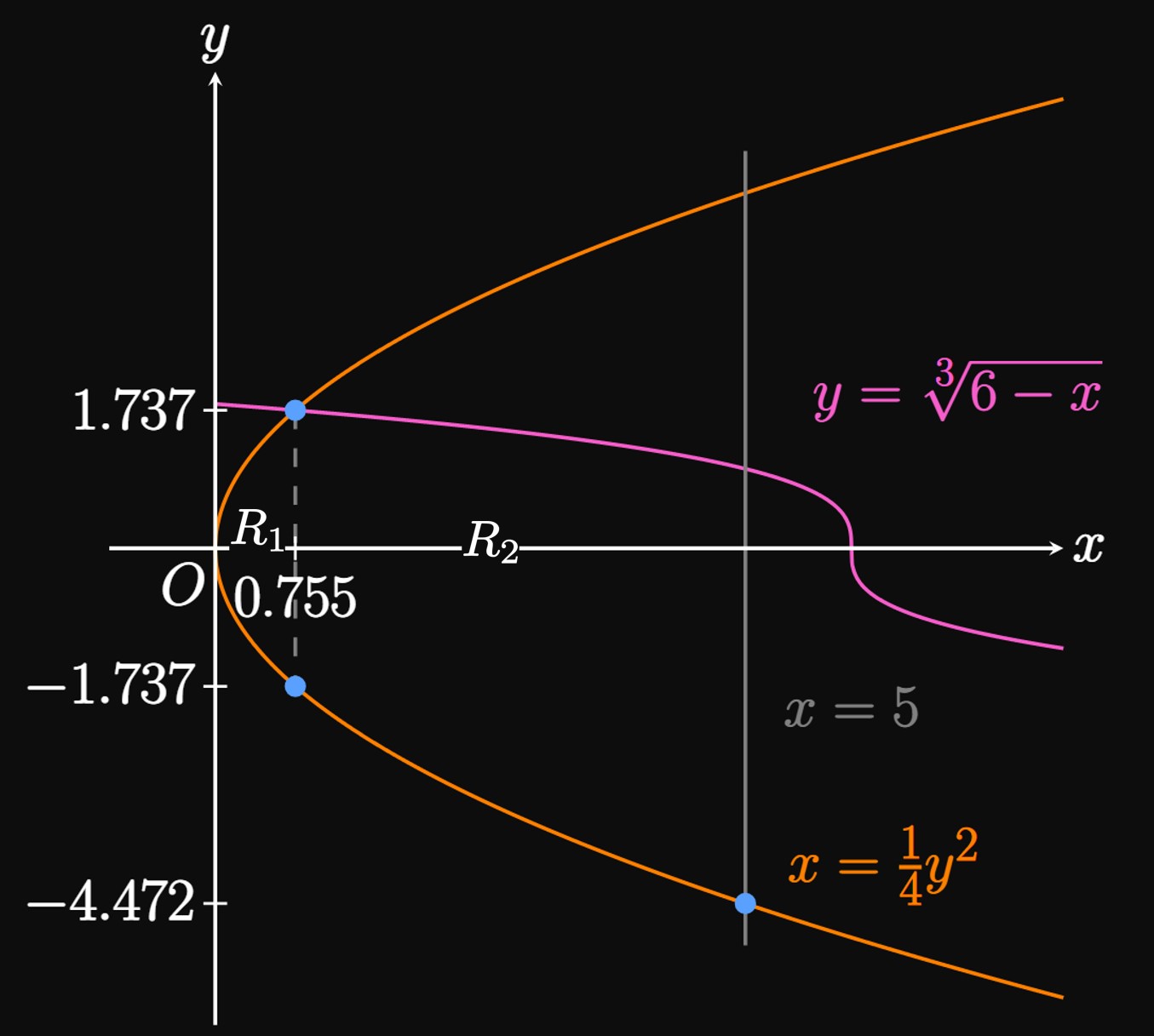
Using a graphing calculator, calculate the area of the region bounded above by \(y = \sqrt[3]{6 - x}\)
and on the sides by \(x = \tfrac{1}{4} y^2\) and \(x = 5.\)
SOLUTION
This problem requires creativity.
Because the boundary functions change throughout the
region, we must create subregions.
One method is to split the region into two subregions, \(R_1\) and \(R_2,\)
as in the figure.
Note that \(y = \sqrt[3]{6 - x}\) \(\iffArrow x = 6 - y^3\)
and \(x = \tfrac{1}{4} y^2\) \(\iffArrow y = \pm 2 \sqrt x.\)
The curves \(y = \sqrt[3]{6 - x}\) and \(x = \tfrac{1}{4}y^2\)
intersect at \((0.755, 1.737).\)
By integrating with \(y,\)
the area of \(R_1\)–bounded between \(x = \tfrac{1}{4} y^2\) and \(x = 0.755\)—is
\[
\ba
A_1 &= \int_{-1.737}^{1.737} \par{0.755 - \tfrac{1}{4} y^2} \di y \nl
&\approx 1.749 \pd
\ea
\]
Equivalently, \(A_1\) may also be calculated by integrating with \(x \col\)
\[
\ba
A_1 &= \int_0^{0.755} \parbr{2 \sqrt x - (-2 \sqrt x)} \di x \nl
&\approx 1.749 \pd
\ea
\]
Then by integrating with \(x,\) the area of \(R_2\)—bounded
between \(y = \sqrt[3]{6 - x},\) \(y = - 2 \sqrt x,\) \(x = 0.755,\)
and \(x = 5\)—is
\[
\ba
A_2 &= \int_{0.755}^5 \parbr{\sqrt[3]{6 - x} - (-2 \sqrt x)} \di x \nl
&\approx 20.117 \pd
\ea
\]
The total area is therefore
\[A_1 + A_2 \approx \boxed{21.866}\]
EXERCISE 5
The edge of a bowl is a parabola.
The top of the bowl is a circle of diameter \(8\) inches,
and its height is \(6\) inches.
Soup is poured into the bowl to reach a liquid level of \(2\) inches
above the base.
Calculate the volume of soup added.
SOLUTION
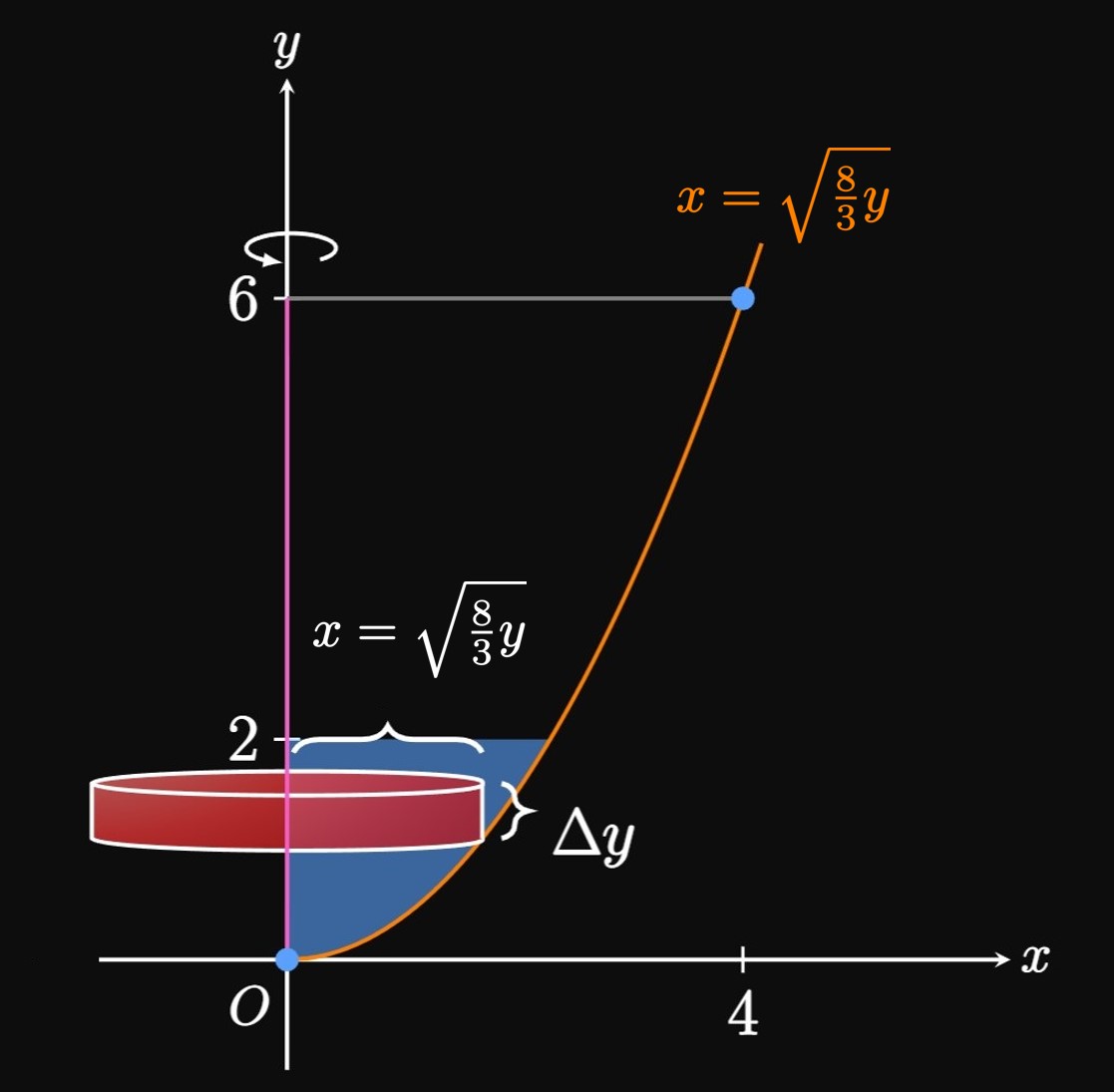
Imagine placing the bowl such that the \(y\)-axis is the central axis.
Then we model its edge using a parabola \(y = ax^2;\)
rotating this parabola about the \(y\)-axis generates the shape of the bowl.
Since the bowl's top has a diameter of \(8\) inches,
its radius is \(4\) inches.
And since the bowl is \(6\) inches tall,
the parabola passes through the point \((4, 6).\)
Substituting this point and solving for \(a\) show
\[6 = a(4)^2 \implies a = \tfrac{3}{8} \pd\]
Since we rotate about the \(y\)-axis, we want to express
all quantities in terms of \(y,\)
so we rewrite \(y = \tfrac{3}{8} x^2\) as \(x = \sqrt{\tfrac{8}{3} y}.\)
The soup level is \(2\) inches, so we calculate the volume of the solid of revolution
from \(y = 0\) to \(y = 2 \col\)
\[
\ba
V &= \pi \int_0^2 \par{\sqrt{\tfrac{8}{3} y}}^2 \di y \nl
&= \frac{4 \pi}{3} \par{y^2} \intEval_0^2 \nl
&= \boxed{\frac{16 \pi}{3}} \approx 16.755 \un{in}^3 \pd
\ea
\]
EXERCISE 6
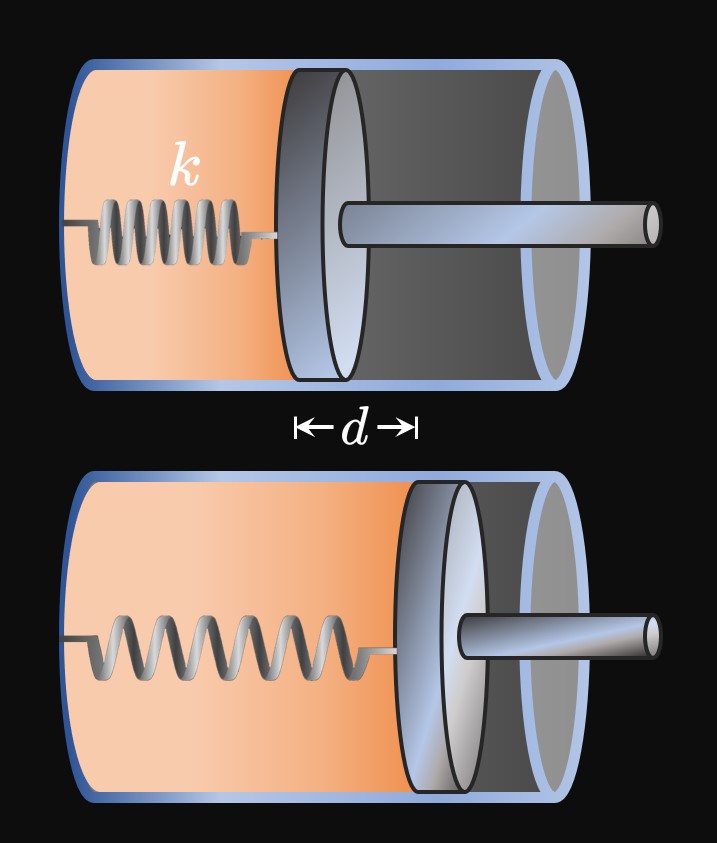
A container of gas with a volume of \(3\) cubic feet and a pressure of \(12\) pounds per square foot is sealed by a piston.
A spring whose stiffness is \(k = 150\) pounds per foot is attached to both the container and the piston;
the spring is initially in equilibrium.
(See Figure 1.)
The gas's volume then expands to \(5\) cubic feet.
Calculate the distance \(d\) the spring stretches.
SOLUTION
Using Boyle's Law with \(V = 3 \un{ft}^3\) and \(P = 12 \un{lb/ft}^2,\) we attain
\[12 = \frac{C}{3} \implies C = 36 \pd\]
The work done by the gas is therefore
\[W = \int_3^5 \frac{36}{V} \di V = 36 \ln \abs V \intEval_3^5 = 36 \ln \par{\frac{5}{3}} \pd\]
This quantity is the amount of energy the gas uses to push out the piston;
it therefore equals the work done in stretching the spring by a distance \(d.\)
We express the work done in stretching the spring as
\[\int_0^d 150 x \di x = 75 x^2 \intEval_0^d = 75 d^2 \pd\]
Accordingly, we see
\[75 d^2 = 36 \ln \par{\frac{5}{3}} \implies d = \sqrt{\frac{36}{75} \ln \par{\frac{5}{3}}} \approx \boxed{0.495 \un{ft}}\]
(Of course, the negative solution for \(d\) does not make sense in this context.)
EXERCISE 7
A line passing through the origin divides the region between the curve \(y = x(2 - x)\)
and the \(x\)-axis into two subregions of equal area.
Find the line's slope.
SOLUTION
Let the line passing through the origin be \(y = mx.\)
Then the line intersects the parabola \(y = x(2 - x)\) when \(mx = x(2 - x) \col\)
\[
\ba
mx &= 2x - x^2 \nl
x^2 &= x(2 - m) \nl
\implies x &= 0 \cma 2 - m \pd
\ea
\]
The area of the top subregion is then
\[
\ba
A_{\text{top}} &= \int_0^{2 - m} \parbr{x(2 - x) - mx} \di x \nl
&= \int_0^{2 - m} \parbr{-x^2 + x(2 - m)} \di x \nl
&= \parbr{-\tfrac{1}{3} x^3 + \tfrac{1}{2} x^2 (2 - m)} \intEval_0^{2 - m} \nl
&= -\tfrac{1}{3} (2 - m)^3 + \tfrac{1}{2} (2 - m)^2 (2 - m) - 0 \nl
&= \tfrac{1}{6} (2 - m)^3 \pd
\ea
\]
In addition, the total area of the region bounded by the parabola is
\[
\ba
A &= \int_0^2 x (2 - x) \di x \nl
&= \int_0^2 \par{2x - x^2} \di x \nl
&= \par{x^2 - \tfrac{1}{3} x^3} \intEval_0^2 \nl
&= \tfrac{4}{3} \pd
\ea
\]
The top subregion has half the area bounded by the parabola; thus,
\[
\ba
A_{\text{top}} &= \tfrac{1}{2} A \nl
\tfrac{1}{6} (2 - m)^3 &= \tfrac{2}{3} \nl
(2 - m)^3 &= 4 \nl
\implies m &= \boxed{2 - \sqrt[3] 4} \approx 0.413 \pd
\ea
\]
EXERCISE 8
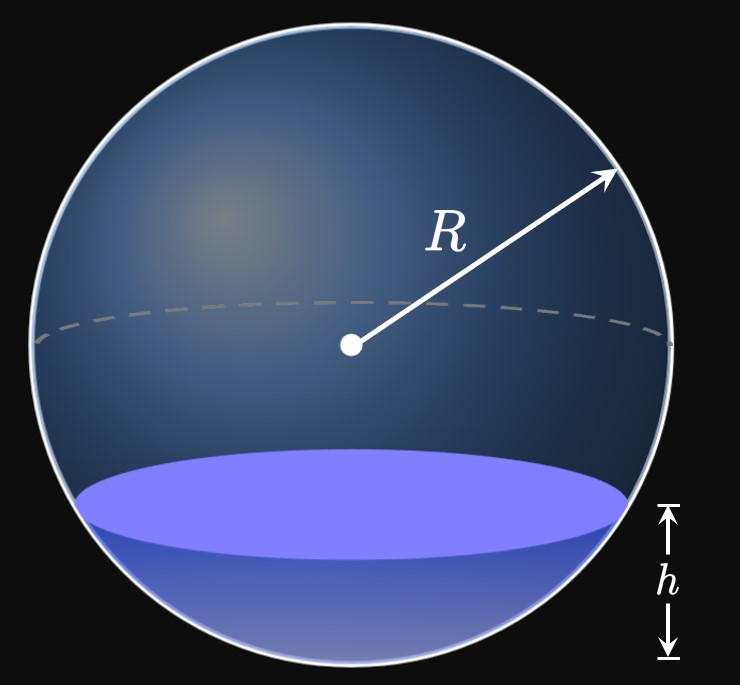
In a sphere of radius \(R,\)
find the volume of the bottom cap of height \(h\)
(Figure 2).
SOLUTION
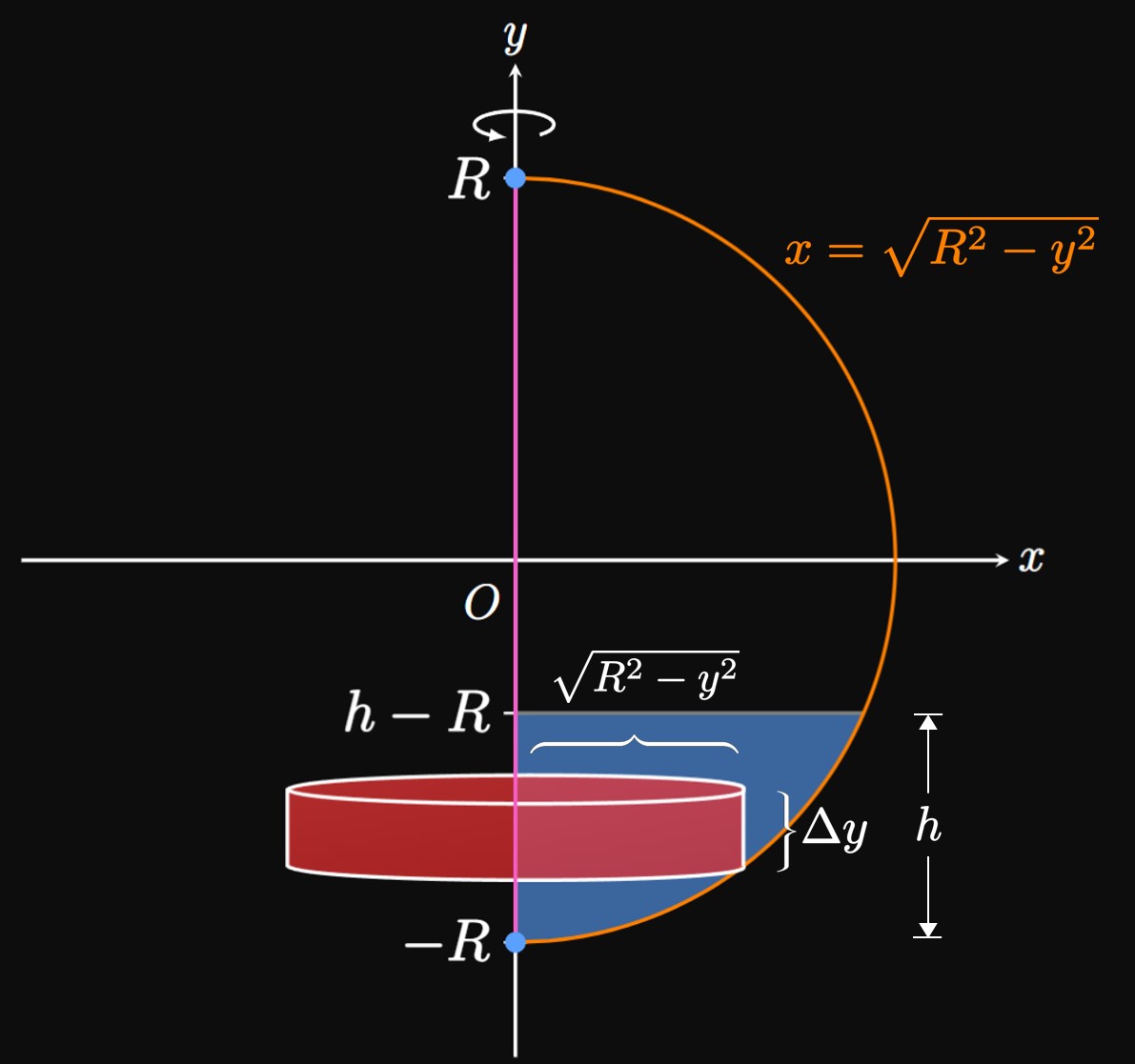
A sphere can be obtained by rotating a semicircle about a central axis.
Since the equation of a circle of radius \(R\) is \(x^2 + y^2 = R^2,\)
an equation of the right semicircle centered at the origin
is \(x = \sqrt{R^2 - y^2}.\)
We shade the region between this semicircle and the \(y\)-axis
from \(y = -R\) to \(y = -R + h.\)
Then we use the Disk Method to revolve this region around the \(y\)-axis;
in doing so, we attain the shape of the bottom cap.
Each disk at \(y\) has a radius of \(r(y) = \sqrt{R^2 - y^2}.\)
The volume of the bottom cap is therefore
\[
\ba
V &= \pi \int_{-R}^{h - R} [r(y)]^2 \di y = \pi \int_{-R}^{h - R} \par{R^2 - y^2} \di y \nl
&= \pi \par{R^2 y - \tfrac{1}{3} y^3} \intEval_{-R}^{h - R} \nl
&= \pi \parbr{R^2 (h - R) - \tfrac{1}{3} \par{h - R}^3} + \pi \par{R^3 - \tfrac{1}{3} R^3} \nl
&= \pi \par{R^2 h - R^3 - \tfrac{1}{3} h^3 + h^2 R - R^2h + \tfrac{1}{3} R^3 + R^3 - \tfrac{1}{3} R^3} \nl
&= \boxed{\pi \par{h^2 R - \tfrac{1}{3} h^3}}
\ea
\]
EXERCISE 9
Consider the family of functions
\[f(x) = \frac{1}{(kx)^2 + 1} \cma\]
where \(k\) is a positive constant.
The region under the graph of \(y = f(x)\)
and above the \(x\)-axis
from \(x = 1\) to \(x = 2\) is the base of a solid whose cross sections perpendicular
to the \(x\)-axis are rectangles of uniform height \(k.\)
For what value of \(k\) is the solid's volume maximized?
SOLUTION
At each \(x,\) the cross section perpendicular to the \(x\)-axis
is a rectangle of base \(f(x)\)
and height \(k.\)
Its cross-sectional area is therefore
\[A(x) = k f(x) = \frac{k}{(kx)^2 + 1} \pd\]
The solid's volume is given by integrating this function from \(x = 1\)
to \(x = 2,\) as follows:
\[
\ba
V &= \int_1^2 \frac{k}{(kx)^2 + 1} \di x \nl
&= \atan kx \intEval_1^2 = \atan 2k - \atan k \pd
\ea
\]
(We mentally performed the substitution \(u = kx\) to attain this antiderivative.)
To calculate the value of \(k\) for which \(V\) is maximized,
we differentiate \(V\) with respect to \(k\) and locate its critical points.
(See Section 3.6
to review the process of optimization.)
Doing so, we set \(\textderiv{V}{k} = 0\)
and solve for \(k.\)
We find the derivative to be
\[
\ba
\deriv{V}{k} &= \frac{2}{(2k)^2 + 1} - \frac{1}{k^2 + 1} \nl
&= \frac{2k^2 + 2 - 4k^2 - 1}{\par{4k^2 + 1} \par{k^2 + 1}} \nl
&= \frac{-2k^2 + 1}{\par{4k^2 + 1} \par{k^2 + 1}} \pd
\ea
\]
So we see
\[\frac{-2k^2 + 1}{\par{4k^2 + 1} \par{k^2 + 1}} = 0 \implies -2k^2 + 1 = 0 \implies k = \frac{1}{\sqrt 2} \pd\]
This value corresponds to a relative maximum of \(V\)
because \(\textderiv{V}{k}\) changes
sign from positive to negative at \(k = 1/\sqrt 2.\)
Since \(V = 0\) when \(k = 0\)
and
\[\lim_{k \to \infty} V = \lim_{k \to \infty} \par{\atan 2k - \atan k} = \frac{\pi}{2} - \frac{\pi}{2} = 0 \cma\]
the relative maximum at \(k = 1/\sqrt 2\) must be the location of the absolute maximum
of \(V.\)
So the volume is maximized for \(\boxed{k = 1/\sqrt 2}.\)
EXERCISE 10
Positive and negative charges attract each other,
whereas charges with the same sign repel each other.
Coulomb's Law states that the electrostatic force
between two charged particles of charges \(q_1\) and \(q_2\) (measured in coulombs, \(\text C\))
separated by a distance \(r\)
is given by
\[F = \frac{k \abs{q_1 q_2}}{r^2} \cma\]
where \(k = 9.0 \times 10^9\) \(\un{N m}^2/\un{C}^2.\)
Figure 3
shows an arrangement of two charges fixed along the positive \(x\)-axis.
(Note: \(1 \muUnit C\) \(= 1 \times 10^{-6} \un C.\))
Calculate the work done by the electrostatic force to
move the \(20 \muUnit C\) charge to \(x = 3\)
move the \(-15 \muUnit C\) charge to \(x = 3\)
move the \(-15 \muUnit C\) charge to \(x = 1\)
SOLUTION
The two particles attract each other with an electrostatic force of
\[
F = \frac{\par{9.0 \times 10^9} \abs{\par{20 \times 10^{-6}} \par{-15 \times 10^{-6}}}}{r^2}
= \frac{2.7}{r^2} \pd
\]
The \(20 \muUnit C\) needs to be moved from \(x = 0\) to \(x = 3.\)
Since this positive particle is attracted to the negative particle,
the positive particle experiences a force acting to the right.
(We therefore give \(F\) a positive sign.)
The positive particle is initially located a distance of \(4 \un m\) left of the negative particle;
at \(x = 3,\) this distance becomes only \(1 \un m\) left.
So the work done by the electrostatic force is
\[
\ba
W &= \int_{-4}^{-1} \frac{2.7}{r^2} \di r
= -\frac{2.7}{r} \intEval_{-4}^{-1} \nl
&= 2.7 \par{\frac{1}{-4} - (-1)} = \boxed{2.025 \un J}
\ea
\]
The negative particle is attracted to the positive particle
and so experiences a force of \(F = 2.7/r^2\) to the left.
(The sign of \(F\) is therefore negative.)
Initially, the negative particle is \(4 \un m\) right of the positive particle;
after it is moved to \(x = 3,\) the negative particle is \(3 \un m\) right.
The work done is therefore
\[
\ba
W &= \int_4^3 -\frac{2.7}{r^2} \di r
= \frac{2.7}{r} \intEval_4^3 \nl
&= 2.7 \par{\frac{1}{3} - \frac{1}{4}} = \boxed{0.225 \un J}
\ea
\]
At \(x = 1,\) the negative particle is only \(1 \un m\) to the right.
The work done is therefore
\[
\ba
W &= \int_4^1 -\frac{2.7}{r^2} \di r
= \frac{2.7}{r} \intEval_4^1 \nl
&= 2.7 \par{1 - \frac{1}{4}} = \boxed{2.025 \un J}
\ea
\]
EXERCISE 11
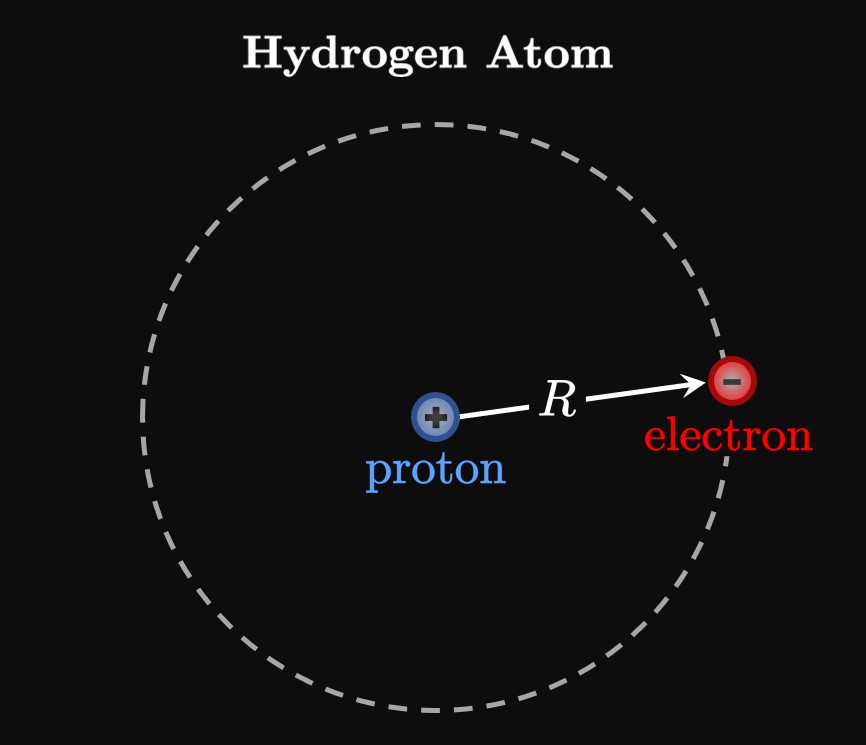
In the Rutherford–Bohr model for the hydrogen atom, an electron undergoes a circular orbit of radius \(R\)
around a stationary proton (Figure 4).
When the hydrogen atom absorbs a photon, the atom's total energy increases
and the electron jumps to a higher energy level,
meaning its orbit increases in radius.
Using Coulomb's Law in terms of \(R,\)
calculate the work needed to move the electron farther out to an orbit of radius \(2R.\)
Assume that the electron is moved slowly and radially outward.
(A proton has a charge of \(1.6 \times 10^{-19}\) \(\un C,\)
while an electron has a charge of \(-1.6 \times 10^{-19}\) \(\un C.\))
SOLUTION
The electron is attracted to the center proton,
so the electron experiences a force toward the center.
To move the electron farther away (to a larger orbit), we must apply an equal
force radially outward.
By Coulomb's Law, at some distance \(r\) we must apply an outward force equal to
\[F = \frac{\par{9.0 \times 10^9} \par{1.6 \times 10^{-19}}^2}{r^2} = \frac{2.304 \times 10^{-28}}{r^2} \pd\]
We integrate along the electron's path—namely, from \(r = R\) to \(r = 2R.\)
The energy needed equals the work done by the electrostatic force,
which we calculate in joules to be
\[
\ba
W &= \int_R^{2R} \frac{2.304 \times 10^{-28}}{r^2} \di r
= -\frac{2.304 \times 10^{-28}}{r} \intEval_R^{2R} \nl
&= -2.304 \times 10^{-28} \par{\frac{1}{2R} - \frac{1}{R}} = \boxed{\frac{1.152 \times 10^{-28}}{R}}
\ea
\]
EXERCISE 12
A bucket initially has a mass of \(2\) kilograms and contains \(1\) liter of water.
The bucket contains a hole from which water exits at a constant rate.
The bucket is lifted to a height of \(2\) meters; at this point,
it holds a volume of \(0.6\) liter of water.
Calculate the work done in lifting the bucket
if the bucket is lifted upward at a constant speed.
(Water's density is \(1\) kilogram per liter.)
SOLUTION
Initially, the mass of water is \(1 \un{kg};\)
at the end, the mass of water is \(0.6 \un{kg}.\)
Thus, the bucket's starting mass is \(3 \un{kg},\)
and its final mass is \(2.6 \un{kg}.\)
We define the mass as a function of height, \(y.\)
Let \(y = 0\) be the bucket's initial height, and let \(y = 2 \un{m}\) be its final height.
The rate of change of the bucket's mass is then
\[\frac{\Delta m}{\Delta y} = \frac{2.6 - 3}{2 - 0} = -0.2 \undiv{kg}{m} \pd\]
So the bucket's mass \(m\) as a function of height \(y\) is
\[m(y) = 3 - 0.2y \pd\]
The force of gravity, in newtons, acting on the bucket at any \(y \in [0, 2]\) is
\[F(y) = m(y) \cdot g = 9.8 m(y) = 9.8(3 - 0.2 y) = 29.4 - 1.96 y \pd\]
To overcome the influence of gravity, an equivalent force \(F(y)\) must be applied upward.
The work done is therefore
\[
\ba
W &= \int_0^2 F(y) \di y \nl
&= \int_0^2 (29.4 - 1.96 y) \di y \nl
&= \par{29.4 y - 0.98 y^2} \intEval_0^2 \nl
&= \boxed{54.88 \un J}
\ea
\]
EXERCISE 13
Consider the function
\[f(x) = 3x^2 + x^n \, e^{-x^6} \cma\]
where \(n\) is a positive integer.
Determine all the values of \(n\) such that the average value of \(f\)
on \([-1, 1]\) is \(1.\)
SOLUTION
The average value of \(f\) on \([-1, 1]\) is
\[
\ba
\avg f &= \frac{1}{1 - (-1)} \int_{-1}^1 \par{3x^2 + x^n \, e^{-x^6}} \di x \nl
&= \tfrac{1}{2} \int_{-1}^1 \par{3x^2 + x^n \, e^{-x^6}} \di x \nl
&= \tfrac{1}{2} \int_{-1}^1 3x^2 \di x + \tfrac{1}{2} \int_{-1}^1 x^n \, e^{-x^6} \di x \nl
&= \tfrac{1}{2} \par{x^3} \intEval_{-1}^1 + \tfrac{1}{2} \int_{-1}^1 x^n \, e^{-x^6} \di x \nl
&= 1 + \tfrac{1}{2} \int_{-1}^1 x^n \, e^{-x^6} \di x \pd
\ea
\]
Equating \(\avg f = 1\) shows
\[
\ba
1 + \tfrac{1}{2} \int_{-1}^1 x^n \, e^{-x^6} \di x &= 1 \nl
\tfrac{1}{2} \int_{-1}^1 x^n \, e^{-x^6} \di x &= 0 \nl
\implies \int_{-1}^1 x^n \, e^{-x^6} \di x &= 0 \pd
\ea
\]
From the properties of symmetry for definite integrals (Section 4.4),
\(\int_{-a}^a g(x) \di x = 0\) if \(g\) is odd—that is, if \(g(-x) = -g(x).\)
Thus, \(g(x) = x^n \, e^{-x^6}\) must be odd.
Note that
\[g(-x) = (-x)^n \, e^{-(-x)^6} = (-x)^n \, e^{-x^6} \and -g(x) = -x^n \, e^{-x^6} \pd\]
We have \((-x)^n = -x^n\) only when \(n\) is an odd integer.
Thus, \(\avg f = 1\) for
\[n = \boxed{1 \cma 3 \cma 5 \cma \dots}\]