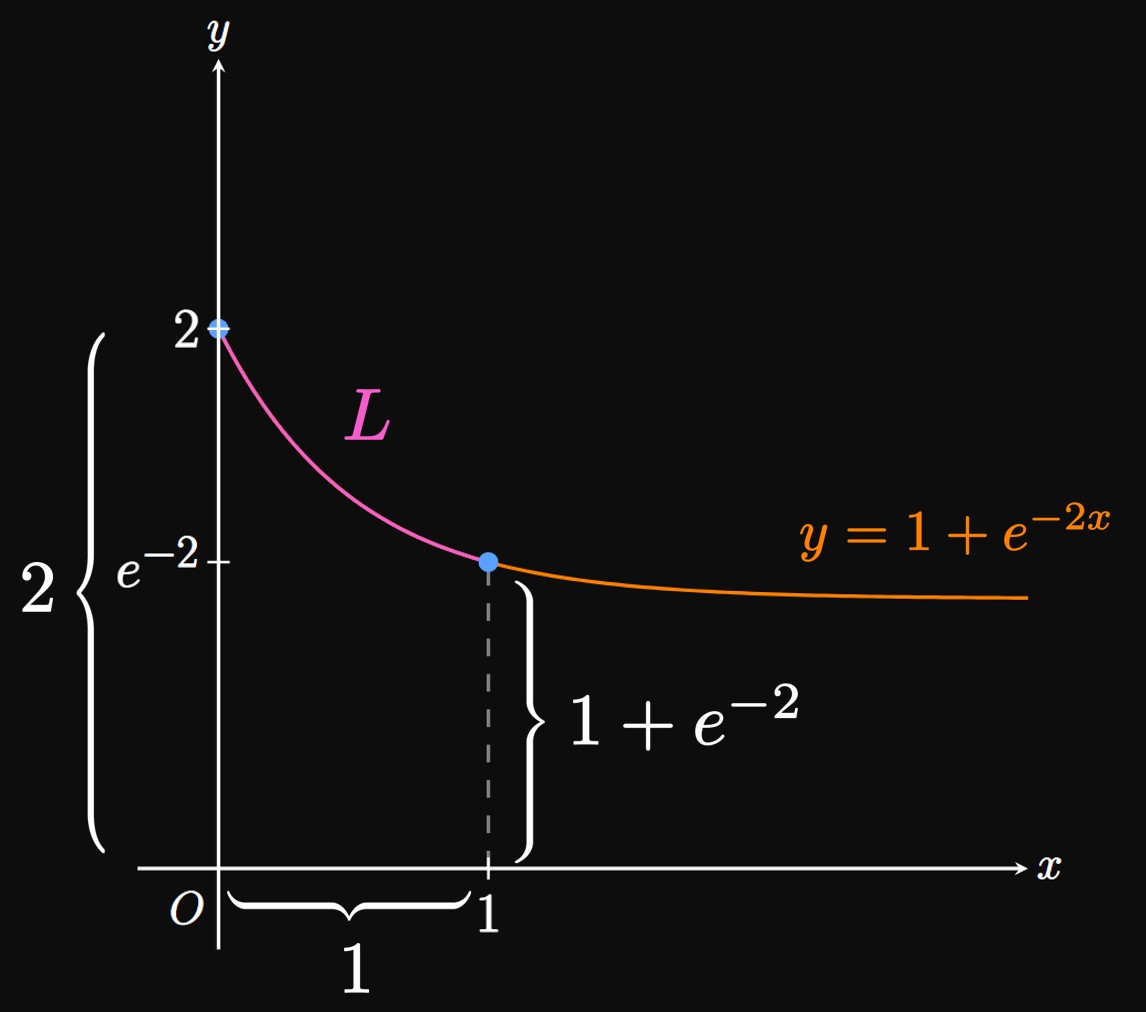
To three decimal places, find the perimeter of the region
bounded by the curve \(y = 1 + e^{-2x},\) the \(x\)-axis,
the \(y\)-axis, and the line \(x = 1.\)
SOLUTION
The region is bounded by three straight sides of lengths
\(2, 1,\) and \(1 + e^{-2}.\)
It is bounded above by the curve \(y = 1 + e^{-2x},\)
whose derivative is
\[\deriv{y}{x} = -2e^{-2x} \pd\]
Thus, the curve's length over \(0 \leq x \leq 1\) is
\[L = \int_0^1 \sqrt{1 + \par{-2e^{-2x}}^2} \di x = \int_0^1 \sqrt{1 + 4e^{-4x}} \di x \approx 1.368 \pd\]
So the region's perimeter is
\[2 + 1 + \par{1 + e^{-2}} + 1.368 \approx \boxed{5.503}\]
EXERCISE 2
The average lifespan of a light bulb is \(800\) hours.
Using an exponential probability density function,
calculate the probability that a light bulb lasts more than \(900\) hours.
SOLUTION
We model the light bulb's longevity using an exponential probability density function:
\[
f(t) =
\bc
0 & t \lt 0 \nl
ke^{-kt} & t \geq 0 \cma
\ec
\]
where \(t\) is time in hours.
The mean of this function is given to be \(\mu = 800.\)
Recall that the mean is \(\mu = 1/k,\) so we have
\[
f(t) =
\bc
0 & t \lt 0 \nl
\dfrac{e^{-t/800}}{800} & t \geq 0 \pd
\ec
\]
Accordingly, the probability that a light bulb lasts more than \(900\) hours is given by
the improper integral
\[\int_{900}^\infty \frac{e^{-t/800}}{800} \di t \pd\]
Using the methods of Section 6.5, we obtain
\[
\ba
P(T \geq 900) &= \lim_{b \to \infty} \int_{900}^b \frac{e^{-t/800}}{800} \di t \nl
&= \lim_{b \to \infty} \par{- e^{-t/800}} \intEval_{900}^b \nl
&= \par{\lim_{b \to \infty} - e^{-b/800}} - \par{-e^{-900/800}} \nl
&= e^{-9/8} \approx \boxed{0.325} = 32.5 \% \pd
\ea
\]
EXERCISE 3
Total surplus is the sum of consumer surplus and producer surplus.
We use total surplus to measure how beneficial a market is to a society,
since high total surplus indicates a high level of satisfaction with a market.
Let \(X\) be the equilibrium quantity produced.
Prove that the total surplus is maximized at the equilibrium point.
SOLUTION
The total surplus \(s_T\) is the area between the curves \(D\) and \(S\)—namely,
\[s_T = \int_0^x \parbr{D(t) - S(t)} \di t \pd\]
(We use \(t\) simply as a dummy variable.)
To maximize \(s_T,\) we find the critical numbers—the values of \(x\)
for which \(\textderiv{s_T}{x} = 0.\)
(See Section 3.6
to review the process of optimization.)
By Part I of the Fundamental Theorem of Calculus,
\[\deriv{s_T}{x} = D(x) - S(x) \pd\]
So we see
\[D(X) - S(X) = 0 \implies D(X) = S(X) \pd\]
Observe that \(D(x) - S(x) \gt 0\) when \(x \lt X\)
and \(D(x) - S(x) \lt 0\) when \(x \gt X.\)
Hence, the First-Derivative Test asserts that \(s_T\) has a relative maximum
at \(x = X.\)
Note that \(s_T = 0\) when \(x = 0.\)
Also, \(s_T\) is increasing on \([0, X]\) and decreasing on \([X, \infty),\)
so the absolute maximum must occur at \(x = X,\)
meaning total surplus is maximized at the equilibrium point.
EXERCISE 4
Over the interval \([1, x],\) \(f\) is increasing
and has an arc length function given by
\[s(x) = \int_1^x \sqrt{t^2 - 2t + 2} \di t \pd\]
If \(f(2) = 5,\) then determine the identity of \(f.\)
SOLUTION
The integrand of the arc length function takes the form
\(\sqrt{1 + [f'(t)]^2}.\)
We therefore see
\[
\ba
\sqrt{1 + [f'(t)]^2} &= \sqrt{t^2 - 2t + 2} \nl
1 + [f'(t)]^2 &= t^2 - 2t + 2 \nl
[f'(t)]^2 &= t^2 - 2t + 1 = (t - 1)^2 \nl
\implies f'(t) &= t - 1 \pd
\ea
\]
[We choose the positive solution instead of \(f'(t) = -(t - 1)\)
because then \(f\) is increasing and so \(f'\) must be positive.]
Solving this differential equation, we have
\[f(t) = \tfrac{1}{2} t^2 - t + C \pd\]
Then substituting the initial condition \(f(2) = 5\) shows
\[f(2) = \tfrac{1}{2} (2)^2 - 2 + C = 5 \implies C = 5 \pd\]
Hence, the identity of \(f\) is
\[f(t) = \boxed{\tfrac{1}{2} t^2 - t + 5}\]
EXERCISE 5
A rectangle of height \(m\) and width \(1/m^2\) is submerged
in a body of water such that the top side is a depth of \(m\)
beneath the water's surface.
Prove that the hydrostatic force against the rectangle is independent of \(m.\)
SOLUTION
Picking the downward direction to be the positive \(y\)-axis,
we note that the rectangle is bounded between \(y = m\)
and \(y = m + m\) \( = 2m.\)
At each \(y,\) a horizontal strip of the rectangle is a distance of \(h(y) = y\)
beneath the surface.
With a constant width of \(w(y) = 1/m^2,\)
the hydrostatic force is
\[
\ba
F &= \gamma \int_m^{2m} y \frac{1}{m^2} \di y = \frac{\gamma}{m^2} \par{\frac{y^2}{2}} \intEval_m^{2m}
= \frac{3 \gamma}{2} \pd
\ea
\]
So \(F\) does not depend on \(m.\)
Accordingly, the hydrostatic force against the rectangle is independent of \(m.\)
EXERCISE 6
Prove that the region bounded by a probability density function
is balanced at its mean value.
SOLUTION
The lamina is balanced at its mean value \(\mu\)
if and only if its centroid is at \(\overline x = \mu.\)
(See Section
7.4
to review finding centroids.)
The lamina's area is \(\int_{-\infty}^\infty f(x) \di x = 1\)
(since \(f\) is a probability density function),
so the \(x\)-coordinate of the centroid is
\[
\ba
\overline x &= \frac{\ds \int_{-\infty}^\infty x f(x) \di x}{1} \nl
&= \int_{-\infty}^\infty x f(x) \di x \nl
&= \mu \cma
\ea
\]
as requested.
EXERCISE 7
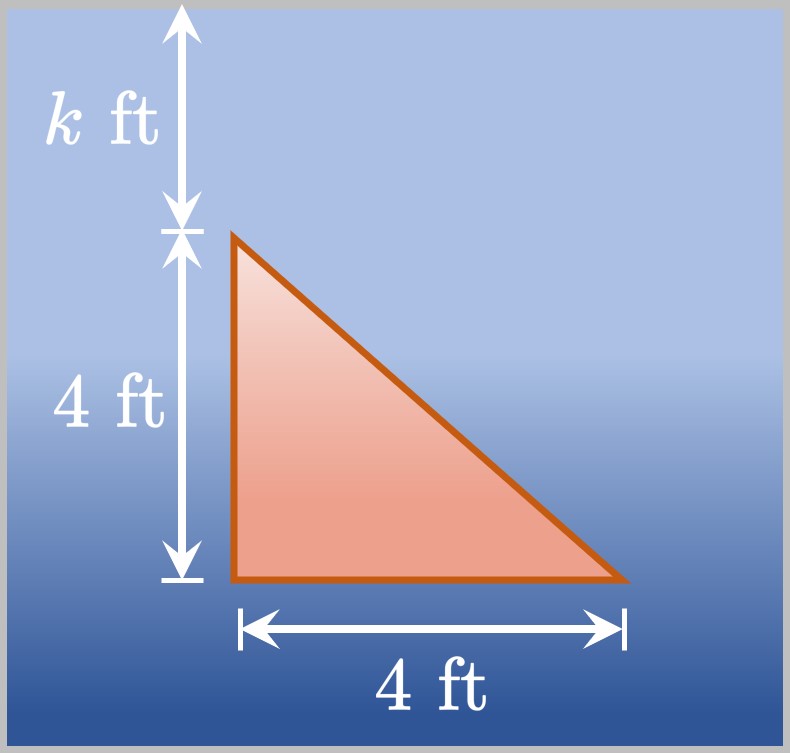
An isosceles right triangle whose legs are \(4\) feet long
is submerged in a uniform body of water such that
the top vertex is located \(k\) feet under the surface
(Figure 1).
Show that the hydrostatic force against the triangle, in pounds, is given by
\(F = 500k + 4000/3.\)
SOLUTION
It is most convenient to take the downward direction to be the positive \(y\)-axis.
A thin, horizontal approximating rectangle at any \(y\) is located a distance
\(h(y) = y\) beneath the surface.
By similar triangles,
\[\frac{w(y)}{y - k} = \frac{4}{4} \implies w(y) = y - k \pd\]
The body is bounded between \(y = k\) and \(y = k + 4,\)
so the hydrostatic force is
\[
\ba
F &= 62.5 \int_k^{k + 4} y (y - k) \di y
= 62.5 \int_k^{k + 4} \par{y^2 - ky} \di y \nl
&= 62.5 \par{\frac{y^3}{3} - \frac{ky^2}{2}} \intEval_k^{k + 4}
= 62.5 \par{\frac{(k + 4)^3}{3} - \frac{k(k + 4)^2}{2} - \frac{k^3}{3} + \frac{k^3}{2}} \nl
&= 62.5 \par{\frac{k^3 + 12k^2 + 48k + 64}{3} - \frac{k^3 + 8k^2 + 16k}{2} - \frac{k^3}{3} + \frac{k^3}{2}} \nl
&= 62.5 \par{8k + \frac{64}{3}} = \frac{125}{2} \par{8k + \frac{64}{3}} = 500k + \frac{4000}{3} \cma
\ea
\]
as requested.
EXERCISE 8
Let \(a\) be any real number.
Prove that the graph of any smooth function \(y = f(x)\)
has an infinite arc length over \(a \leq x \lt \infty.\)
SOLUTION
The integral expression for the arc length from \(x = a\) to \(x = \infty\) is given by
\[L = \int_a^\infty \sqrt{1 + [f'(x)]^2} \di x\]
if \(f'(x)\) is continuous for \(x \geq a.\)
Because \([f'(x)]^2 \geq 0,\) we observe that
\[\sqrt{1 + [f'(x)]^2} \geq \sqrt 1 \gt 0 \pd\]
We see
\[\int_a^\infty \sqrt 1 \di x = \int_a^\infty \dd x = x \intEval_a^\infty = \infty \cma\]
so \(\int_a^\infty \sqrt 1 \di x\) diverges.
By the Comparison Test for Improper Integrals
(from Section 6.5),
the integral \(\int_a^\infty \sqrt{1 + [f'(x)]^2} \di x\)
also diverges.
Hence, the arc length \(L\) is infinite.
EXERCISE 9
A solid is generated by rotating the region bounded by the infinite curve \(y = e^{-x}\) in the first quadrant
about the \(x\)-axis.
Calculate the solid's lateral surface area.
SOLUTION
Since \(\textderiv{y}{x} = -e^{-x},\) the lateral surface area of the generated solid is
\[S = \int_0^\infty 2 \pi e^{-x} \sqrt{1 + \par{-e^{-x}}^2} \di x
= 2 \pi \int_0^\infty e^{-x} \sqrt{1 + e^{-2x}} \di x \pd\]
Substituting \(u = e^{-x},\) we get \(\dd u = -e^{-x} \di x.\)
When \(x = 0,\) \(u = 1;\) when \(x = \infty,\) \(u = 0.\)
So the integral becomes
\[S = - 2 \pi \int_1^0 \sqrt{1 + u^2} \di u = 2 \pi \int_0^1 \sqrt{1 + u^2} \di u \pd\]
Letting \(u = \tan \theta\) results in \(\dd u = \sec^2 \theta \di \theta.\)
When \(u = 0,\) \(\theta = 0;\) when \(u = 1,\) \(\theta = \pi/4.\)
Hence, we attain
\[
\ba
S &= 2 \pi \int_0^{\pi/4} \par{\sec \theta} \sec^2 \theta \di \theta
= 2 \pi \int_0^{\pi/4} \sec^3 \theta \di \theta \nl
&= 2 \pi \par{\tfrac{1}{2} \sec \theta \tan \theta + \tfrac{1}{2} \ln \abs{\sec \theta + \tan \theta} } \intEval_0^{\pi/4} \nl
&= 2 \pi \parbr{\tfrac{1}{2} \par{\sqrt 2} (1) + \tfrac{1}{2} \ln \par{\sqrt 2 + 1}} - 0 \nl
&= \boxed{\pi \parbr{\sqrt 2 + \ln \par{\sqrt 2 + 1}}} \approx 7.212 \pd
\ea
\]
EXERCISE 10
A parabolic cup is \(5\) inches tall,
and its base extends \(3\) inches from the center of the cup's base.
Calculate the hydrostatic force acting against a central cross section of the cup
when it is completely filled with milk, whose specific weight is roughly \(64.3 \undiv{lb}{ft}^3.\)
SOLUTION
Converting the measurements into feet,
we find the height to be \(5/12 \un{ft}\) and the base radius to be \(3/12\) \(= 1/4 \un{ft}.\)
Let's define a coordinate system such that the origin is at the bottom-center
of the cup's cross section.
We model this parabola using \(y = ax^2.\)
Substituting the coordinates of the top tip—that is, \(x = 1/4\) and \(y = 5/12\)—shows
\[a = \frac{5/12}{(1/4)^2} = \frac{20}{3} \pd\]
In addition, the top of the cup—that is, the surface level of the milk—is the line \(y = 5/12.\)
A thin, horizontal approximating rectangle to the cup is therefore a depth of \(h(y) = 5/12 - y\)
below the surface.
Its width is \(2x,\) where
\[x = \sqrt{\frac{y}{a}} = \sqrt{\frac{y}{20/3}} = \sqrt{\frac{3y}{20}} \pd\]
Instead of using \(\gamma = 62.5,\) as for water, we use \(\gamma = 64.3.\)
Doing so, we calculate the hydrostatic force to be
\[
\ba
F &= 64.3 \int_0^{5/12} \par{\frac{5}{12} - y} \cdot 2 \sqrt{\frac{3y}{20}} \di y \nl
&= 64.3 \sqrt{\frac{3}{5}} \int_0^{5/12} \par{\tfrac{5}{12} \sqrt y - y^{3/2}} \di y \nl
&= 64.3 \sqrt{\frac{3}{5}} \par{\tfrac{5}{18} y^{3/2} - \tfrac{2}{5} y^{5/2}} \intEval_0^{5/12} \nl
&\approx \boxed{1.488 \un{lb}}
\ea
\]
EXERCISE 11
Gabriel's Horn is the solid generated by rotating the region
bounded by \(y = 1/x,\) the \(x\)-axis, and the line \(x = 1\) about the \(x\)-axis
(Figure 2).
Show that the solid has infinite surface area but finite volume.
SOLUTION
The region is bounded from \(x = 1\) to \(x = \infty.\)
By using the Disk Method (from Section 5.3),
the horn's volume is
\[
\ba
V &= \int_1^\infty \pi \par{\frac{1}{x}}^2 \di x
= \lim_{k \to \infty} \int_1^k \frac{\pi}{x^2} \di x \nl
&= \lim_{k \to \infty} \par{-\frac{\pi}{x}} \intEval_1^k = - \par{0 - \pi} = \pi \pd
\ea
\]
Thus, Gabriel's Horn has a finite volume.
Now we move on to its lateral surface area: With \(\textderiv{y}{x}\) \(= -1/x^2,\) the horn's surface area is given by
\[
\ba
S &= \int_1^\infty 2 \pi \par{\frac{1}{x}} \sqrt{1 + \par{-\frac{1}{x^2}}^2} \di x \nl
&= \int_1^\infty 2 \pi \par{\frac{1}{x}} \sqrt{1 + \frac{1}{x^4}} \di x \pd
\ea
\]
Because \(\sqrt{1 + 1/x^4} \geq\) \(\sqrt 1 = 1,\)
we have
\[\int_1^\infty 2 \pi \par{\frac{1}{x}} \sqrt{1 + \frac{1}{x^4}} \di x
\geq \int_1^\infty 2 \pi \par{\frac{1}{x}} \di x \pd \]
The right-hand integral becomes the limit
\[\lim_{k \to \infty} \par{2 \pi \ln x} \intEval_1^k = \infty \pd\]
Since \(\int_1^\infty 2 \pi \par{\frac{1}{x}} \di x\) diverges,
the Comparison Test for Improper Integrals
(from Section 6.5)
asserts that
\(\int_1^\infty 2 \pi \par{\frac{1}{x}} \sqrt{1 + \frac{1}{x^4}} \di x\) also diverges.
Accordingly, Gabriel's Horn has an infinite surface area.
EXERCISE 12
The function \(f\) is positive on \([0, a],\) where \(a \gt 0.\)
Region \(R\) is bounded by the graph of \(y = f(x)\) and the line \(x = a\) in the first quadrant.
Let \(y_c\) be the \(y\)-coordinate of the centroid of \(R.\)
Region \(S\) is bounded by the graph of \(y = f(x),\) the lines \(x = a\) and \(y = L,\) and the \(y\)-axis.
In terms of all the provided quantities and the integral \(\int_0^a f(x) \di x,\)
derive an expression for \(L\) such that region \(S\) balances on the \(x\)-axis.
SOLUTION
Region \(S\) balances on the \(x\)-axis if and only if the \(y\)-coordinate of its centroid is \(0.\)
This can only occur if \(L \lt 0.\)
The area of region \(R\) is \(A_R = \int_0^a f(x) \di x,\)
and let \(A_S\) be the area of region \(S.\)
The \(y\)-coordinate of the centroid of region \(S\) is therefore given by
\[
\overline y = \frac{1}{A_S} \int_0^a \par{\tfrac{1}{2} [f(x)]^2 - \tfrac{1}{2} L^2} \di x \pd
\]
Equating this expression to \(0,\) we get
\[
\ba
\frac{1}{A_S} \int_0^a \par{\tfrac{1}{2} [f(x)]^2 - \tfrac{1}{2} L^2} \di x &= 0 \nl
\int_0^a \tfrac{1}{2} [f(x)]^2 \di x - \int_0^a \tfrac{1}{2} L^2 \di x &= 0 \nl
\int_0^a \tfrac{1}{2} [f(x)]^2 \di x - \tfrac{1}{2} aL^2 &= 0 \nl
\int_0^a \tfrac{1}{2} [f(x)]^2 \di x &= \tfrac{1}{2} aL^2 \pd
\ea
\]
Dividing both sides by \(A_R\) gives
\[
\ba
\frac{1}{A_R} \int_0^a \tfrac{1}{2} [f(x)]^2 \di x &= \frac{aL^2}{2A_R} \nl
y_c &= \frac{aL^2}{2A_R} \pd
\ea
\]
Solving for \(L\) (and choosing the negative solution) yields
\[L = -\sqrt{\frac{2 y_c}{a} A_R} = \boxed{-\sqrt{\frac{2 y_c}{a} \int_0^a f(x) \di x}}\]