In volleyball, a player serves the ball by hitting it upward
and over the net,
which is about \(92\) inches above the ground and \(315\) inches away from the serving player
(Figure 1).
Suppose that a \(6\)-foot serving player hits the ball at head level straight
toward the net with a speed of \(880\)
inches per second at some angle \(\alpha\)
above the ground.
In terms of \(\alpha,\) write parametric equations for the volleyball's motion.
(Note: \(g\) = \(386\) inches per second squared.)
Model the shape of the ball's trajectory.
Find the values of \(\alpha\) such that the volleyball is successfully served.
SOLUTION
Let \(t\) be time in seconds;
also let \(x\) and \(y\) (measured in inches) be the horizontal and vertical distances, respectively,
from the serving player.
Note that the ball's initial height is the height of the player, \(6(12)\) \(= 72 \un{in}.\)
The parametric equations are therefore
\[
\ba
x &= \boxed{880(\cos \alpha) t} \nl
y &= 72 + 880(\sin \alpha) t - \tfrac{1}{2}(386) t^2 \nl
&= \boxed{72 + 880(\sin \alpha) t - 193 t^2}
\ea
\]
We eliminate the parameter \(t\) from our parametric equations:
Solving for \(t\) gives
\[t = \frac{x}{880 \cos \alpha} \cma\]
from which we obtain
\[
y = 72 + 880(\sin \alpha) \par{\frac{x}{880 \cos \alpha}} - 193 \par{\frac{x}{880 \cos \alpha}}^2 \pd
\]
Simplifying shows that the volleyball's trajectory takes the shape
\[\boxed{y = 72 + x \tan \alpha - \frac{193 x^2}{880^2 \cos^2 \alpha}}\]
Because the volleyball must be hit above the \(92\)-inch
net, we need
\(y \gt 92\) when \(x = 315.\)
We seek the solutions of \(\alpha\) to
\[72 + 315 \tan \alpha - \frac{193 (315)^2}{880^2 \cos^2 \alpha} \gt 92 \pd\]
Because
\[\frac{1}{\cos^2 \alpha} = \sec^2 \alpha = 1 + \tan^2 \alpha \cma\]
the inequality becomes
\[
\ba
72 + 315 \tan \alpha - \frac{193 (315)^2}{880^2} (1 + \tan^2 \alpha) &\gt 92 \cma \nl
-20 + 315 \tan \alpha - \frac{193 (315)^2}{880^2} - \frac{193 (315)^2}{880^2} \tan^2 \alpha &\gt 0 \nl
-44.729 + 315 \tan \alpha - 24.729 \tan^2 \alpha &\gt 0 \pd
\ea
\]
The solution to this quadratic inequality is
\[0.144 \lt \tan \alpha \lt 12.594 \or 0.143 \lt \alpha \lt 1.492 \pd\]
Converting this interval to degrees, we conclude that the volleyball is successfully served for
\[\boxed{8.194 \degree \lt \alpha \lt 85.46 \degree}\]
This result is logical: when volleyball players serve the ball,
they must worry primarily about hitting the ball hard enough and
straight across the net—not about the angle from the ground.
EXERCISE 2
On a flat field, a football is kicked upward and lands a distance \(D\)
away. (We call \(D\) the range.)
Find the angle above the horizontal at which the football should be kicked to maximize
the range.
SOLUTION
Let \(v_0\) be the velocity at which the football is kicked, and
let \(\alpha\) be the angle to the horizontal from which it is kicked.
Note that its starting height is \(0\) and its final height is \(0.\)
At any time \(t,\)
the football's trajectory follows the parametric equations
\[
\ba
x &= v_0 (\cos \alpha) t \cma \nl
y &= v_0 (\sin \alpha) t - \tfrac{1}{2} gt^2 \pd
\ea
\]
We want the time at which the football touches the ground,
so we equate \(y\) to \(0 \col \)
\[
\ba
v_0 (\sin \alpha) t - \tfrac{1}{2} gt^2 &= 0 \nl
\implies t &= \frac{2 v_0 \sin \alpha}{g} \pd
\ea
\]
This is the time at which the football hits the ground.
We therefore see
\[D = v_0 (\cos \alpha) \par{\frac{2 v_0 \sin \alpha}{g}} = \frac{2 v_0^2 \sin \alpha \cos \alpha}{g} \pd\]
Because \(2 \sin \alpha \cos \alpha\) \(= \sin 2 \alpha,\) we attain
\[D = \frac{v_0^2 \sin 2 \alpha}{g} \cma\]
which is maximized for \(\alpha = 45 \degree.\)
(When \(\alpha = 45 \degree,\) \(\sin 2 \alpha = 1,\) the maximum value of sine.)
Thus, the football should be kicked at \(\boxed{45 \degree}\) to the horizontal
to maximize the range of its trajectory.
EXERCISE 3
A curve \(C\) is parameterized by \(x = f(t)\) and \(y = g(t)\)
for \(0 \leq t \leq 6.\)
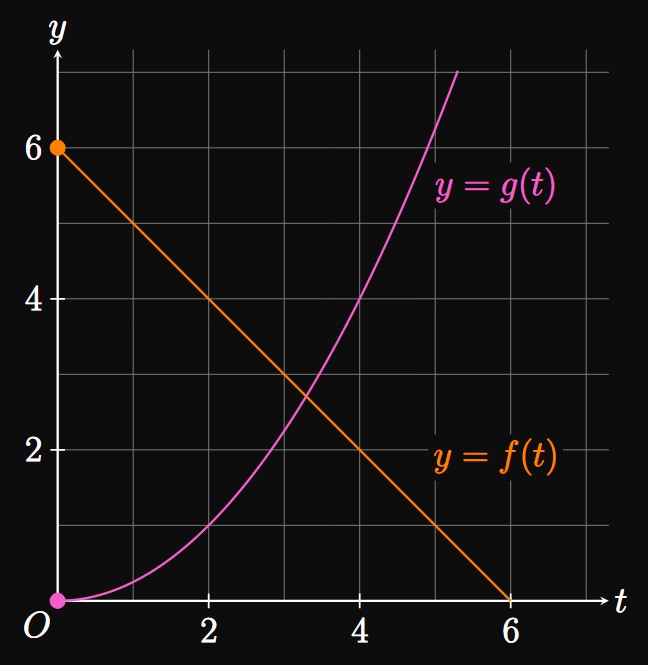
Figure 2 shows the graphs of \(f(t)\) and \(g(t),\)
where \(f\) is linear and \(g\) is quadratic.
Find the identity of \(f(t).\)
Find the identity of \(g(t).\)
By eliminating the parameter, represent \(C\)
using a Cartesian equation.
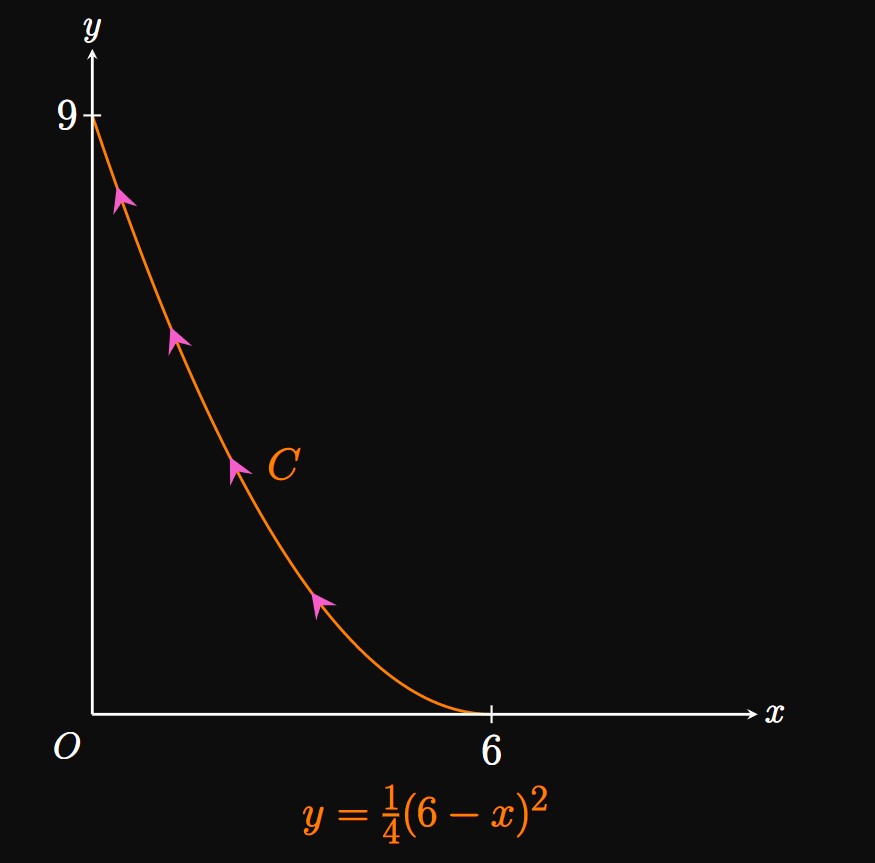
Sketch the curve \(C.\)
Draw arrows to indicate the direction
in which \(C\) is traced as \(t\) increases from \(0.\)
SOLUTION
Do not confuse the graphs of \(y = f(t)\) and \(y = g(t)\)
with the curve \(C.\)
The function \(f\) is linear.
In the given figure,
the graph of \(y = f(t)\) passes through the points \((0, 6)\) and \((6, 0).\)
Thus, the identity of \(f\) is given by the line
\[f(t) = \boxed{6 - t}\]
The function \(g\) is a quadratic.
In the given figure,
we see that \(y = g(t)\) passes through the origin and the point \((4, 4).\)
Thus,
\[g(t) = \boxed{\tfrac{1}{4} t^2}\]
The curve \(C\) is parameterized by
\[
\baat{2}
x &= f(t) &&= 6 - t \cma \nl
y &= g(t) &&= \tfrac{1}{4} t^2 \pd
\eaat
\]
From the first equation \((x = 6 - t),\) we get \(t = 6 - x.\)
Substituting this expression into the second equation
\((y = \tfrac{1}{4} t^2)\) gives
\[\boxed{y = \tfrac{1}{4} (6 - x)^2}\]
The shape of the curve \(C\) follows this Cartesian equation.
When \(x = 6,\) we see
\[y = \tfrac{1}{4} (6 - 6)^2 = 0 \pd\]
Also, when \(x = 0\)
\[y = \tfrac{1}{4} (0 - 6)^2 = 9 \pd\]
Thus, the curve \(C\) is a quadratic with vertex \((6, 0)\)
and \(y\)-intercept \((0, 9).\)
As \(t\) increases from \(0,\)
\(x = f(t)\) decreases but \(y = g(t)\) increases.
We therefore draw arrows that point left and upward along the curve.
EXERCISE 4
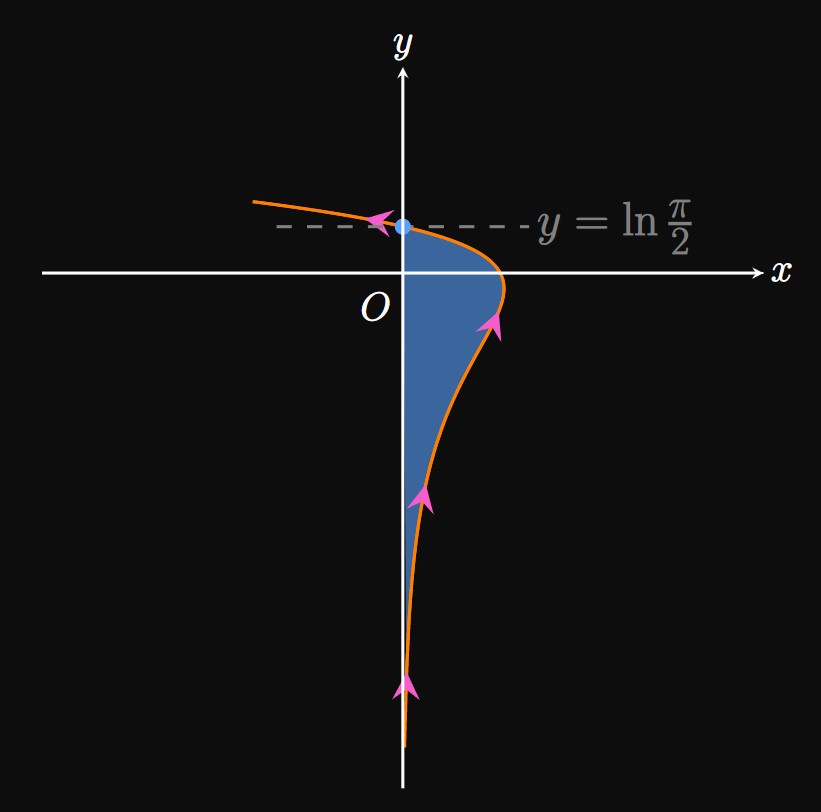
Show that the unbounded region
in the first and fourth quadrants enclosed between the \(y\)-axis and the
curve with parameterization \(x = t \cos t\) and \(y = \ln t\) has area \(1.\)
SOLUTION
The curve intersects the \(y\)-axis when \(t \cos t = 0,\)
which first occurs when \(t = \pi/2;\)
at this time, \(y = \ln(\pi/2).\)
As \(t \to 0^+,\) \(\ln t \to -\infty.\)
This area is therefore unbounded.
In Cartesian coordinates, the improper integral (see Section 6.5)
that represents this area is
\[\int_{y = -\infty}^{y = \ln(\pi/2)} x \di y \pd\]
As \(y \to -\infty,\) \(t \to 0^+;\) when \(y = \ln(\pi/2),\) \(t = \pi/2.\)
Also, \(\dd y = (1/t) \di t.\)
The improper integral therefore becomes
\[
\ba
\int_0^{\pi/2} (t \cos t) \par{\tfrac{1}{t}} \di t &= \int_0^{\pi/2} \cos t \di t \nl
&= \sin t \intEval_0^{\pi/2} \nl
&= \sin \tfrac{\pi}{2} - \sin 0 \nl
&= \boxed 1
\ea
\]
as requested.
EXERCISE 5
On the roof of a \(20\)-meter building,
a woman kicks a ball up and away from the building with an initial velocity of
\(16\) meters per second
directed \(45 \degree\) above the horizontal.
Calculate the maximum height the ball reaches.
SOLUTION
The ball's height \(y\) above the ground at any time \(t\) is
\[
\ba
y &= 20 + 16 (\sin 45 \degree) t - \tfrac{1}{2}(9.8)t^2 \nl
&= 20 + \par{8 \sqrt 2} t - 4.9 t^2 \pd
\ea
\]
To maximize \(y,\) we locate its critical points.
Since the trajectory is a parabola, the absolute maximum of \(y\) must
occur at the critical point.
(See Section 3.1 to review the
arguments of locating extrema.)
We differentiate to attain
\[\deriv{y}{t} = 8 \sqrt 2 - 9.8 t = 0 \implies t = \frac{8 \sqrt 2}{9.8} \pd\]
Thus, the maximum height is
\[
\ba
\maxSub y &= 20 + 8 \sqrt 2 \par{\frac{8 \sqrt 2}{9.8}} - 4.9 \par{\frac{8 \sqrt 2}{9.8}}^2 \nl
&= 20 + \frac{64}{9.8} \nl
&\approx \boxed{26.531 \un{m}}
\ea
\]
EXERCISE 6
The shape of a horse racetrack is given by the polar graph
\(r = 2 + 2 \cos \theta,\) where \(r\) is measured in meters.
A bell tower is located at the pole.
A horse runs counterclockwise along the track at a constant angular speed of
\(8\) radians per minute.
When \(\theta = 3 \pi/2,\)
is the horse moving toward or away from the bell tower?
SOLUTION
The horse's angular speed is \(\textderiv{\theta}{t} =\) \(8 \undiv{rad}{min}.\)
Our objective is to connect \(\textderiv{r}{t}\) to the quantities we can find:
\(\textderiv{r}{\theta}\) and \(\textderiv{\theta}{t} = 8.\)
(See Section 2.7
to review the procedure of working with related rates.)
By the Chain Rule,
\[
\ba
\deriv{r}{t} &= \deriv{r}{\theta} \deriv{\theta}{t} \nl
&= 8 \deriv{r}{\theta} \pd
\ea
\]
We obtain
\[\deriv{r}{\theta} = - 2 \sin \theta \cma\]
so \(\textderiv{r}{\theta} |_{\theta = 3 \pi/2}\)
\(= 2.\)
Hence,
\[\deriv{r}{t} \intEval_{\theta = 3\pi/2} = 8(2) = 16 \pd\]
Also, \(r(3\pi/2) = 2.\)
Since \(r\) and \(\textderiv{r}{t}\) have the same sign,
the horse is moving away from the bell tower.
EXERCISE 7
A curve parameterized by \(x = f(t)\) and \(y = g(t)\)
passes through the point \((1, 3)\) when \(t = 2\) and satisfies
\[\deriv{y}{x} = \frac{3t^2 - 6t + 2}{2t - 4} \pd\]
Find one possible set of identities for \(f\) and \(g.\)
SOLUTION
Because
\[\deriv{y}{x} = \frac{\textderiv{y}{t}}{\textderiv{x}{t}} \cma \]
we see
\[
\ba
\deriv{x}{t} &= 2t - 4 \nl
\deriv{y}{t} &= 3t^2 - 6t + 2 \pd
\ea
\]
Solving each differential equation
reveals
\[
\ba
x &= t^2 - 4t + C_1 \cma \nl
y &= t^3 - 3t^2 + 2t + C_2
\ea
\]
for any constants \(C_1\) and \(C_2.\)
Substituting the initial conditions \(x(2) = 1\) and \(y(2) = 3\) shows
\[
\ba
x &= (2)^2 - 4(2) + C_1 = 1 \implies C_1 = 5 \nl
y &= (2)^3 - 3(2)^2 + 2(2) + C_2 = 3 \implies C_2 = 3 \pd
\ea
\]
Thus, the identities of \(f\) and \(g\) are
\[
f(t) = \boxed{t^2 - 4t + 5} \lspace g(t) = \boxed{t^3 - 3t^2 + 2t + 3}
\]
EXERCISE 8
In terms of \(r,\) find the arc length of one arch of the cycloid
\[x = r(\theta - \sin \theta) \cmaa y = r(1 - \cos \theta) \pd\]
SOLUTION
One arch of the cycloid is traced over \(0 \leq \theta \leq 2 \pi.\)
We differentiate both parametric functions to see
\[\deriv{x}{\theta} = r(1 - \cos \theta) \and \deriv{y}{\theta} = r \sin \theta \pd\]
Observe that
\[
\ba
\par{\deriv{x}{\theta}}^2 + \par{\deriv{y}{\theta}}^2
&= [r(1 - \cos \theta)]^2 + (r \sin \theta)^2 \nl
&= r^2 (1 - 2 \cos \theta + \cos^2 \theta + \sin^2 \theta) \nl
&= r^2 (2 - 2 \cos \theta) \pd
\ea
\]
So the arc length is
\[L = \int_0^{2 \pi} \sqrt{r^2 (2 - 2 \cos \theta)} \di \theta = r \int_0^{2 \pi} \sqrt{2 - 2 \cos \theta} \di \theta \pd\]
Using the identity \(\sin^2 x = \tfrac{1}{2} (1 - \cos 2x)\) with \(2x = \theta,\) we have
\[\sin^2 \frac{\theta}{2} = \tfrac{1}{2} (1 - \cos \theta) \iffArrow 1 - \cos \theta = 2 \sin^2 \frac{\theta}{2} \pd\]
The integral therefore becomes
\[
\ba
L &= r \int_0^{2 \pi} \sqrt{4 \sin^2 \frac{\theta}{2}} \di \theta \nl
&= r \int_0^{2 \pi} \abs{2 \sin \frac{\theta}{2}} \di \theta \nl
&= 2r \int_0^{2 \pi} \sin \frac{\theta}{2} \di \theta \nl
&= 4 r \par{-\cos \frac{\theta}{2}} \intEval_0^{2 \pi} \nl
&= \boxed{8r}
\ea
\]
EXERCISE 9
A particle travels counterclockwise along the cardioid \(r = 1 + \sin \theta,\)
where \(r\) is measured in inches,
with an angular speed of \(4\) radians per minute.
In square inches per minute, find the rate at which the particle sweeps out area with respect to the pole
when the particle is located \(\pi/6\) radians counterclockwise from
the positive \(x\)-axis.
SOLUTION
Let \(\theta = m\) be the line that connects the origin to the particle.
Since the particle travels counterclockwise with an angular speed of \(4\) radians per minute,
this is the rate at which \(m\) increases with time.
Mathematically, if \(t\) is time in minutes, then \(\textderiv{m}{t} = 4.\)
In addition, the rate at which the particle sweeps out area with respect to \(m\) is given by
\[\deriv{A}{m} = \deriv{}{m} \int_0^m \tfrac{1}{2} (1 + \sin \theta)^2 \di \theta \pd\]
By Part I of the Fundamental Theorem of Calculus
(see Section 4.3),
this equation becomes
\[\deriv{A}{m} = \tfrac{1}{2} (1 + \sin m)^2 \pd\]
We want \(\textderiv{A}{t}\) when \(m = \pi/6;\) by the Chain Rule, we have
\[\deriv{A}{t} = \deriv{A}{m} \deriv{m}{t} = 4 \cdot \tfrac{1}{2} (1 + \sin m)^2 = 2 (1 + \sin m)^2 \pd\]
(See Section 2.7
to review the procedure of working with related rates.)
Substituting \(m = \pi/6,\) we have
\[
\deriv{A}{t} \intEval_{m = \pi/6} = 2 \par{1 + \sin \frac{\pi}{6}}^2 \nl
= \boxed{\frac{9}{2} \un{in}^2/\un{min}}
\]
EXERCISE 10
A cannonball is launched upward with an initial speed of \(20\) meters per second
at an angle of \(57 \degree\) from the horizontal, on a platform \(10\) meters above the ground.
Calculate the length of the cannonball's trajectory until it hits the ground.
SOLUTION
Parametric equations for the cannonball's motion in the horizontal and vertical directions are, respectively,
\[
\ba
x &= (20 \cos 57 \degree) t \approx 10.893 t \cma \nl
y &= 10 + (20 \sin 57 \degree) t - \tfrac{1}{2} (9.8) t^2 \approx 10 + 16.773 t - 4.9 t^2 \pd
\ea
\]
We see
\[\deriv{x}{t} = 10.893 \and \deriv{y}{t} = 16.773 - 9.8 t \pd\]
The ball hits the ground when \(y = 0\)—that is,
when
\[t = \frac{-16.773 - \sqrt{16.773^2 - 4(-4.9)(10)}}{2(-4.9)} \approx 3.941 \un{sec} \pd\]
The arc length is therefore
\[
\ba
L &= \int_0^{3.941} \sqrt{(10.893)^2 + (16.773 - 9.8t)^2} \di t \nl
&\approx \boxed{60.451 \un{m}}
\ea
\]
EXERCISE 11
A projectile is fired such that its distance from the launch point
is always increasing.
Ignoring air resistance, calculate the maximum angle above the ground at which the projectile
could have been launched.
SOLUTION
Let \(x\) be the projectile's horizontal position and \(y\) be its vertical position.
If \(t\) is time, then parametric equations for the projectile are
\[
\baat{2}
x &= v_0 (\cos \alpha) t \cma \nl
y &= v_0 (\sin \alpha) t - \tfrac{1}{2} gt^2 \pd
\eaat
\]
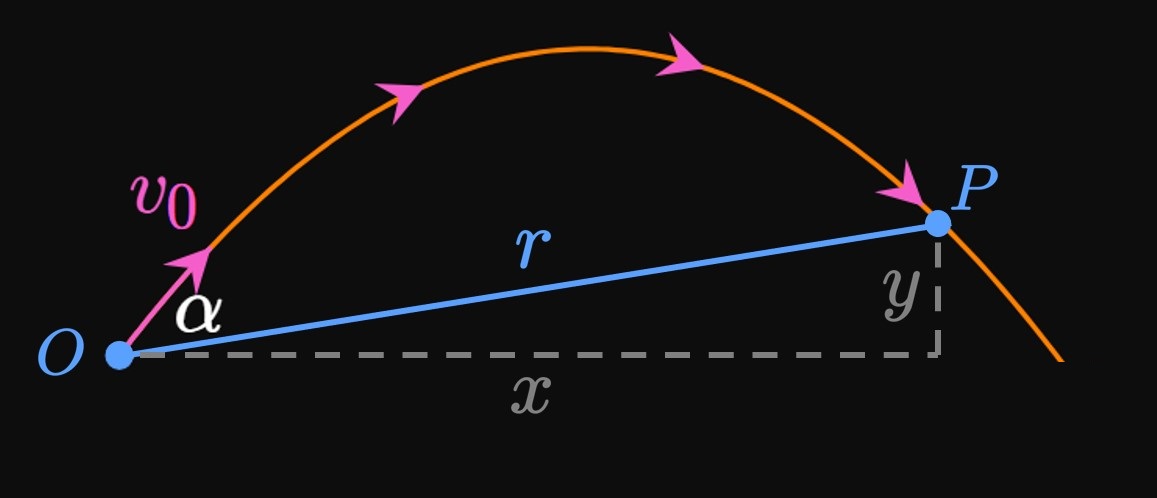
The projectile's distance from the launch point to a point on its trajectory (see the figure) is,
by the Pythagorean Theorem,
\[
\ba
r &= \length{OP} \nl
&= \sqrt{x^2 + y^2} \nl
&= \sqrt{[v_0 (\cos \alpha) t]^2 + \parbr{v_0 (\sin \alpha) t - \tfrac{1}{2} gt^2}^2} \nl
&= \sqrt{\par{v_0}^2 \par{\cos^2 \alpha} t^2 + \par{v_0}^2 \par{\sin^2 \alpha} t^2 - v_0 (\sin \alpha) gt^3 + \tfrac{1}{4} g^2 t^4} \nl
&= \sqrt{\tfrac{1}{4} g^2 t^4 - v_0 (\sin \alpha) gt^3 + \par{v_0}^2 t^2} \pd
\ea
\]
The distance \(r\) is always increasing, so we need \(\textderiv{r}{t} \gt 0\)
for all \(t \gt 0.\)
Differentiating gives
\[
\deriv{r}{t} = \frac{g^2 t^3 - 3 v_0 (\sin \alpha) gt^2 + 2 \par{v_0}^2 t}{2 \sqrt{\tfrac{1}{4} g^2 t^4 - v_0 (\sin \alpha) gt^3 + \par{v_0}^2 t^2}} \pd
\]
This function must not have any critical points;
that is, \(\textderiv{r}{t} \ne 0.\)
We therefore see
\[
\ba
\frac{g^2 t^3 - 3 v_0 (\sin \alpha) gt^2 + 2 \par{v_0}^2 t}{2 \sqrt{\tfrac{1}{4} g^2 t^4 - v_0 (\sin \alpha) gt^3 + \par{v_0}^2 t^2}} &\ne 0 \nl
g^2 t^3 - 3 v_0 (\sin \alpha) gt^2 + 2 \par{v_0}^2 t &\ne 0 \nl
t \parbr{g^2 t^2 - 3 v_0 (\sin \alpha) gt + 2 \par{v_0}^2} &\ne 0 \pd
\ea
\]
By the Quadratic Formula, the expression in brackets equals \(0\) when
\[
\ba
t &= \frac{3 v_0 (\sin \alpha) g + \sqrt{\parbr{- 3 v_0 (\sin \alpha) g}^2 - 4 (g^2) [2 \par{v_0}^2]}}{2 g^2} \nl
&= \frac{3 v_0 (\sin \alpha) g + \sqrt{9 \par{v_0}^2 g^2 \sin^2 \alpha - 8 g^2 \par{v_0}^2}}{2 g^2} \pd
\ea
\]
No real solutions of \(t\) exist if the discriminant, the expression within the square root,
is negative.
So we see
\[
\ba
9 \par{v_0}^2 g^2 \sin^2 \alpha - 8 g^2 \par{v_0}^2 \lt 0
&\iffArrow 9 \sin^2 \alpha - 8 \lt 0 \nl
&\iffArrow \sin^2 \alpha \lt \frac{8}{9} \nl
&\iffArrow \sin \alpha \lt \frac{\sqrt 8}{3} \nl
&\iffArrow \alpha \lt \boxed{\asin \par{\frac{\sqrt 8}{3}}} \approx 70.429 \degree \pd
\ea
\]
This result is independent of \(g\) and the projectile's initial speed!