Let \(A\) be the area of the region bounded
above by the line \(2x - y - 1 = 0,\)
below by the curve \(y = e^{3 \sin x} \cos x,\)
and on the sides by the lines \(x = 2\) and \(x = k,\)
where \(k \gt 2.\)
Express \(A\) as a function of \(k.\)
How quickly is \(A\) changing with respect to \(k \ques\)
What is unique about this result?
Suppose that \(k\) is increasing at a rate of \(2\) units per second.
How quickly is \(A\) increasing when \(k = 3 \ques\)
Let \(R\) be the region bounded by the parabola \(y = x^2,\)
the \(x\)-axis, the \(y\)-axis, and the line \(x = k,\)
where \(k\) is a positive constant.
Let \(S\) be the solid whose base is region \(R\)
and whose cross sections perpendicular to the \(x\)-axis are squares.
Find the value of \(k\) for which the area of \(R\)
and the volume of \(S\) have equal magnitudes.
Using a graphing calculator, calculate the area of the region bounded above by \(y = \sqrt[3]{6 - x}\)
and on the sides by \(x = \tfrac{1}{4} y^2\) and \(x = 5.\)
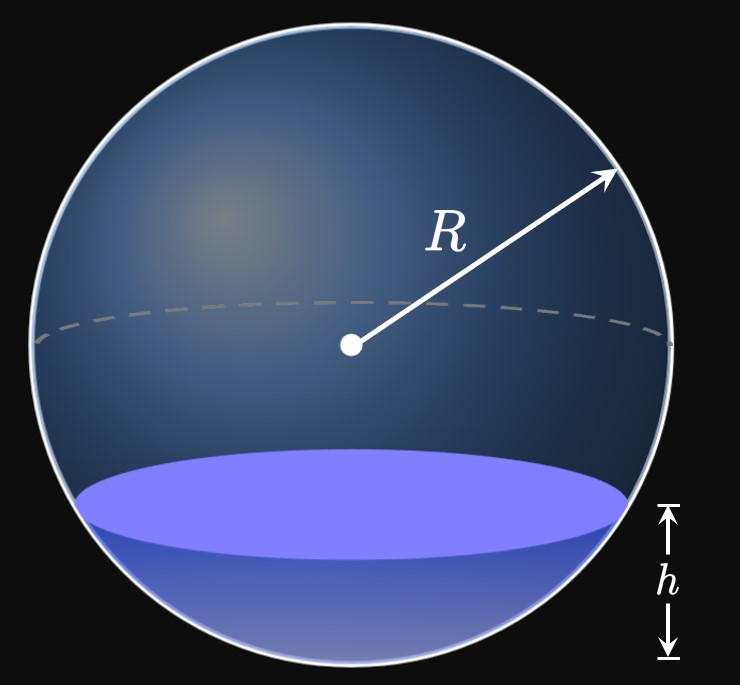
The edge of a bowl is a parabola.
The top of the bowl is a circle of diameter \(8\) inches,
and its height is \(6\) inches.
Soup is poured into the bowl to reach a liquid level of \(2\) inches
above the base.
Calculate the volume of soup added.
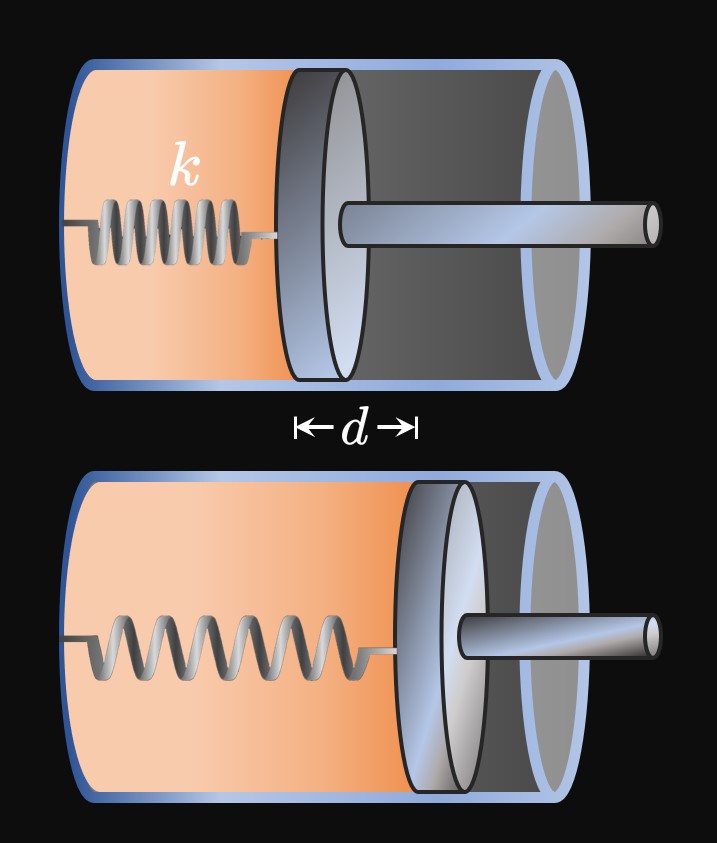
A container of gas with a volume of \(3\) cubic feet and a pressure of \(12\) pounds per square foot is sealed by a piston.
A spring whose stiffness is \(k = 150\) pounds per foot is attached to both the container and the piston;
the spring is initially in equilibrium.
(See Figure 1.)
The gas's volume then expands to \(5\) cubic feet.
Calculate the distance \(d\) the spring stretches.
A line passing through the origin divides the region between the curve \(y = x(2 - x)\)
and the \(x\)-axis into two subregions of equal area.
Find the line's slope.
Consider the family of functions
\[f(x) = \frac{1}{(kx)^2 + 1} \cma\]
where \(k\) is a positive constant.
The region under the graph of \(y = f(x)\)
and above the \(x\)-axis
from \(x = 1\) to \(x = 2\) is the base of a solid whose cross sections perpendicular
to the \(x\)-axis are rectangles of uniform height \(k.\)
For what value of \(k\) is the solid's volume maximized?
Positive and negative charges attract each other,
whereas charges with the same sign repel each other.
Coulomb's Law states that the electrostatic force
between two charged particles of charges \(q_1\) and \(q_2\) (measured in coulombs, \(\text C\))
separated by a distance \(r\)
is given by
\[F = \frac{k \abs{q_1 q_2}}{r^2} \cma\]
where \(k = 9.0 \times 10^9\) \(\un{N m}^2/\un{C}^2.\)
Figure 3
shows an arrangement of two charges fixed along the positive \(x\)-axis.
(Note: \(1 \muUnit C\) \(= 1 \times 10^{-6} \un C.\))
Calculate the work done by the electrostatic force to
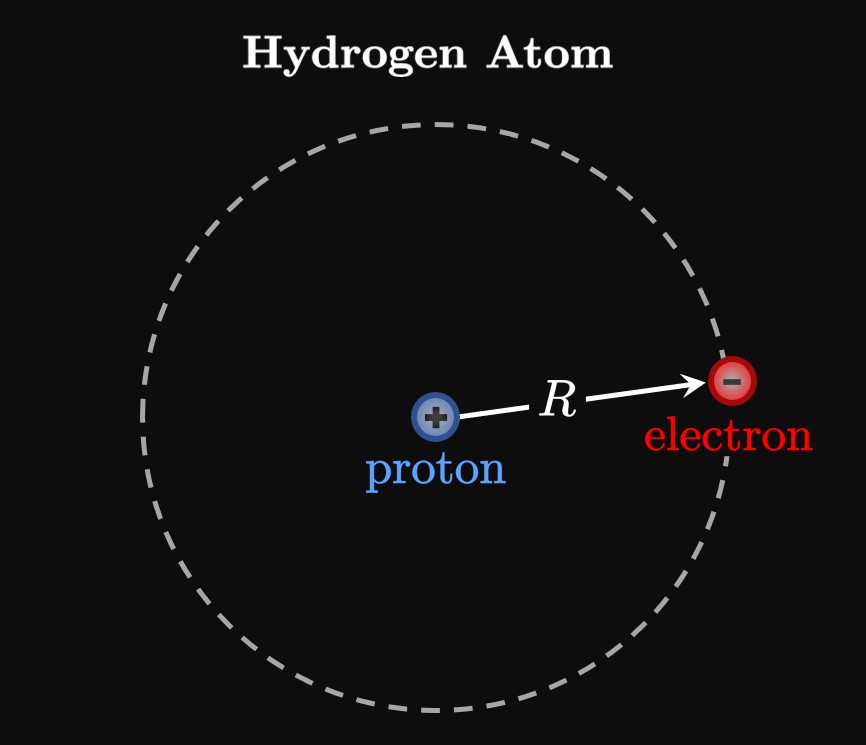
In the Rutherford–Bohr model for the hydrogen atom, an electron undergoes a circular orbit of radius \(R\)
around a stationary proton (Figure 4).
When the hydrogen atom absorbs a photon, the atom's total energy increases
and the electron jumps to a higher energy level,
meaning its orbit increases in radius.
Using Coulomb's Law in terms of \(R,\)
calculate the work needed to move the electron farther out to an orbit of radius \(2R.\)
Assume that the electron is moved slowly and radially outward.
(A proton has a charge of \(1.6 \times 10^{-19}\) \(\un C,\)
while an electron has a charge of \(-1.6 \times 10^{-19}\) \(\un C.\))
A bucket initially has a mass of \(2\) kilograms and contains \(1\) liter of water.
The bucket contains a hole from which water exits at a constant rate.
The bucket is lifted to a height of \(2\) meters; at this point,
it holds a volume of \(0.6\) liter of water.
Calculate the work done in lifting the bucket
if the bucket is lifted upward at a constant speed.
(Water's density is \(1\) kilogram per liter.)
Consider the function
\[f(x) = 3x^2 + x^n \, e^{-x^6} \cma\]
where \(n\) is a positive integer.
Determine all the values of \(n\) such that the average value of \(f\)
on \([-1, 1]\) is \(1.\)