To three decimal places, find the perimeter of the region
bounded by the curve \(y = 1 + e^{-2x},\) the \(x\)-axis,
the \(y\)-axis, and the line \(x = 1.\)
The average lifespan of a light bulb is \(800\) hours.
Using an exponential probability density function,
calculate the probability that a light bulb lasts more than \(900\) hours.
Total surplus is the sum of consumer surplus and producer surplus.
We use total surplus to measure how beneficial a market is to a society,
since high total surplus indicates a high level of satisfaction with a market.
Let \(X\) be the equilibrium quantity produced.
Prove that the total surplus is maximized at the equilibrium point.
Over the interval \([1, x],\) \(f\) is increasing
and has an arc length function given by
\[s(x) = \int_1^x \sqrt{t^2 - 2t + 2} \di t \pd\]
If \(f(2) = 5,\) then determine the identity of \(f.\)
A rectangle of height \(m\) and width \(1/m^2\) is submerged
in a body of water such that the top side is a depth of \(m\)
beneath the water's surface.
Prove that the hydrostatic force against the rectangle is independent of \(m.\)
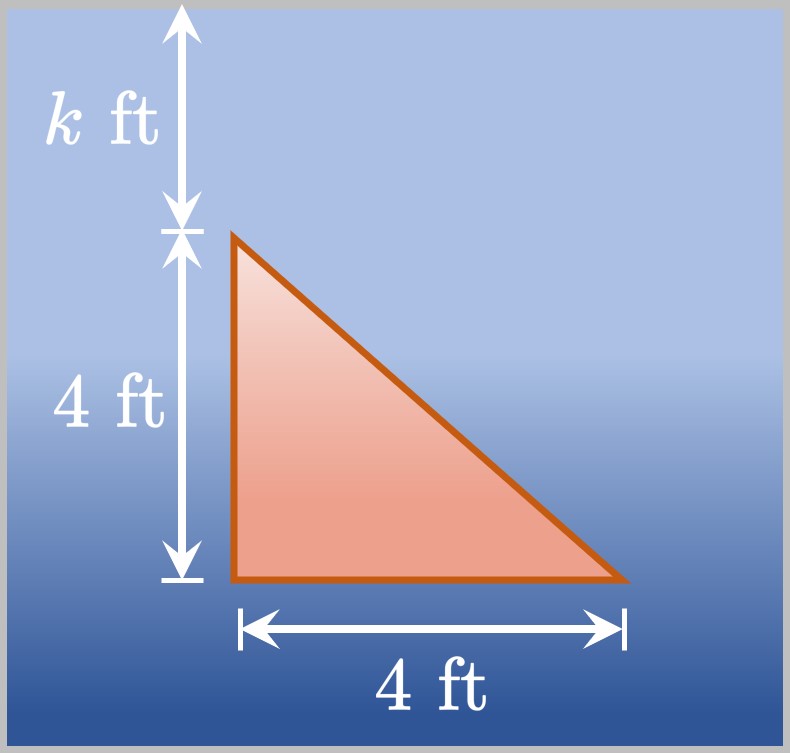
An isosceles right triangle whose legs are \(4\) feet long
is submerged in a uniform body of water such that
the top vertex is located \(k\) feet under the surface
(Figure 1).
Show that the hydrostatic force against the triangle, in pounds, is given by
\(F = 500k + 4000/3.\)
A solid is generated by rotating the region bounded by the infinite curve \(y = e^{-x}\) in the first quadrant
about the \(x\)-axis.
Calculate the solid's lateral surface area.
A parabolic cup is \(5\) inches tall,
and its base extends \(3\) inches from the center of the cup's base.
Calculate the hydrostatic force acting against a central cross section of the cup
when it is completely filled with milk, whose specific weight is roughly \(64.3 \undiv{lb}{ft}^3.\)
Gabriel's Horn is the solid generated by rotating the region
bounded by \(y = 1/x,\) the \(x\)-axis, and the line \(x = 1\) about the \(x\)-axis
(Figure 2).
Show that the solid has infinite surface area but finite volume.
The function \(f\) is positive on \([0, a],\) where \(a \gt 0.\)
Region \(R\) is bounded by the graph of \(y = f(x)\) and the line \(x = a\) in the first quadrant.
Let \(y_c\) be the \(y\)-coordinate of the centroid of \(R.\)
Region \(S\) is bounded by the graph of \(y = f(x),\) the lines \(x = a\) and \(y = L,\) and the \(y\)-axis.
In terms of all the provided quantities and the integral \(\int_0^a f(x) \di x,\)
derive an expression for \(L\) such that region \(S\) balances on the \(x\)-axis.